what is its literary worth?
In fact, a large company of the writers of this age have begun to think it necessary that poetry break loose from the bonds of meter and rhyme, so that the poet may devote all his mental and poetic energies
(1) This "Talk of the Month" was delivered over the Near East Arab Broadcasting Station.
to that creative making which draws its matter from the great, pure wellspring, without restriction or condition.
And after all, what are we in the world but a small channel of the world river, from which we branch and by which we are affected? Is it within our power, alone, to stand apart and hold fast to a matter of our own, unaffected by the main courses and currents that pour into this river without respite — now tinting its water with rich beauties, now driving it on in turmoil, turbid and dust-clouded?!
I do not think, then, that we have any choice in this matter, nor do I think our poetic destiny hangs upon our will — if our poetry is fated to keep on growing and to receive its share of natural development — so long as we appease our intellectual hunger at Western tables and graft our culture, without reserve, upon a Western culture which, in its perpetual development and renewal, has never ceased to be the best model for the atomic age of surpassing speed in which we live!
From this we conclude that we are walking in the track of Western poetry. What, then, are the constituents of that poetry, and how far has it freed itself of its bonds?
It is a question of far-reaching breadth and depth, and space falls short of encompassing it as it should be encompassed. Yet whoever has had occasion to follow the modern poetic renaissance surely perceives that it is one manifestation of that total, all-embracing "liberation" which plainly marks every department of their life alike: the artistic, the literary, and the social.
The arts, for example, have broken loose from their classical bonds, heedless of the protest and condemnation which the conservatives hurl at them with vehemence. It is as though these artists walked alone in the clear light, while the world behind them floundered in the tumult of artistic consciousness!.. It is no idle thing, in my view, this confidence of the contemporary artist in the worth of his production — else why has he cut his chains with such extraordinary boldness, and soared like the eagle in his free skies?!
Among the poets of France and America — did we but know it — there is an enormous number, brilliant and of world renown... and I defy anyone to find in their collections a single trace of meter or rhyme! It is as though their poetic consciences had come to refuse, utterly, whatever curbs their freedom and their flight.
And consider the furniture in our modern houses — how it inclines, in the design of its lines, toward simplification and clarity and escape from all complication and confusion... Even our fashions — what a great turn there is in them toward liberation, which the creators of fashion take as their guide for whatever contents modern taste and sets it at ease!
It seems to me that these manifold manifestations, all moving in one direction, are but the natural expression of people's state of mind — the mind of one who has come out of two world wars, having suffered from their scourges every kind of hardship and privation, and who therefore demanded freedom on every plane as a reaction to what had befallen him... And it was natural that his soul, athirst for freedom, should be reflected in every work that issues from him: artistic, literary, or social...
I would not have it understood from my words that the matter is settled — that Western poetry has been liberated once for all, and that no one remains to string rhymes and attend to meters. No: these will, in every time and place, have those who look toward
them and sing of nothing else.. I myself am one of those brought up to relish metered poetry and to thrill to it. My task here is no more than an attempt to set forth a reality and to analyze our position toward it, in the measure of that reality's close bearing on the characteristics of the age on the world plane — whose example we follow, and by whose influences we are influenced.
In the light of the foregoing, it appears to me, among the probable estimates, that there is a strong tendency toward the liberation of Arabic poetry from meter and rhyme. It is justification enough for this liberation that it is a faithful image of the spirit of the age, and of its children's repudiation of every fetter that curbs the release of the human powers in man to create what is better.
It remains for me to affirm that it is by no means easy for prose poetry to attain those qualities which raise it to the rank of metered poetry. There are definite artistic conditions without which it is mere fallen speech — and hence most prose poetry until now
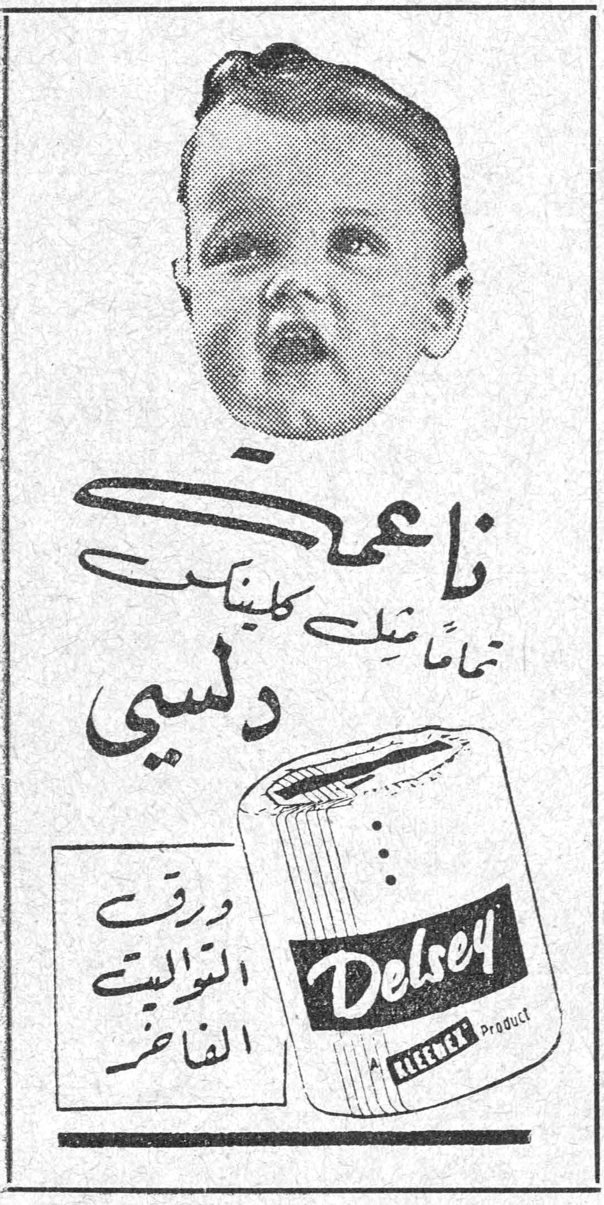
Advertisement for Delsey Paper
Perfectly soft, just like Kleenex
Delsey
Delsey
KLEENEX Product
The luxury toilet paper