
Pierre Balmain owns one of the famous fashion houses of Paris, as do Jacques Fath and Christian Dior... And Mr. Mansur Munsif, proprietor of the "Mun Hayim"
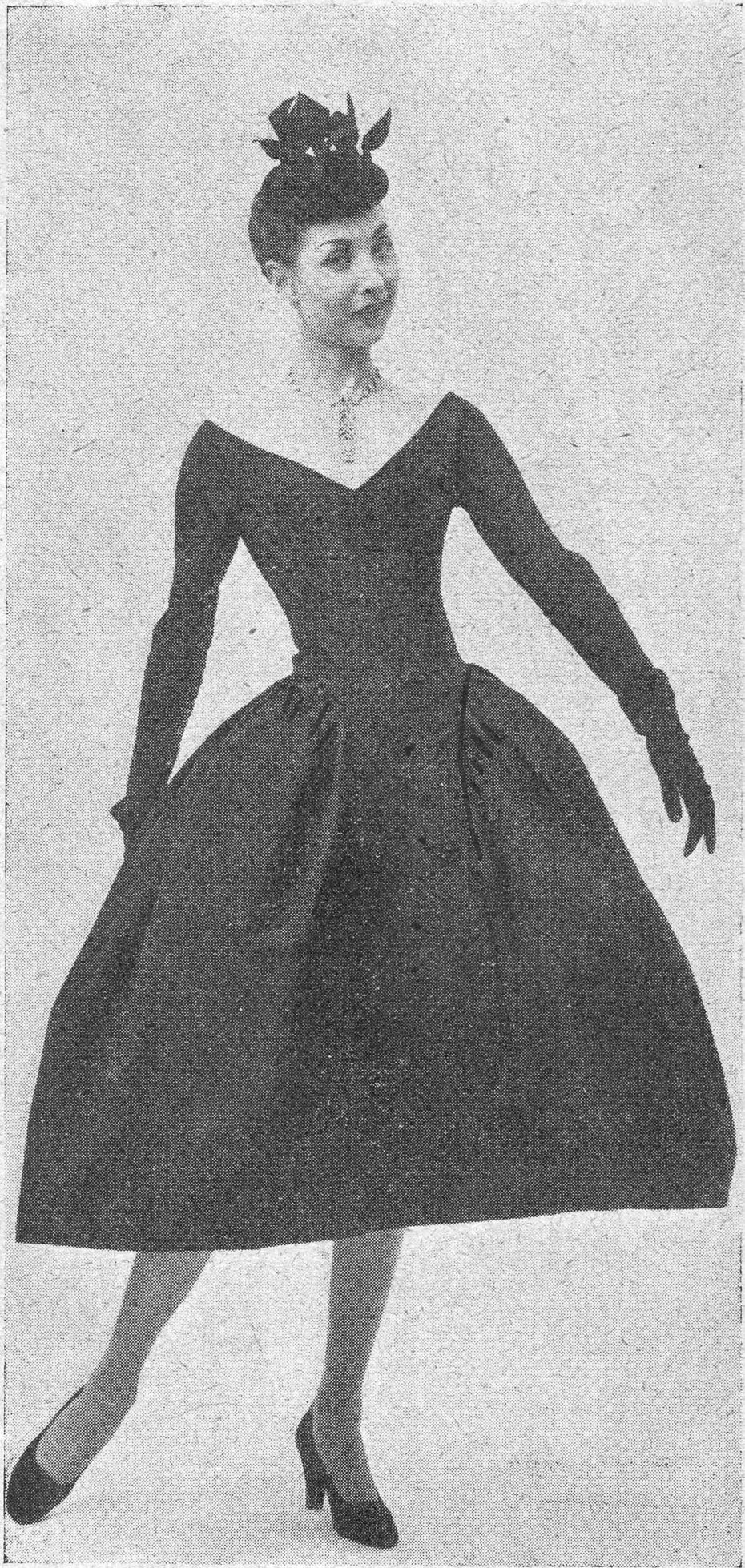
A black faille dress for cocktails or dinner — designed by Dior
house of dressmaking and fashions, was kind enough, during his stay in Paris, to bring back this delightful talk on the newest trends for the winter season, under the influence of Pierre Balmain. He said:
Every season has its principal trend and its principal line in fashion, and the winter season of 1956 keeps to the "slim" line it has followed for several years. Most of the dresses are narrow, with no seam at the waist, the seams descending to the region between the waist and the rise of the hip. Here knots or flounces lend the hips roundness and fullness.
There is an interest this season in enlarging the hats, which has its effect in broadening the shoulders and lending the collar and the sleeves a certain importance, for the sake of balance and harmony.
The tailleur: the shoulders of the tailleur remain in their natural place, with a tendency to broaden them by means of the rounded cut of the sleeves — and the natural waistline is kept, without a seam. The principal lines running lengthwise down the front are adorned with raised braid or with glittering trimming, and there is a trend toward cheerful colors and thick tweed fabrics.
The coat: the coat resembles the tailleur in its basic lines, with the difference of the sleeves, which tend toward width and roominess and are often content with three-quarter length. The collar of the coat is almost always like the broad Louis XIII collar, adorned with fur.
Day dresses: simple and stripped of every outward ornament except the favored borders of a fabric contrasting in color, in which the skirt usually ends — and there is a trend toward trimming the dresses with glossy satin.
Cocktail and dance dresses: cocktail dresses lean toward simplicity and freedom from complication — here the bosom, the shoulders, and the back must be bared — and care is taken in choosing rich fabrics and dark colors such as black.
As for the short dance dresses, they usually range between white satin and black velvet — and here embroidery and handwork mingle in a delicate feminine lavishness that lends the lady a winsome gaiety and youthful charm. The dress is generally accompanied by a coat or an oblong stole matching in color.
The colors: black still holds its lofty place among the colors, followed by green, then copper, then lemon, then red..