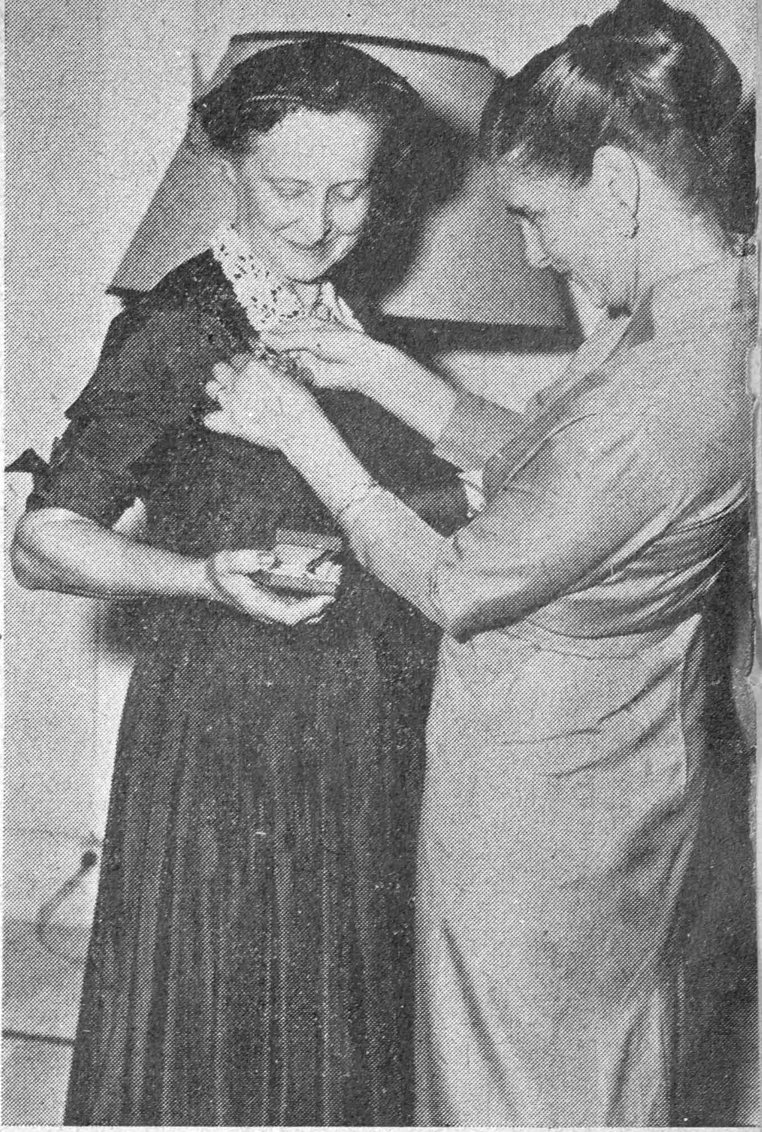
have come to know on more than one occasion — the First Lady, Mrs. Chamoun, decorated her with the Lebanese Order of Merit, in recognition of her great service to the project of industrial renaissance, particularly at "Jdeidet Marjeyoun." For this emissary of Bayard Dodge, the friend of the Arabs, devoted all her resources to the rescue of a generation, and worked with sincerity and self-sacrifice to help the refugees and the Lebanese in a positive way and to teach them self-reliance through the mastery of a handicraft.
It is a kindly gesture on the government's part to appreciate the work of Mrs. Alma Kerr, and we reckon that the first credit for it belongs to Mrs. Chamoun, who has accompanied the Marjeyoun project as it grew and flourished.
Mrs. Kerr has now returned to the United States, and her project lives on in the keeping of a select group of volunteer ladies.
Cocktail parties were given in Mrs. Kerr's honor, and she was seen off with wishes for a speedy return to our land — on her part and on ours as well...
• On the evening of the twelfth
of December, the Cénacle Libanais presented Dr. Salwa Nassar in a lecture on "Atomic Energy — the Aspects of Its Use and Its Effect on Society." And the fact is that Dr. Nassar is now the focus of Lebanon's eyes in the field of science; and she succeeded more than on any previous occasion in simplifying scientific theories and bringing them down to the level of the general public, so that the audience felt, as they left the hall of the Cénacle, that the subject of the atom was no longer altogether a riddle!!
Behind the modest brain of Dr. Nassar there lies a momentous project which, were it granted fulfillment, would render our country a very great service. Why should not a select group of our educated ladies join hands to bring it into being and to press the government to approve it? The project of Salwa Nassar equals in importance the greatest project the state debates in the Chamber of Deputies. Can the reason for their failure to adopt it be that they set no store by the opinion of "a woman?" — We do not wish to understand it so.

The Cénacle Libanais
The Cénacle resumes its activity after the holiday season, presenting the following lectures:
1 — Monday, January 9 — Ibrahim Abd al-Al (in French): How to Build Lebanon.
2 — Monday the 16th of the same month: Philippe Takla — The Foundations of Lebanese Domestic Policy.
3 — Thursday the 19th — Father Doueire Lathour, head of the French Medical Institute in Beirut: Einstein and His Genius.
4 — Monday the 23rd: Brigadier Jean Aziz Ghazi — Lebanese Characters: Faces and Scenes.
5 — Monday the 30th — Bassem al-Jisr — "The State of the Lebanese Press and the Scope of Its Mission."
During the past month the Social, Humanitarian, and Cultural Committee of the General Assembly approved, by a majority of 35 votes against three, with 13 members abstaining, the preamble and the three articles of the draft convention on the nationality of married women.
The purpose of issuing this convention is that a woman shall not be required to follow the nationality of her husband when he is not of her own country, and that it shall prevent the difficulties that beset a wife when, after her marriage to or divorce from a foreigner, she finds herself left without any nationality, or a foreigner in her own homeland, or the holder of a double nationality — all in consequence of the conflicting provisions of different laws.
The provisions of the convention approved by the committee lay down that a woman shall not lose her nationality upon marrying a foreigner, and that she shall not be compelled to assume her husband's nationality against her will; she may, however, be permitted to take her husband's nationality in accordance with the naturalization procedures in force in the country, should she so desire; nor shall she be prevented from taking her husband's nationality in those countries where that is the wife's right.