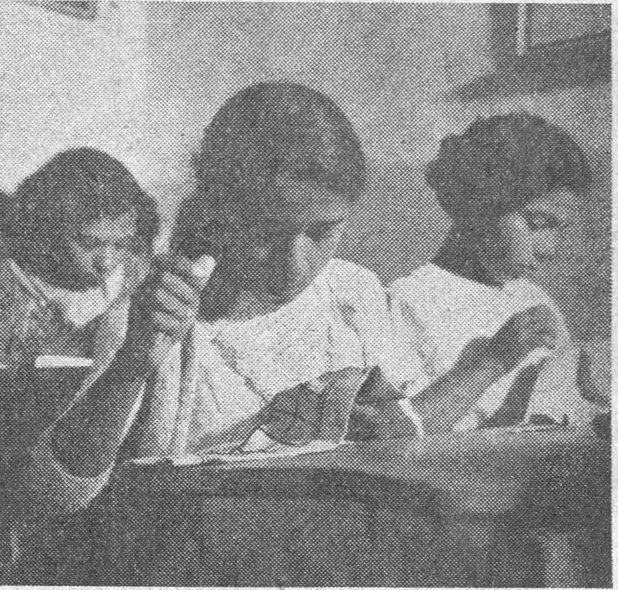
Late last month, in West Hall at the American University of Beirut, the Beirut public witnessed an exhibition of the handicrafts produced by the "Basic Education" centers for the refugees. Convinced as we are of the importance of the project and of the need to spread news of it from the nearest sources, we relay below a talk about it by Ustad Ahmad Tuqan, education adviser at the Relief Agency.
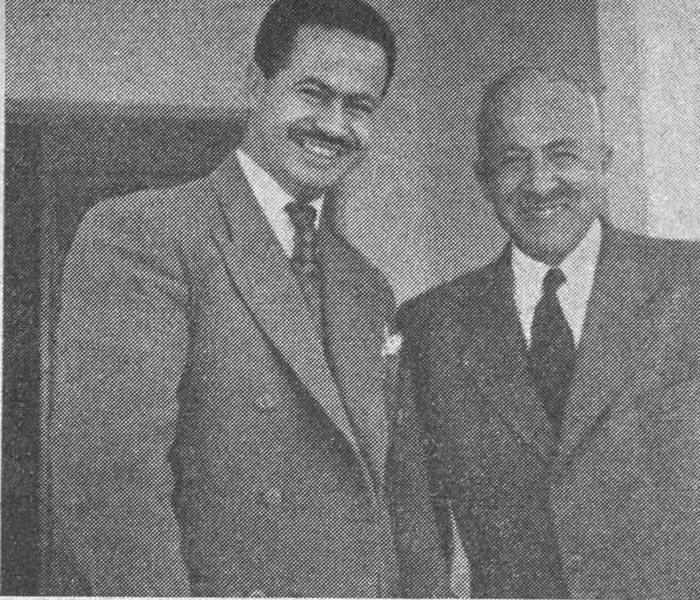
Ustad Ahmad is a branch of the deep-rooted "Tuqan" tree — brother of the two poets Ibrahim and Fadwa. He held important educational posts in the government of Mandate Palestine, then served as Minister of Education (three times) in the Hashemite Kingdom of Jordan — and lately he chose to give up the ministry in order to serve his countrymen through the international Relief Agency.
The story in a few lines: The aim of the international Relief Agency, ever since it came into being, has been to help the Arab refugees improve their condition. This institution went on groping for its way of working
without achieving what it wanted until two years ago, when it began opening its "Basic Education" centers in the principal refugee areas. This event marked a point of departure in their lives, and aid turned from the negative kind, which abases the soul and holds it back short of the goal of its ambition, to the constructive, positive kind, which strengthens a man's arm and makes the springs of good well up from within his own self.
In what emptiness did these heaped-up thousands of human beings live? How were they to direct their vital energies, of body and of mind, toward building a better life?
How were they to pass from a life of dependence, with the idleness and misery that accompany it, to a dignified living earned by the sweat of the brow, until a final solution of their question should be considered?
And Basic Education came to answer all of that. Little by little the psychological knots were untied, minds opened to the truth, and the results revealed astonishing manual talents.
The origin of "Basic Education":
Among the problems that had to be faced in the camps was this: "How are the hours of leisure — for the woman and for the man — to be filled in a useful way?" To deal with this question the Relief Agency turned to the Pakistani expert from the UNESCO organization, Dr. Ibad al-Rahman Khan, who began to prepare the ground for the idea among the refugees. Like everything new, his idea met with resistance, all the more since the refugees doubt everything and fear everything — and what best brought them back from their fears and their resistance was the success of the idea in the first center, established in the Dekwaneh camp (Beirut). And how quickly the news spread among the refugees! They all rose up demanding the opening of centers in their camps like the first center, and
the fierce opposition turned into request and entreaty... Here one must acknowledge the merit of Ustad Hafs al-Saqqa in fostering the project and spreading its message.
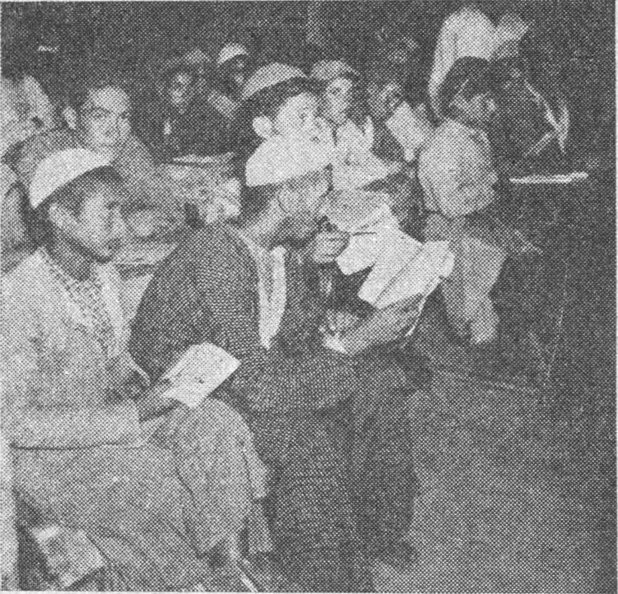
Its aim... We have said that the first aim of Basic Education is to fill the refugees' empty hours with what is useful — with what leads inevitably to raising their morale, which had sunk and sagged little by little. In this, several lines of activity were followed, applied according to environment and circumstances. The first thing we strove for was the wiping out of illiteracy and the creation of an awareness of learning even among adults, so as to profit from the opportunities.
Ustad Ahmad Tuqan, and on his right Ustad Hafs Umar al-Saqqa
One of the centers of the "fight against illiteracy" in the Gaza Strip
... the little girls' passion for handicrafts