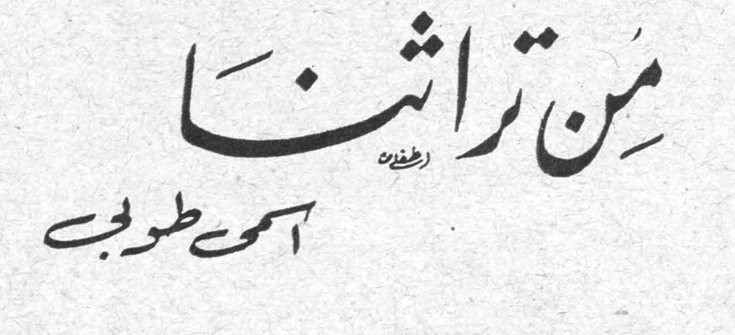
A monthly guidance corner which we announced in the last issue, in response to a question from Mrs. Anissa Najjar. We have entrusted her with supervising the corner, on the understanding that a select company of our thoughtful ladies shall take turns in writing it, beginning with the author of the first word on the subject, our militant woman of letters, Mrs. Asma Tubi.
From the folds of history she peeps out... or perhaps we pull her by her gown to make her peep out... for modesty was in the nature of her age. And it was in the nature of her age to submerge her: no portrait is preserved of her, no long, broad pages about her in history... only fleeting glimpses here and there.
Perhaps this injustice has a cause... Most of the books
that have reached us about the life of Andalusia were composed after the fall of that great country... composed in circumstances in which the letters of woman lay hidden beyond the reach of pens... or those pens toiled to follow the traces of man, and that was weariness enough for them.
Her name... Zainab... and her title, physician of the Banu Awd... And if we know that the Arabs in Andalusia kept their tribal loyalties, living as they had lived in Tihama and Najd — every clan with its home ground and a firm bond among them... and if we know that the individual among them was still wholly absorbed into the tribe, exactly as happened in the Arabian Peninsula... then we know why her title
prevailed over her, so that she was known as Zainab, physician of the Banu Awd... and no more.
Was her calling doctoring with herbs and the like...? Binding wounds like her Arab grandmother...? No, she was not so... She was a physician, trained and specialized in the medicine of the eyes... so proficient in her branch of specialty that she performed surgical operations upon the eye... with the most precise surgical instruments of her age.
And that age of hers... it was the most brilliant of all the ages of the Arabs... the age of al-Nasir, who reigned in Andalusia for 50 years, and who conquered for the Arabs such fortresses and provinces that their feet trod the heart of Europe and the edges of Asia... He carried them to the summit of glory... he wrought miracles for them. He made gold flow in Andalusia... encouraged learning... sought out the masters of language to translate into Arabic from the Greek, the Persian, the Indian, and other tongues, and bestowed much upon them in return... and so on.
And the Arabs fell upon the translated books, expounding them and mastering them, while al-Nasir raised, and raised again, the standing of the learned. And when they had produced and created, there flocked to Andalusia — not from neighboring Spain alone, but from England and Italy — the seekers of learning and knowledge, to carry over into their own languages what the Arabs had composed... and to translate, they in their turn this time, the
lofty sciences and letters produced by the matchless Arab pens.
And woman walked side by side with man, seeking learning and attaining it with all her intelligence and her desire, until Gustave Le Bon said in his book The Civilization of the Arabs the following: "As for the eminence of the Arab woman and the loftiness of her station in the brilliant ages of the Arabs, it is told by the number of Arab women who distinguished themselves by their penetration in the sciences and letters."
But what did woman study...? And in what science and art did she excel? In the composing of verse...? Philosophy...? Prosody and the rules of the language and its letters...? Yes, she studied all of this, so that the women professors among them gave lessons in those sciences, in the palaces, to the wives and daughters of the caliphs... But what woman cared for most was medicine.
She inherited from her grandmother the love of doctoring... from the day when the grandmother carried the bandages at her waist... and marched behind the armies to bind up wounds... from the day when her people's acknowledgment of the genuineness of her primitive art was won... They would pitch a tent for the women eminent in this art — such as Ku'ayba bint Sa'd al-Aslamiyya... pitch her a tent in the mosque... then carry the wounded man to her, and she would stanch the flow of blood if he bled... and set his bones... and then dress his wounds...