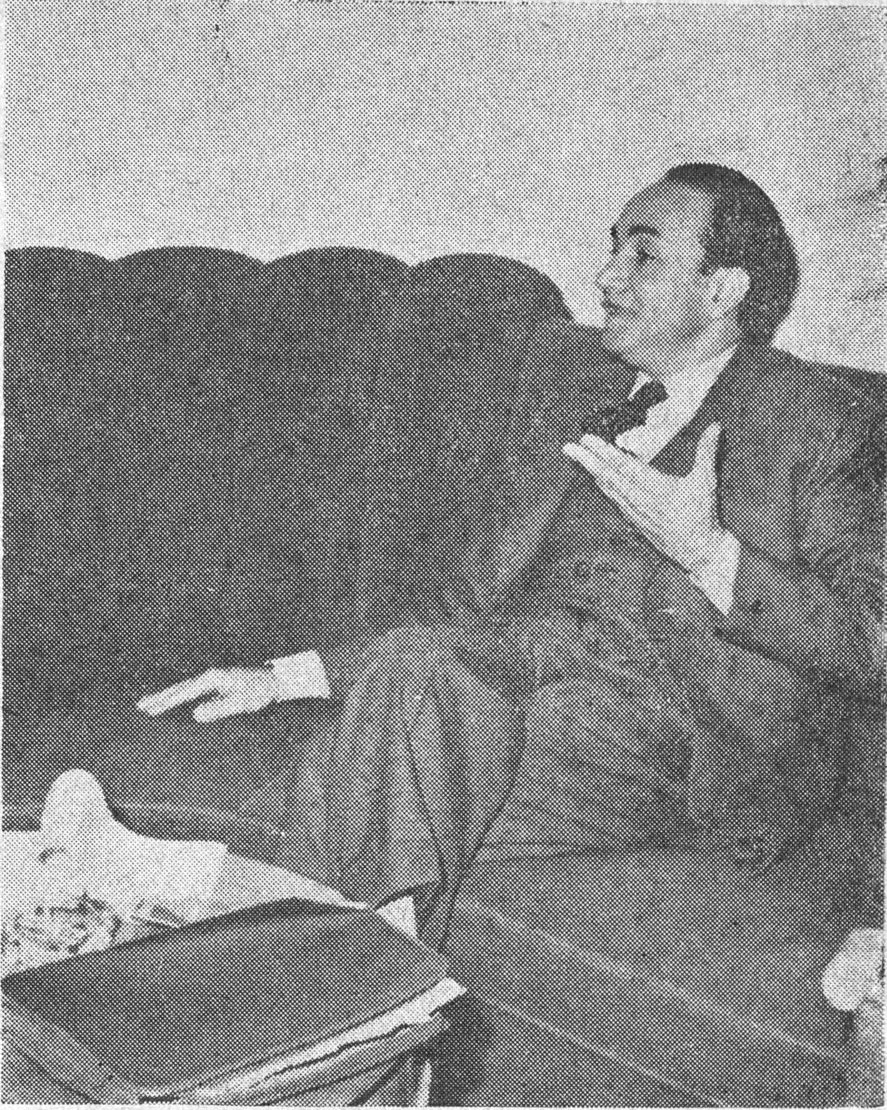
Dr. Bishr Faris
• He was born in Egypt of parents born in Bikfaya.
• His studies: secondary schooling, Egyptian; a doctorate in letters from the Sorbonne in Paris.
• He completed his higher culture in Germany, England, and Italy.
• He has written in both Arabic and French, and works of his have been translated into German and English.
• The subjects of his literary works extend to literary criticism and fiction — he is the pioneer of the symbolist school in poetry — and the theater (he has a play, "The Crossroads," which appeared in French on the stages of Paris and in German on the stages of Austria and Germany from 1950 to 1954).
• And the subjects of his scholarly works extend to philosophy, the sociology proper to Arab civilization, and the Arabic language.
• Among his works on art: a history of Eastern art, Christian and Islamic — it won the prize of the French Academy of Fine Arts in 1954 — and then the principles of Arabic music.
• He worked in journalism, writing for al-Muqattam and al-Muqtataf for twenty years.
• He is a member of the Egyptian Scientific Institute and the Eastern member of the French Institute of Oriental Archaeology in Cairo.
What shall I say of Dr. Bishr Faris after all that the Lebanese papers and magazines have written?... But the woman's pen... and her "voice"... have reaches all their own! Do you suppose I am sowing seeds of rivalry between the woman's voice... and the man's? Between her pen and his? No... there is no room here for any of that... whatever they may write, men or women... for with Dr. Faris the new never runs dry... he has enough to fill the breast of every magazine...
I met him after a poetry session of his at the American University of Beirut, at which he scattered over his audience poems... touched by the fever of symbolism... I still remember how some of them defied the taste of Dr. Anis Frayha and his "lurking" connoisseurship — and those poems remain defiant of him, to his full acceptance and contentment...
I did not ask Dr. Faris about his poetry — it is a new breath in the world of our letters... Is it not time for that literature to renew itself... to open out... to tell us what it has not told before?...
We talked of nature in Lebanon — and between nature and poetry there is a brotherhood... or say... a bond of motherhood.
Nature in Lebanon... Dr. Faris has drawn great gain from it... and this gain reached its zenith at Chtaura, which witnessed the birth of poems of his, and of a play, "From Behind the Dam," which he composed in French and which has been translated into German. He himself finished rendering it into Arabic this summer at Chtaura — which he calls the emerald.
As for the Eastern girl, our man of letters speaks of her with tenderness and hope... between her and the light hang threadbare veils... now dissolving. And to this girl he has dedicated his new poem, which the magazine al-Adib is to publish under the title "To the Girl of the Age." He said to me in the course of speaking of her: "Life does not play... but you women must not fear it... it gives to whoever asks... on condition that he toil in the asking... Frivolity makes it light... he who is faithful to it... is refined by it... No... it no longer becomes the girl