Readers will remember what we wrote about a year ago on the delightful modern life that Mrs. Nahla Marwa lives with her husband, the engineer Hassan Shouman, on her farm at Jezzin (the Bekaa). From those plains flourishing with greenery and water, Nahla writes to us of one side of her absorbing experience!!
In the summer and autumn seasons, and in the various parts of the Lebanese countryside, there spread tents of hair, inhabited by the wandering Bedouins.
These Bedouins have their particular ways of living, which I had occasion this summer to come to know at close hand, when some of these tribes came down to the plains stretching near our house.
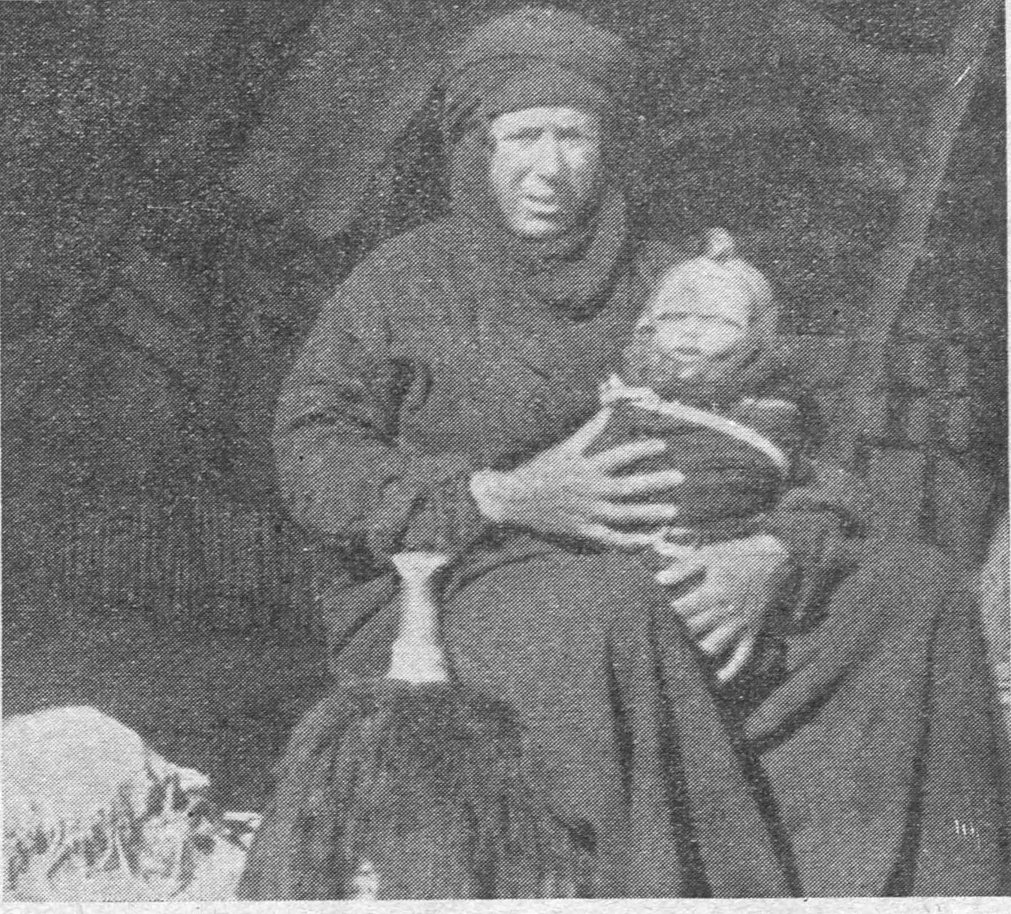
How often I would watch "Umm Rashed" the Bedouin woman from my kitchen
window, and I went to visit her from time to time.
Umm Rashed is the fourth wife of Abu Rashed... Before her he married three women. The first bore him no children, so he divorced her; the second bore two daughters, so he divorced her to marry another, hoping for "the boy"; and the third died a year after her marriage; so he married Umm Rashed, who bore six daughters before God blessed her with the boy!
But let us return to the tent of hair in which Abu Rashed's family lives. It is a large tent made of goat's hair, divided inside into two parts: one part for sleeping and one part for receiving guests. As for cooking, washing, and the rest, Umm Rashed does it on the wide ground behind the tent.
The ways of living among all the Bedouins are primitive to a degree the mind cannot conceive. Civilization has not managed to seep in to them even through a hole in the tent! And the sun of the twentieth century has not yet risen upon them. Yet with all that, they are happy, and would take no substitute for the tent of hair. I once asked Abu
Rashed whether he would accept to live in one of the villages, in a house of stone, if it were offered to him. He answered me with all assurance that the Bedouin prefers his freedom to everything: he is free; every country is his country; he is bound by no government and no law.
Abu Rashed trades in camels and sheep — those animals that accompany the Bedouin wherever he lives, and that are his only way of earning some money. Two days before the date of their departure for Syria, Abu Rashed went to the market of Baalbek and sold a camel for a hundred and
fifty liras, with which to buy provisions for the winter — sugar, dibs, tea, and coffee — and some clothing for himself and his family.
Umm Rashed spends her day like any mother with that number of children. She cooks and bakes and washes and sews and spins, and helps her daughters gather firewood and fetch water from a spring or a river near the tent.
The Bedouins' food is very simple: it consists of bread, burghul, kishk, milk, laban, and dibs, and sometimes beans and lentils. And if vegetables grow cheap in the summer season, they buy tomatoes; as for meat, they eat it on occasions, such as feasts and weddings.
Umm Rashed was surprised one day by my visit while she was worn out with cooking, her children gathered around her. I observed that the children were hungry, waiting for the food to be done — but my observation was mistaken. Umm Rashed was cooking sweets for her children, and they, like all children, love sweets. She described this kind of
Umm Rashed and her seventh daughter, "Roza"