Evan Senior, editor-in-chief of the famous English magazine “Music and Musicians,” tells us of his journey last year to Russia and of his meeting with the man who personally knew the Russian composer Tchaikovsky.
On one of June's blazing hot days I went with my friend Kenneth Wright, in a ZIS car, from Moscow out toward the countryside. The road was exceedingly beautiful, shaded on both sides by forests of fir and pine. That day I was tired, having been up all night attending concerts; but for all that I was eager to reach the Kaaba of musicians — the house of Tchaikovsky near the village of Klin, ninety miles from Moscow.
While the car was carrying us past the little villages, the ornamented wooden houses, and the old churches, my friend suddenly turned to me and said: “Be ready, and keep hold of your camera — who knows, you may get a picture of Tchaikovsky's ghost!!”
After a few hours we reached Tchaikovsky's house: two stories of wood painted a dark red. We made for the door, and there we saw an old, faded sign on which was written: “P. Tchaikovsky receives on Mondays and Tuesdays. Not at home. Do not disturb him.” While we were contemplating the writing, the door opened; our tongues were tied, and we stared in bewilderment at the person standing before
us, so strong was the resemblance between him and Tchaikovsky, and I murmured in a low voice, “Kenneth — this is the ghost!” And in truth, whoever studies this man's features closely would take him for Tchaikovsky himself: he
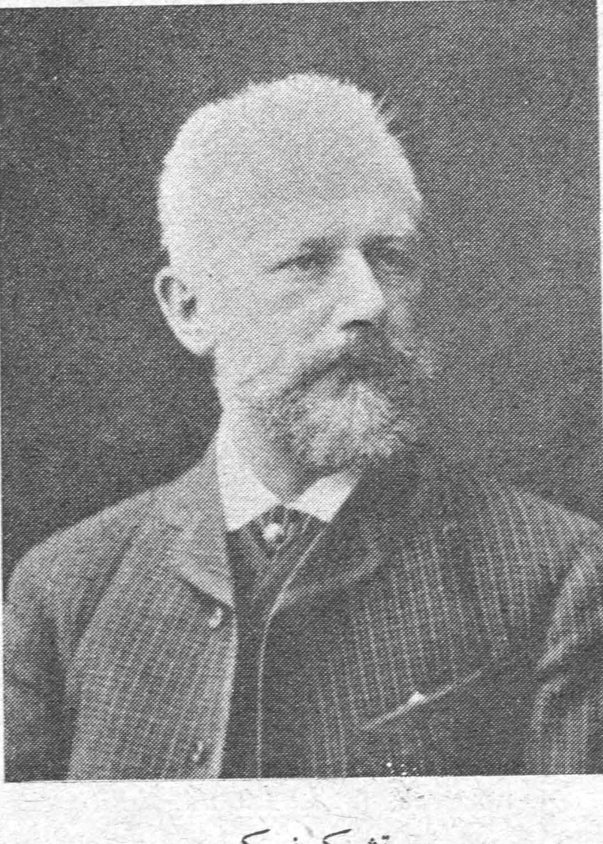
Tchaikovsky
has the very same roundness of head and that same short white beard!! He welcomed us in clear English, wishing us a pleasant stay. This old man with the radiant face was none other than Vladimir Davydov, son of Alexandra, the sister so dear to Tchaikovsky's heart; he had been his uncle's petted favorite, whom he took as friend and companion in his last days. Sixty-one years ago Vladimir was in the army and was present at his uncle's death; and now you see him, at eighty, presiding over
this museum with vitality, a smile never leaving his face.
This house, to which visitors come from every part of the world, is the third house Tchaikovsky lived in in this neighborhood; he used the upper floor for sleeping and for work, and the lower floor for meals. When Tchaikovsky died, his servant Alexei Sofronov bought the house and preserved all his master's belongings; but four years later, that is in 1897, Modest, the composer's brother, and his nephew Davydov joined in buying the house and fitting it out to become a museum for visitors; and it was Davydov who took over the running of the house, for he loved it more than himself. We went up to the upper floor and entered the sitting room: it is long and narrow, and all its furniture of the massive kind; at the head of the room stand a piano and a table laden with boxes of cigarettes, for Tchaikovsky was a heavy smoker — so Davydov told us. On the table we also saw a memorandum book on which was written: “I must be in London on the first of June.” He did in fact reach London on May 29, 1893, and on June 1 he attended the playing of his Fourth Symphony; afterward he went to Cambridge, and all that while he was
engrossed in composing the Sixth Symphony.
The walls of the room