The Arab home today is faulted for contenting itself, where music is concerned, with a radio turned to its own fancy; and if a passage of classical music should greet its ear, it grows weary of listening and hastens to cut off its breath! For the great majority of our society has no taste for this kind of music, and some go to the extreme of counting that a kind of patriotic zeal, on the claim that this music is Western — and its being Western is enough for it to meet with our avoidance and aversion...
The plain, unvarnished truth is that music is an international heritage that politics cannot touch, whose heights regional and racial differences cannot reach; it is the property of all people equally. How, then, are we to save the situation and turn back from an error we have inherited generation after generation?
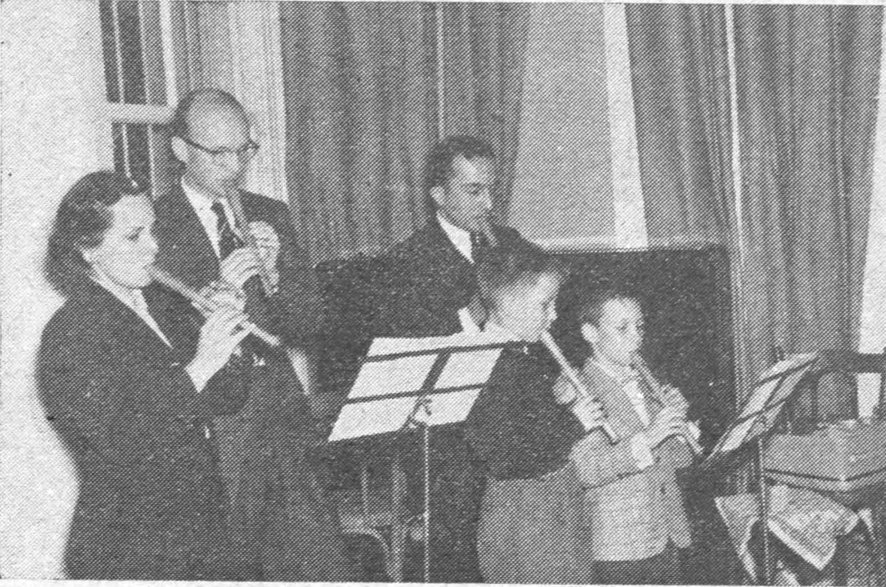
The "recorder" quintet: the Levitt family with François Lalive and the institute's proprietor, Mr. Sami Salibi
The problem, fortunately, is not so desperate. In most Arab countries today there are the first signs of an artistic renaissance that invites optimism, its vanguard the educated youth who have arrived at the truth and who hold in their grasp the destinies and hopes of tomorrow.
Sami Suleiman Salibi:
A stubborn, believing fighter in the battle that we
hope will record music's final victory... He began teaching the piano and the violin while still an adolescent student in Broummana, and he has not stopped to this day. His work was on a narrow scale until last year, when he was able to open the "Ras Beirut Institute of Music and Drawing" — that unique institute whose students, children and adults alike, numbered one hundred within months of its founding.
He began learning the piano with his teacher in Broummana, Mrs. Turtle; then he passed into the care of Kugel, at that time director of the music department at the American University of Beirut; and he finished at the Conservatory at the hands of the musician Wadih Sabra, God rest his soul...
And the amateur student walked on and persevered along the road of music without meeting material or moral encouragement, and he began to teach his fellow students devotedly. Among his first pupils were Samia al-Hajj, Fadlou Shehadi, Najwa Shahin, and many others.
Music is no longer a luxury:
Mr. Salibi affirms that music is no longer for luxury, no longer one of the superfluities; it is among the necessities of life for the modern family, and the greatest responsibility falls upon our mothers. What prevents them, he says, from learning to play a musical instrument so as to accompany their children and encourage them? This is an ordinary thing in the foreign family, and among my students are fathers, mothers, and children, all together...
The family's members playing together:
The way to a musical renaissance in the Arab home, says Mr. Salibi, lies through the parents' encouragement of the little ones and the joining of the members of a single family in playing, to create a cooperative artistic atmosphere that turns the family's members away from scattering apart and seeking the sources of their pleasure each alone...
And if the parents cannot learn music and teach it to their