kerchief and the Christian woman in her fringed black kerchief, standing side by side, each pouring out to the other feelings of joy and congratulation at their daughters' winning the sewing certificate. This scene left in heart and soul a great esteem for the Village Revival Society, for the care it expends in teaching woman the affairs of the household alongside the art of sewing, to raise her economic level.
To this generous, striving society, the sincerest congratulations and the loveliest wishes.
Zahiyah Dughan Directress of Makassed College for Girls
With the coming of spring, the Lebanese Child-Welfare Society celebrates "Child Day" under the patronage of every mother, reminding the Lebanese public of its duty toward the child — every child — in care, welfare, tenderness, and charity. As usual, throughout the week preceding Child Day, the society will present a special program from the Lebanese broadcasting house in Beirut, in which a number of children from the schools and colleges will take part, along with representatives of the Arab and foreign embassies, who will speak about childhood in their own countries and the associations working in its service.
The society is joining with the National Revival Society at the American University in organizing the Childhood Exhibition in West Hall during the same week, with the participation of the social and charitable institutions in Beirut and beyond Beirut. All this is to raise the standing of the child — that small growing bud of today... the grown man of tomorrow. So to Child Week and to Child Day on March 18 we direct the eyes and ears of our honored
readers, and we wish the society's president, Mrs. Zahia Salman, and her gracious fellow members — who have been working with diligence and hope in the service of the child for twenty years — every success and prosperity.
• Before mid-March Mrs. Nahida Fadli al-Dajani travels with her little daughter Hala to join her husband, Mr. Ghanem al-Dajani, who now holds in Jeddah the post of director of programs and
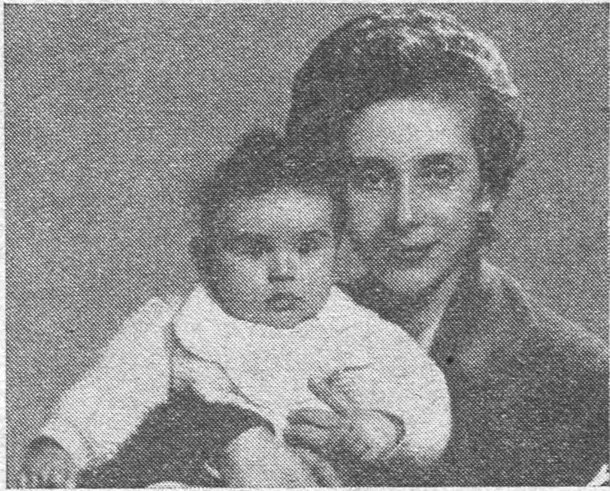
supervisor-general of the Saudi broadcasting service.
For the past two years Mrs. Nahida has served as an announcer and as supervisor of the musical programs, and by her going to Jeddah Radio Lebanon loses a creative woman's element — and we hope that after a year we shall be listening to Nahida's voice from the great Saudi radio — the first woman's voice to go forth with confidence and rouse woman there from a slumber that has lasted long!
And 'The Woman's Voice' for its part counts Nahida a cherished one of its own family; but she will not, by her going, lose its affection and its special regard — and she will be, in the Saudi lands, our watchful representative and our faithful link. The magazine needs more than one 'Nahida' to spread its voice through the Arab countries — so go with God's blessing, dear friend...
• The "Union for the Protection of Juveniles in Lebanon," presided over by Mrs. Alice Nakkash, held its annual general assembly in the lecture hall of the Ministry of National Education on January 27, 1956. The meeting was under the patronage of Mrs. Zalfa Chamoun, and it was attended by an elite of men of thought and letters and those concerned with social affairs. His Excellency Mohieddine Nsouli spoke on social work in Lebanon; Mr. Hardy Wickwar, the United Nations expert in social affairs, on a general plan for social services in Lebanon; and Mr. Ibrahim Chemayel on the work of the Union.
Among the aims the Union achieved in 1954 and 1955 was the appointment of women social workers in the various provinces to secure the handling of delinquent juveniles before the juvenile courts and to carry out the social inquiries relating to them. The Union holds it necessary to establish modern reformatories equipped to train juveniles in manual and vocational work, and an observation home to shelter juveniles before their appearance in the court examining their case. Close cooperation is therefore indispensable between the Union and the authorities, above all the Ministry of Social Affairs. The statistics prepared by the Union for 1955 showed that 1,312 delinquent juveniles appeared before the juvenile courts in Lebanon, of whom 1,092 were male and 220 female. Various offenses were attributed to them, chiefly theft, begging, and vagrancy. 173 juveniles were sentenced to be placed in reform institutions, and 12 to be placed in institutions with which the Ministry of Social Affairs has contracted; as for the rest, most were handed over to their families, and against the others no offense was proven.