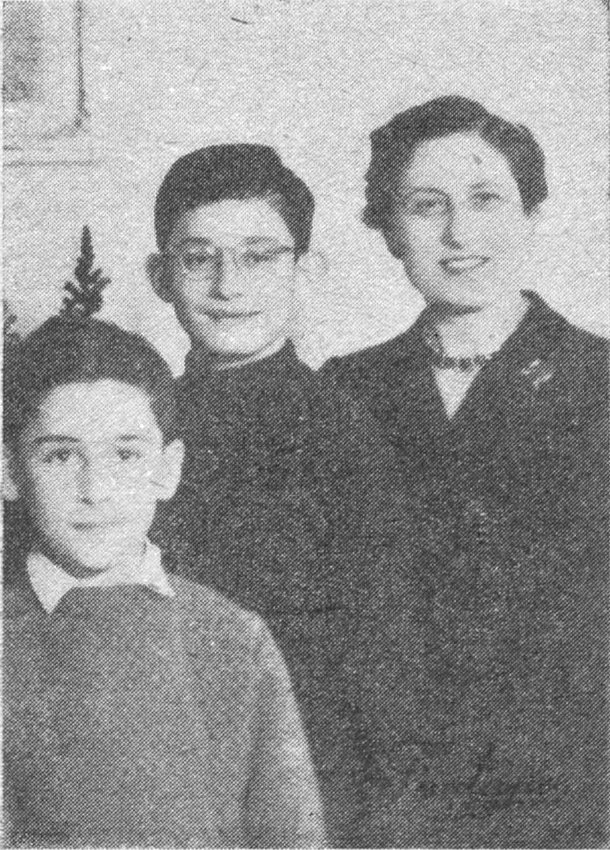
The author of this study is a graduate of Beirut College for Women, known for her scientific spirit and her frankness. She did not let the seven years she spent in Paris — the post of her husband, Dr. Matta Aqrawi — go to waste; rather she profited by the opportunity, observing and investigating, absorbing and drinking deep from the abundant spring...
We are pleased to present, one after another, a series of Mrs. Aqrawi's studies and impressions, which she begins by speaking of the fashion shows of Paris.
- The importance of fashion designers is that they are creative artists, and their moral standing equals that of the great artists.
- Each of the famous couturiers has his own style and his own troupe of models, "mannequins."
- There is no doubt that Dior is the leader of the movement of creation and the dictator of women's dress throughout the world.
- Every gown has its name, expressing at times the artist's emotion as he created it.
- Every fashion show in the salons of Paris is a splendid work of art, composed in an orderly fashion.
Anatole France once said: If it were granted me to lift the curtain of the unseen and stretch my hand into the distant future, to choose from the basket of literary productions that will be published a hundred years after my death — what do you suppose I would choose? ... A love story? No... for a love story, however tangled, never goes beyond a single unchanging tune: a man loves a woman who does not love him, or a woman loves a man who does not want her, or each loves the other to the point of madness, or hates the other violently and fiercely. And even if we added a third lover, its possibilities would not exceed ten situations... No. I would not choose a story from the library of the future, nor a work of history, for history books, when they offer us something that stirs desire, do not go beyond the scope of the story... All I would want of the future's heritage is a fashion magazine, so that I might look upon women's dress a generation after my death. I am certain that their temptations and their fancies would make me understand mankind's coming civilization far better than the books of the philosophers, the storytellers, the scientists, and the preachers...
It is known of Marcel Proust, the famous French novelist, that while composing his well-known book "In Search of Lost Time" (A la Recherche du Temps Perdu) he withdrew from the world for ten years, secluding himself in the apartment of his house, lining the walls of his room with cork to raise an impregnable barrier between himself and the clamor of the outside world; and that he would not leave the confines of his house except when he wished to describe some piece of women's dress — then he would go to the aristocratic salons, or to the Opera, or to the wardrobe of one
Mrs. Najla Aqrawi with her two children, Sabah and Amin
of his lady friends, to catch an image he would immortalize in his splendid prose and engrave in his winding, sinuous expressions.
Proust left a precious literary legacy, counted among the most eloquent writing in the French language, including pages in which he describes the women's fashions of his age.
There is no doubt that fashion is closely bound to the civilization in which it arises; it interacts with the social and economic atmosphere, influencing it and expressing it. If we cast a glance over history we find numerous examples of this: the simplicity of Greek dress expresses that classical civilization; the magnificence of women's dress in the fifteenth century expresses the flourishing of wealth in that age; and the fashions issuing from the palaces of the Bourbon kings and their courtiers tell of the life of