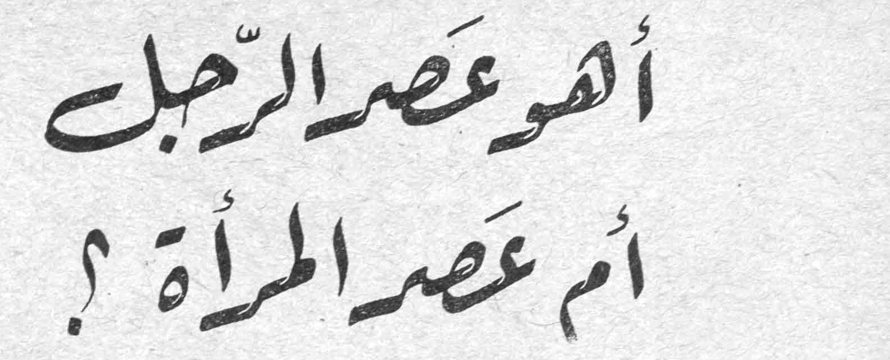
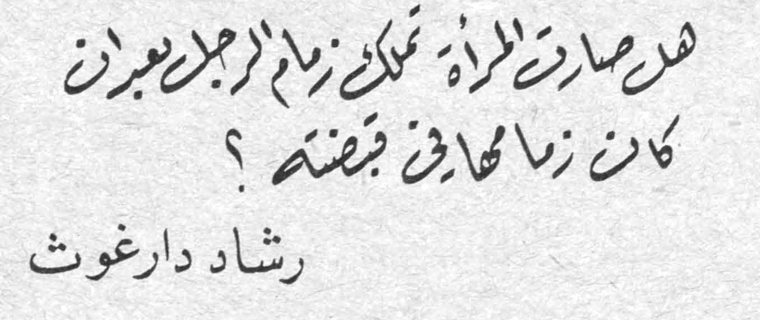
Has woman come to hold man's reins, after her reins were in his grasp?
"Bertrand Russell" says: "My hope of putting an end to woman's subjection to man has been fulfilled." And Russell is today, beyond dispute, the greatest of the living philosophers of the age. What, then, does he mean by this bold statement — above all in a time when some countries complain of the tyranny of "woman," after the complaint had centered upon the tyranny of man in every place, since the most ancient times?
In those times, man himself was a slave. A slave to ignorance and benightedness, a slave to superstitions and illusions, a slave to appetites and to gross matter; so it was natural that woman — a being like man, though she appeared weaker than he — should sink to the level of her companion in life. Among one people she was a creature whose humanity was in doubt; among others, a beast fit for nothing but a vessel for offspring. Woman was thereby, in man's eyes, a body and nothing more. Yet in truth she is, like man, spirit and body, and life holds together in no being except by this eternal marriage.
And we must acknowledge that it was the great heavenly religions alone that attempted to do woman justice, at the very outset, by stages. The Mosaic lawgiver said: religion is not laid upon you, O Esther — and Christ the Lord defended Mary Magdalene — and the Prophet Muhammad said: Paradise lies beneath the feet of mothers.
And so woman came forth, thanks to this guidance from on high, out of the darkness of the indefinite into the light of
the definite. With that she took a step toward... emancipation. A praiseworthy step, even though it required hundreds of years of evolution.
And we know, from what we observe in the reality of life, that evolution on every plane is a process of extreme slowness — above all on the social plane. It is not enough that an individual, or individuals, should will a thing for it to be accomplished for him or for them, as by a sorcerer's spell. Hence the conservative nations have been the closer to stability, and consequently the nearer to attaining their ends of intended evolution, and swifter at it than others.
Yet stability itself, like revolution, devours its children if they grow passive. And so learning, which woman began to seek as man had sought it, was her road to the next step. And this second step was swifter than the first. For learning itself — having developed in woman her personality, so that she came to feel her human dignity — is in its very self a perpetual motion. And learning has, beyond that, a second momentous property: it is general, universal. So woman's evolution, thanks to learning, was general and universal, and her renaissance was a perpetual movement, mounting without pause!
It is enough to point to what woman has attained in the likes of Great Britain: imposing herself upon... the throne, and imposing her personality, from atop that throne, upon the world. Queen Victoria, for example, was the title of her entire age; and in that there was for woman — for the cause of woman — a great gain.
Does the emancipation of woman, then, in the conception
of the contemporary philosopher Bertrand Russell, mean that she has become — not a queen only — but the holder of man's reins, after her reins had been in his grasp even when she mounted the throne of rule?
In antiquity we find the names of queens and heroines who were renowned, and whose lands were renowned for their flourishing reigns: from Zenobia of Palmyra to Dido of Carthage, and from Cleopatra of the Greeks to Hatshepsut of the Pharaohs — all of them crowned women and reigning queens. Yet their effect, despite all that, upon the renaissance of woman remained limited: it did not pass beyond the sphere in which they reigned and the time in which they lived. Quite unlike what we witness and feel today — the extended effect of such events, an effect that grows greater with the days and works on in generation after generation — and that thanks to learning... beyond doubt or question.
But that a woman should be seated upon the throne of the United Kingdom — a woman whom her peoples love with such love, and who requites those peoples with such devotion — is an event worth, in itself, in the age of learning, six thousand years of evolution!
And like it in its effect upon the renaissance of woman, and upon man's understanding of that renaissance, is the choosing of a woman to preside over the United Nations, the greatest international institution humanity has known in its history. It is a choice that would have been neither possible nor palatable were it not for learning, which was and remains the road of evolution and emancipation, and the road of equality