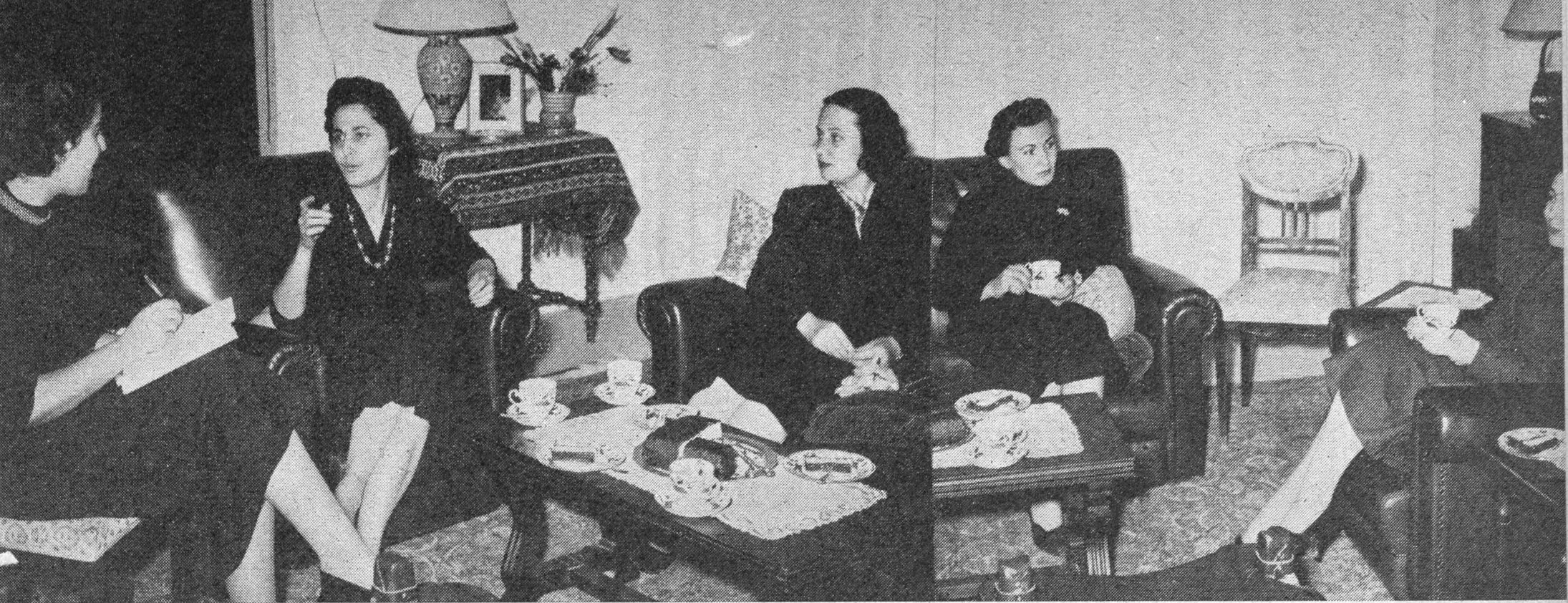
The members of the roundtable, from right to left: Faiza, Hassana, Sabiha, and Salwa — Afaf recording the conversation.

The “Woman's Voice” roundtable met this month in the salon of Mrs. Salwa Dimashqiyah al-Said — that venerable salon which, in the recent past, witnessed and heard the proceedings of gathering after gathering, alive with literary, social, and patriotic exchanges and debates, all of them presided over by the elegant, eloquent mistress of the house — Mrs. Julia Tu'mah Dimashqiyah, God rest her soul.
The talk of the roundtable turned on important questions concerning the upbringing of our children at the age of adolescence. The salon brought together a select company of the ladies of our polite society. Mrs. Faiza Antiba and Mrs. Sabiha Faris hold, besides their practical experience, the master's degree in education; and Mrs. Hassana al-Daouk and Mrs. Salwa al-Said possess an experience with their own children no less rich and useful than that of their two colleagues. Each of the four ladies has several children at this delicate age — I mean from eleven to about twenty — when the personality either crystallizes and settles, psychologically, emotionally, and mentally, or the seeds of anxiety and inner disintegration grow within it... This is a very difficult stage, in which father and mother play a fundamental and important part.
Each of us took her comfortable seat, and questions drawn from the reality of our daily life, touching the upbringing of our adolescent children, began to rain down upon Faiza Antiba, the leader of the roundtable.
Is freedom necessary? To what extent, and when should it be given? Is it permissible to look into the
children's private affairs — their letters and diaries? And—? Is it well for a mother to give her children the chance to talk with her on every subject, the important and the trifling alike? Or must a slight barrier remain between them, to preserve authority and respect?
Salwa said: “We hear a great deal about the need to give the child freedom of speech before his parents. And I know that the repression found in our children comes from fear of their parents and from not confiding to them their problems and troubles. But at the same time I consider too much talk impudence, and so I prefer that some barrier remain between parents and children.”
With this question Salwa turned to Faiza and Sabiha for enlightenment... Sabiha answered her: “I believe it is better for the child to speak before his parents of everything that stirs in his mind, even at the sacrifice of a little of that awe and dread which some parents desire. For the mother who opens that road before him helps him to a right understanding of those natural problems and