— You say, Madam, that you know me... As for me, I am at a loss, for my memory is too strong to forget so important an occasion as making the acquaintance of your person!
"You men are simpletons...!"
Says May:
After a moment... May answered in her warm, deep voice: — You men are simpletons! We all laughed, and May's face lit up. The gloomy air about us lightened... and I breathed easily as I answered May's questions — her interrogation, rather!... — Were you not at the Aintoura school in 1903? — I was. — And you had a companion there, my kinsman Naoum Ziadeh. — Exactly. — And was there not a busy correspondence between Naoum and a pupil named Kinar Shihab, of the nuns' school overlooking your school? I sat riveted to my place, dumbfounded, listening as May went on with her words: — I learned, from inquiries of my own, that it was you — "the one" — who used to write my kinsman Naoum's letters to Kinar... — Yes! I myself!! — Then why did it never occur to you to find out about "the one" who was answering your letters? Did you credit Kinar with such eloquence and quickness of wit?! You should have deduced, as I deduced, that it was "I" who was answering the letters... Do you see now how men are simpletons?!!
•
After this delightful preamble and singular reception, every veil of courtesy and formality fell away from between us; May came to feel at ease with me, and I with her, as though she and I had been intimate friends from of old. I took to sitting with her for hours playing pinochle, while she talked on in her natural vein, freely and without affectation, letting fly jokes and anecdotes, so that we laughed and she was diverted... Every now and then May would ask me, in her sweet Egyptian accent, to tell her about Gibran. And it dawned on me that her first motive in summoning me to her may have been simply to hear news of Gibran from the companion of his boyhood at the Hikma school, and the companion of his youth and his art afterward in Paris... She would listen to me with longing, torn between rapture and tenderness, making no attempt to hide — from me at least — that virgin feeling she bore for the poet, which remained a bud closed in its sheath, stifled in its own perfume, never given leave to open and breathe out its fragrance. May's visitors grew many in that season, and she would bid me linger, keeping me on after the last of them had gone, so that we might return to pouring out our sorrows; then we would join forces to make "onion soup"... both of us loved it, and ate it with the keenest appetite! In those sweet, limpid moments I would steal glances at May's head and draw it in secret, for she objected to that most strenuously... When I had
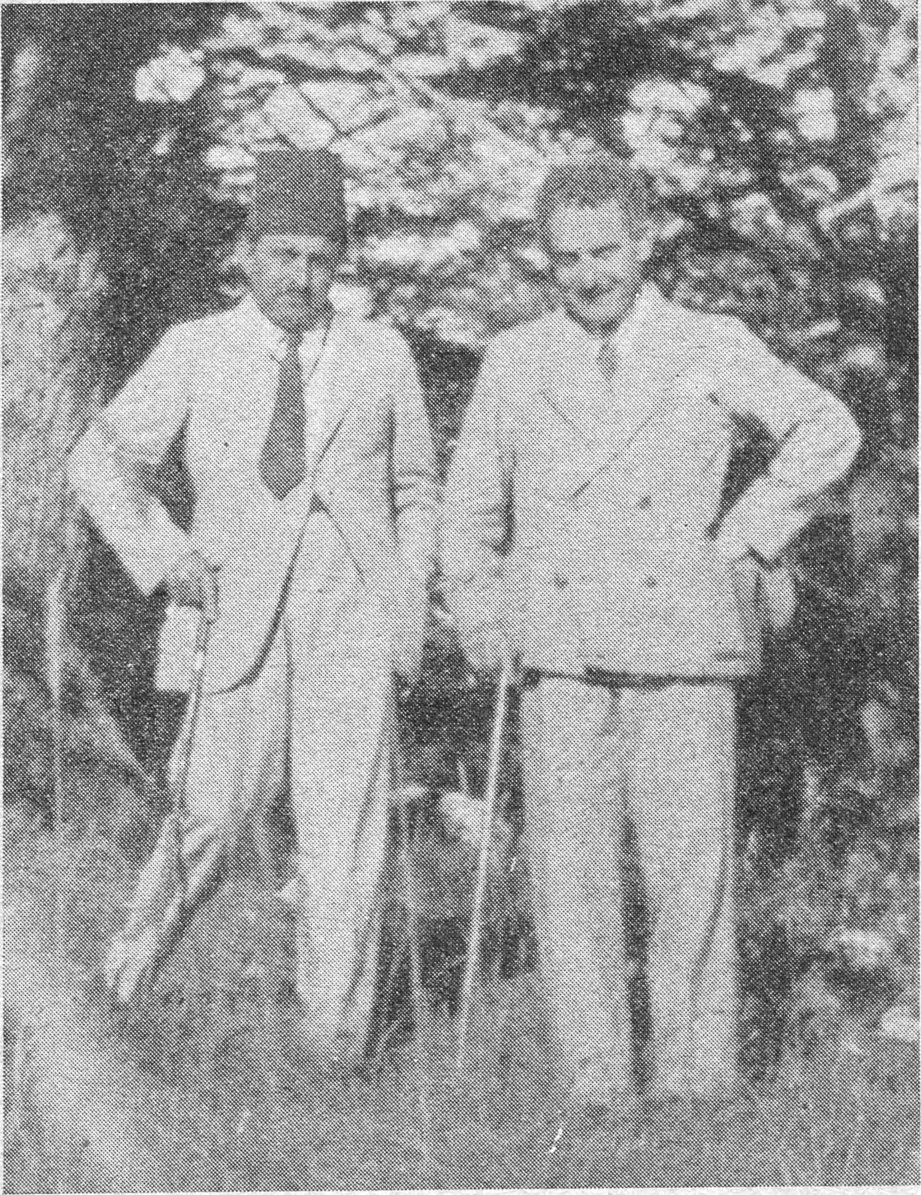
The two friends, Rihani and Howayek, in 1938
finished the portrait and showed it to her, she smiled, content, and said: "Call it The Black Ribbon."
•
Then May moved to Freike in search of rest and recreation, by a sound arrangement of Ameen's. I went off to Antioch. When I returned from my journey I went straight up to Freike, where Rihani's maidservant informed me that the Ustad received no one — none of "the people" — in the morning! At the sound of our wrangling Ameen came out of his green room and rounded on the maid: — Why, girl... is Youssef one of "the people"!?... May woke at the commotion and the laughter — her house was not far from Rihani's — and she opened her window and insisted, in a tone that brooked no refusal, that Ustad Youssef come down to her at once!. And in the flood of her joy at the dear guest she locked her door well and brought out a lavish lunch... caring not at all that she was depriving her friend of Sitt Saada's (1) "ghammeh."
(1) The sister of Ameen Rihani.