him two daughters: Saada, the elder, and Saud. Emira Shams had left three sons: Emir Qasim, Emir Khalil, and Emir Amin. It is told of Umm Saada and her great devotion to her husband that she hastened to sell her jewelry and her ornaments to meet the expenses of the Emir and his retinue in exile. Emir Bashir alluded to this in the second article of his will, where he says: "Inasmuch as the days of my exile have grown long and nothing remains to me of my possessions, I having spent in this exile all the money I had — for the whole sum of money that was in my hands when I left the Mountain I had spent by my departure from Istanbul." Then he says: "And the expenses disbursed by me over and above, before and after the bounty of the Sublime State, I took by way of lawful debt from the revenues of the means of my wife Husn Jahan; and I sold some of her jewelry and received what money she had." In appreciation of his wife's kindnesses, Emir Bashir appointed her his absolute executrix after his death, as set down in the second article of the will.
Emira Saada lived with her younger sister a life of luxury, opulence, and ease in her father's great palace: she wore the loveliest clothes, adorned herself with precious jewels, and frequented the sumptuous baths, like all the emiras and noblewomen of that age.
The French poet Lamartine described what he and his wife saw in the Shihabi Emir's palace, in his book 'Journey to the East,' noting the refinement and ornament of the building, and reporting from his wife what she had seen in the bath of the emiras' luxury, their adornment, and their extravagance in finery; the emirs themselves enjoyed the bath only at fixed hours, after which they would leave it to the emiras. It is well known that the emirs
of Lebanon, Maans and Shihabs alike, took great pains over the building of their baths and decorated their ceilings and walls. We have found no detailed accounts touching the appearance of Emira Saada, her costume and her dress; but we may learn something of the matter from what the Lebanese historian Rustum Baz wrote, for instance: that a woman's attire consisted of a silver tasa made by the goldsmith and engraved with fine workmanship, with a large pointed knob of woven threads set at its crown; as for the clothing of the body, it was a qumbaz with a square sash resembling a shawl or the mashalih; the chemise was long, of 'sitkruza' cloth; the drawers were tied with a fastening above the ankles; and on the feet were worn yellow or black
babouches — though the woman of fashion wore the 'pantofla,' which is a kind of babouche.
The settled splendor did not last long in the life of Emira Saada, for she accompanied her parents and her younger sister into exile, and kept moving with them through foreign lands until at last they settled in Istanbul. There, in the land of exile, far from the pomp of the emirate and the grandeur of the palace at Beiteddine, Saada married Emir Salim al-Shihabi, son of Emir Abdullah, son of Hasan, the brother of Emir Bashir II.
As for Saud, she was married to Emir Khalil, son of Bashir, son of Ahmad al-Lamai, whose father was at that time qaimaqam of the Christians. Thus the family grew in exile,
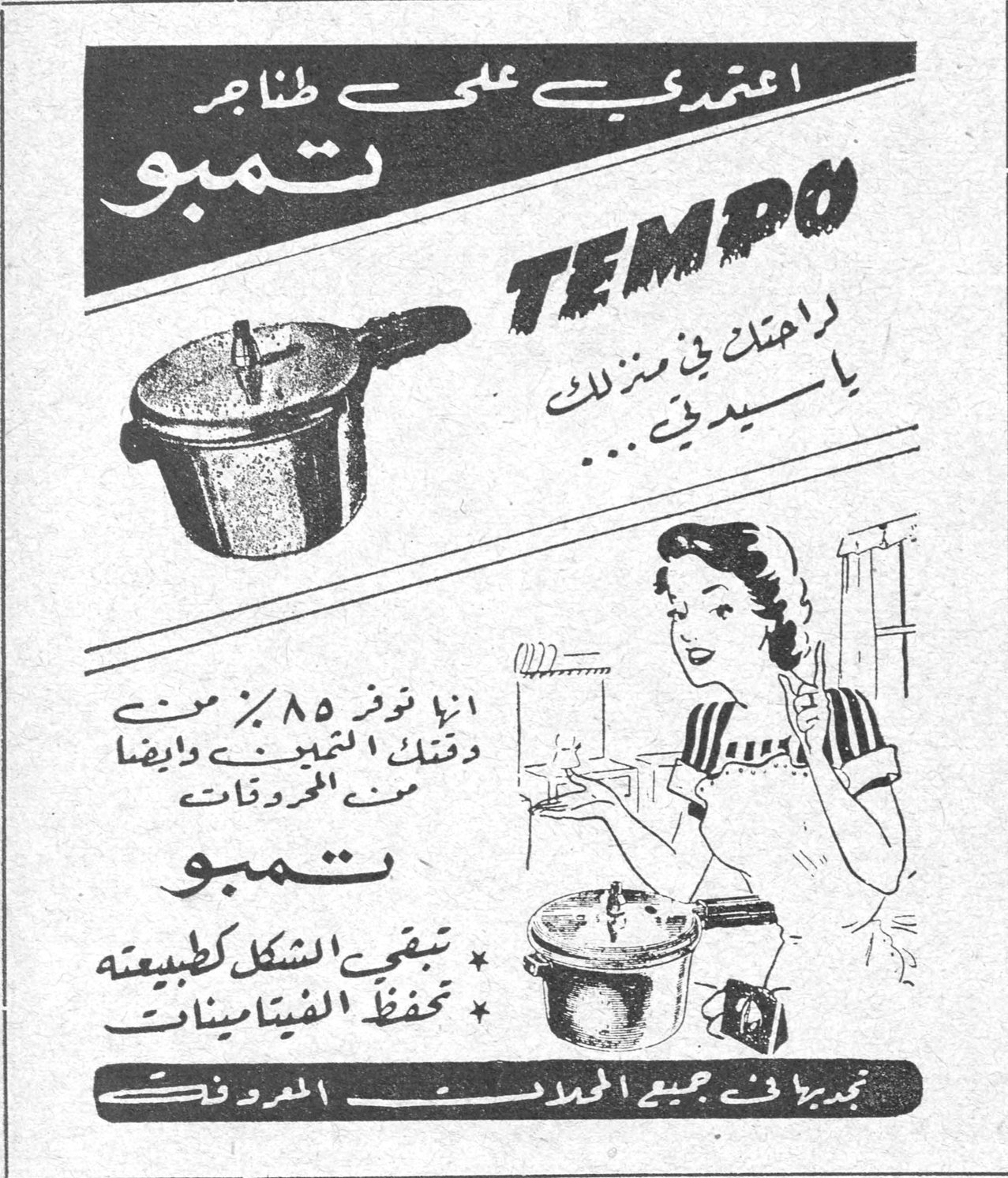
The Tempo Pot
Rely on the Tempo pot
TEMPO
Your comfort in your home, Madam...
It saves 85% of your steaming time and of fuel as well
Tempo
* It keeps the food's natural form
* It preserves the vitamins
You will find them in all the well-known shops