and Husn Jahan remained with her two daughters and her two sons-in-law at the Emir's side until he died, on the thirtieth of December 1850; and not long afterward she left the country with her children, in the late summer of 1851.
We do not know much of the life of Emira Saada after the death of Emir Bashir the Great, but she outlived her sister Saud, who died ten years after her father, that is, in 1860. On her return from Istanbul, Saada settled first in the town of Jiyeh, then moved to Hadath, near Beirut, where she lived a tranquil life with her Shihabi husband until God took her in 1884; she was buried in the monastery of Mar Antonios in the town of Baabda, in Lebanon. It is worth noting that she was not confined in her married life as her sister Saud was: Saud lived in
the village of al-Mahdub, facing Brummana in the Metn, and it is told that her Lamai husband was known for his fierce jealousy over her, and would not permit her to leave his house.
Emir Bashir loved his two daughters Saada and Saud and honored them, though his life with them was not long, especially at Beiteddine; and it is said that Saud's rich and splendid trousseau became proverbial. He tried to secure comfort and independence for them after his death, and the fourth article of his will reads as follows: "I have appointed her" — that is, his wife Husn Jahan — "executrix for me by this will, and in everything pertaining to the discharge of my obligations; and none of my heirs, nor any other, shall oppose her in anything, for this is my will. And she is guardian over my children
— her children — Saada and Saud, to raise them in the fear of God Almighty and to marry them with their own consent; and no one shall have any opposition to her or to them. This is my pleasure and my wish." End of text.
And in the fifth article he bequeathed to his two daughters a portion of his real property, saying: "As for the outer house and the maydan, I have given them to my children Saada and Saud by a legal deed."
These are brief glimpses touching the life of Emira Saada, for the historians have not spoken of her at length — the more so as she did not meddle in affairs of government, and enjoyed the splendor of her father's emirate for only a limited time. It was enough for her that she should be immortalized in her father's byname.
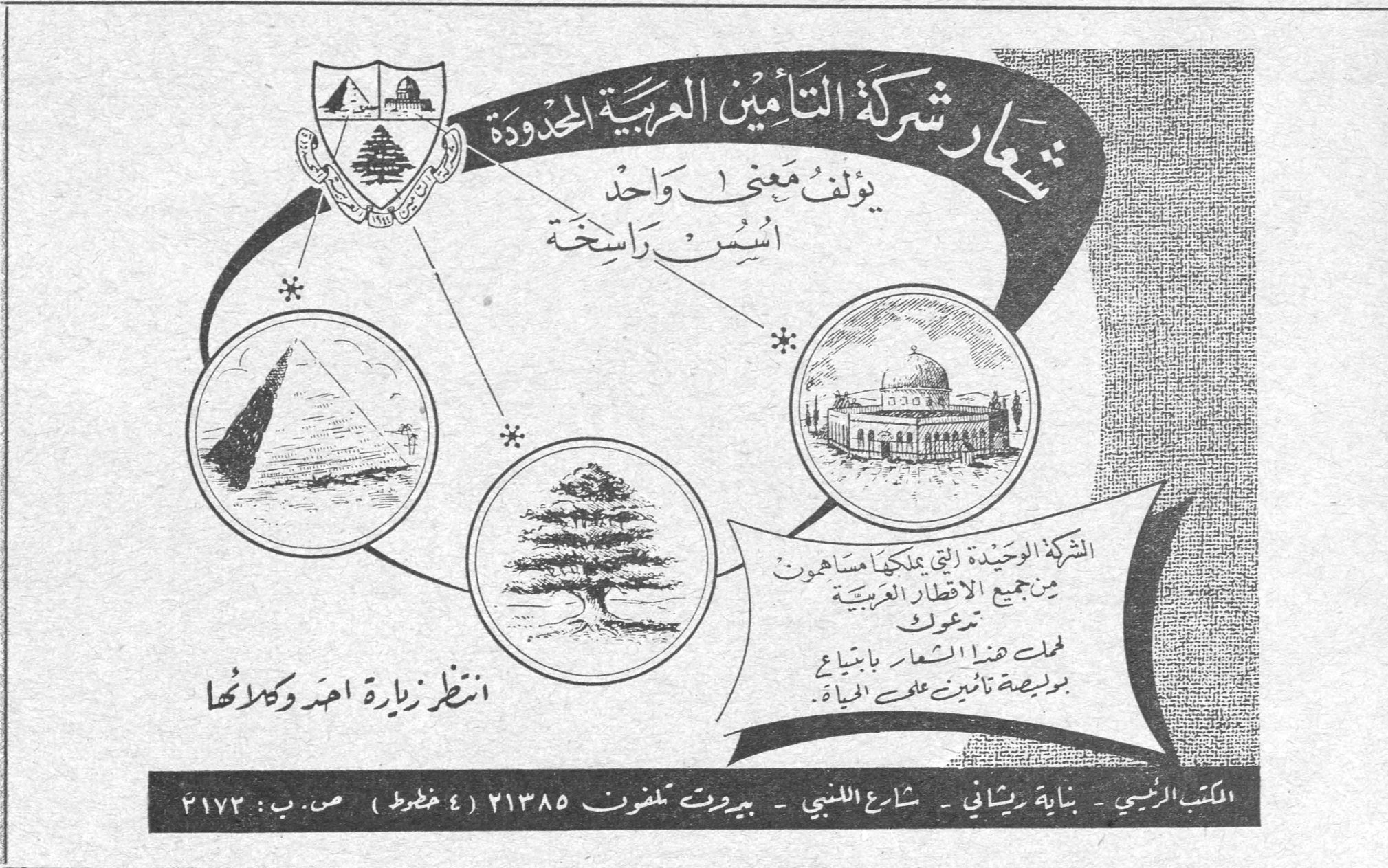
The Arab Insurance Company, Ltd.
The emblem of the Arab Insurance Company, Ltd.
composes a single meaning
Firm foundations
The only company owned by shareholders from all the Arab countries invites you to carry this emblem by purchasing a life insurance policy
Await a visit from one of its agents
Head Office — Rishani Building — Allenby Street — Beirut, Telephone 21385 (4 lines) P.O. Box: 2172