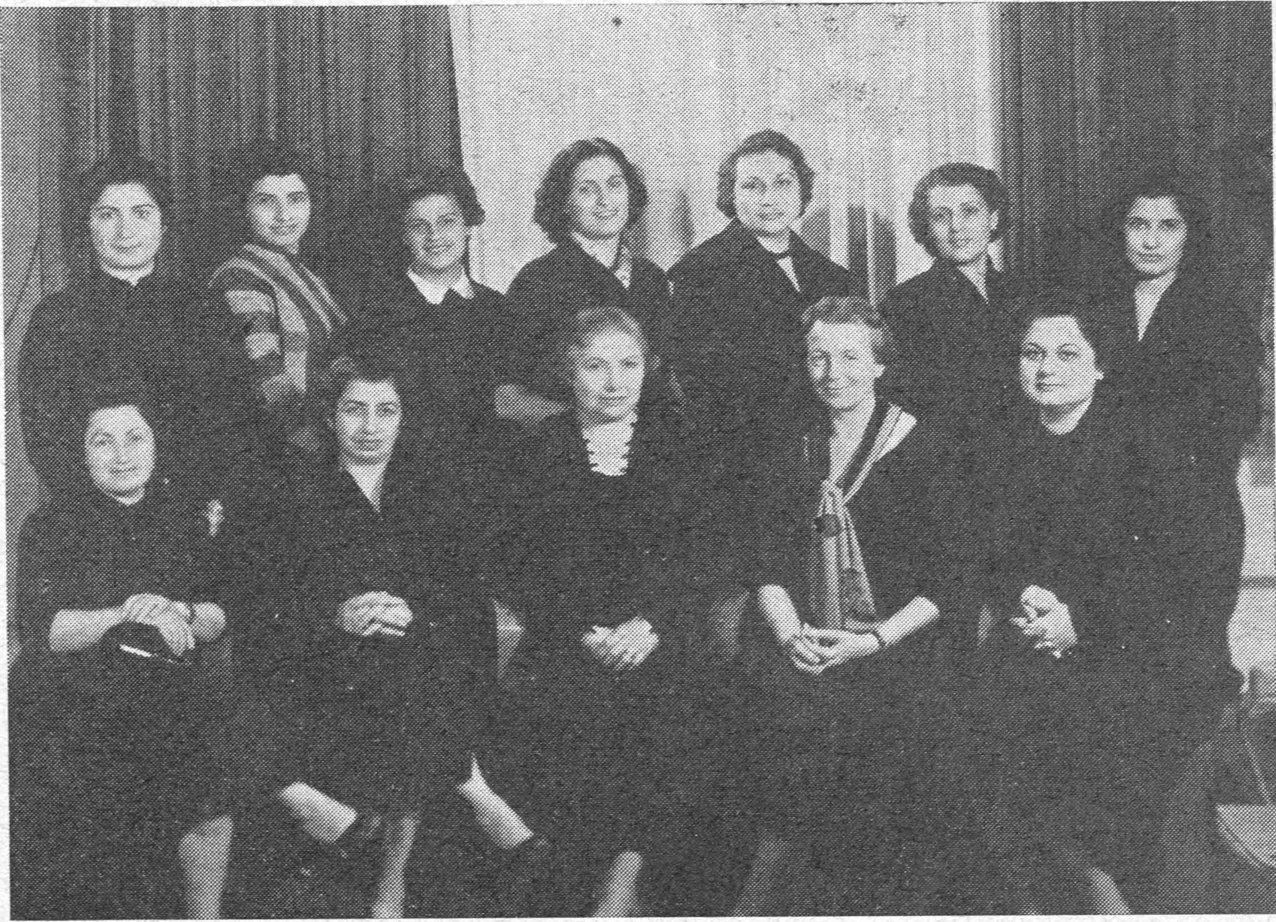
The Administrative Board of the Iraqi Women's Union
Seated, from left to right, Mesdames: Azza al-Istrabadi, secretary; Dhafira Jaafar; Asia Wahbi, president; Sara Jamali; Batul Abd al-Ilah Hafiz.
Standing, from left, Mesdames: Fakhriya al-Shaykhun, Bahija Ahmad, Fatima Ahmad Qadri, Badriya Muhammad Hasan Salman, Shafiqa al-Pachachi, Madiha Tawfiq Baban.
Everyone who visits Iraq cannot but admire the rapid progress and the activity apparent in every quarter of society — to say nothing of the industrial establishments of every kind and the continuous work for the betterment of the individual and the community which the government carries on — while woman devotes herself to raising the standard of her Iraqi sister, protecting childhood and motherhood, and combating social ills. I visited some of the institutions, and my admiration for the organization and precision was no less than my admiration for the Iraqi woman. And here I am now to speak of the
works of the Iraqi Women's Union — that Union which gathers together a number of women's associations, and whose members — the presidents of the various associations — perform glorious works in the field of the country.
The Union has a splendid club, the gift of the Iraqi government, in which are delivered the lectures the Union organizes under the name of "the Cultural Season," at the rate of one lecture each week. The first lecture was delivered by Dr. Mustafa Jawad, its subject "The Old Women's Charitable Institutions in Iraq"; the second lecture was given by
Mrs. Maida al-Haydari, its subject "The Importance of the School in the Life of the Iraqi Woman"; the third lecture was delivered by Dr. Abd al-Jalil al-Tahir, entitled "The Family Budget"; and the fourth lecturer was Dr. Ibrahim Shawkat, his subject "The Science of Geography among the Arabs." The lectures continue until the middle of May.
"Women's affairs" is the item to which the Union gives its greatest attention: it works for everything that concerns her advancement and strives with all the strength it has been given to raise the standard of the Iraqi woman culturally, socially, and economically.
The Union struggles for the recognition of woman's full exercise of her political rights, and it organized a campaign which it called "Woman's Rights Week," in which lectures and debates were delivered and the Iraqi press and radio took part; the women addressed memoranda to the government and to those in responsibility and organized a plebiscite. This campaign had the happiest effect, and woman's supporters multiplied; may the Iraqi woman, in the near future, be granted this legitimate right.
The Union has also raised the question of the family waqf, and the necessity of woman's sharing with man through her attainment of the right of ownership.
The nurse used to be regarded as a hired hand; after continuous effort the Union succeeded in convincing the competent quarters of the necessity of considering her a government official, to encourage many women to work in this honorable calling, which the country needs.
The Iraqi Women's Union takes part in many congresses, not only to show the extent of the Iraqi woman's activity, but