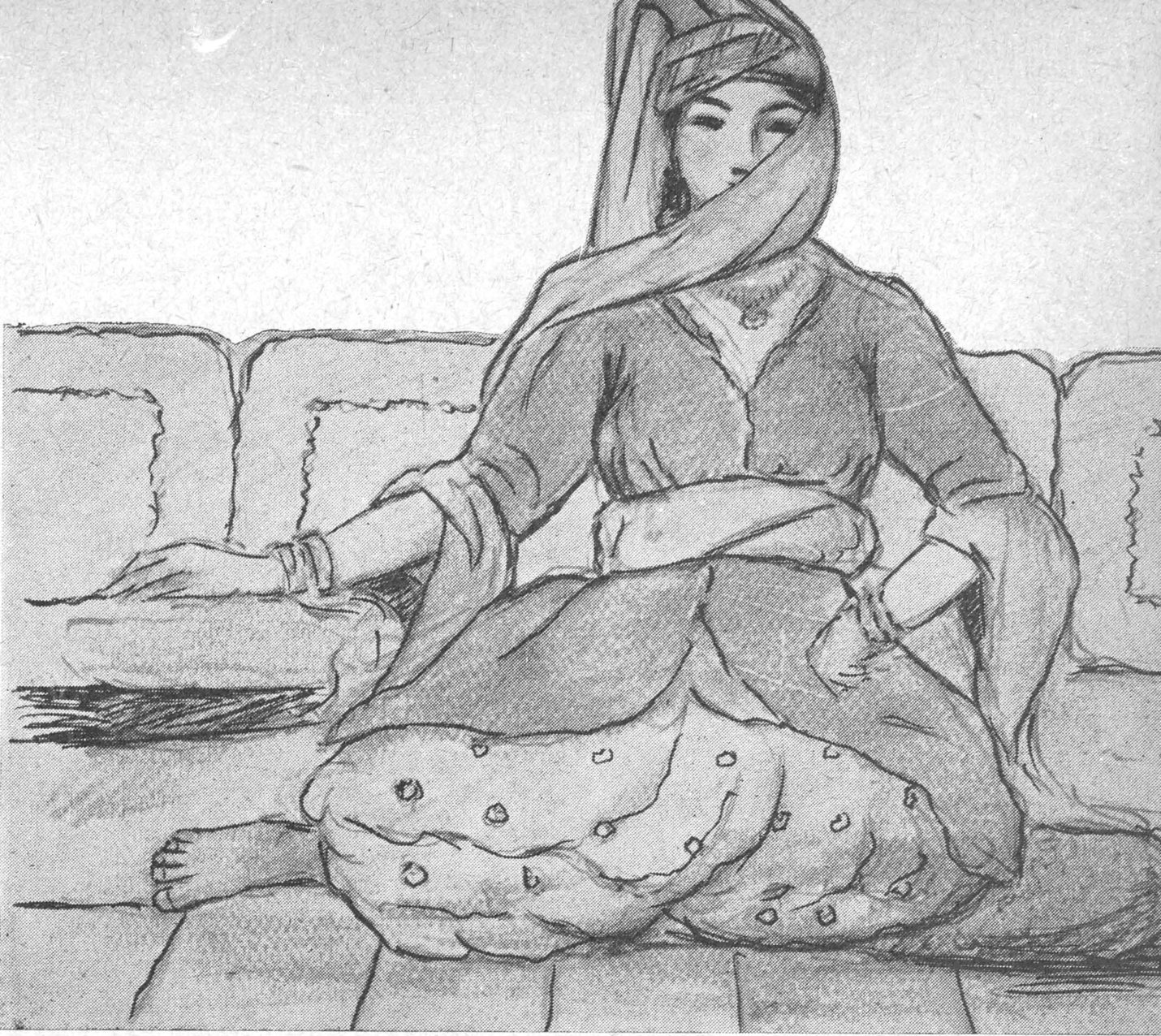
Emira Hbous Arslan in her youth — by Youssef Howayek
When we speak of Emira Hbous Arslan, it seems to us that we are going back to an age far off in the darkness, sunk deep in antiquity — nothing like the brief interval, a mere hundred and thirty years, that separates us from her; and that is only because of the great distance between the way of life which the heroine of our story led, and the demands of living that we face in our present days.
What doubles this remoteness, despite the recentness of the era, is that the information about her that remains to us is so scanty and meager as to suffice for the telling of tales without quenching the thirst for their details, which does not allow us to penetrate to the core of this personality as though we had truly lived alongside her. Necessity, however, contents us with a mere survey of her deeds; and in that, al-Bustani's book The Emiras of Lebanon is our nearest road and best guide.
She was known among high and low as Sitt Hbous, mistress of the
emirate of the Gharb — and this emirate means all the heights that overlook the city of Beirut. She inherited it from her husband, Emir Abbas ibn Fakhr al-Din al-Arslani, and after his death she took to herself the guardianship of their four minor sons, proving thereby that she possessed all the qualifications of any emir in whose person are gathered the destinies of the subjects under him in all the affairs of their political and economic life.
Nor did the sagacity of this able stateswoman escape Emir Bashir Shihab the Great, who was then still at the beginning of his rule over Lebanon; so he worked to raise her standing and appointed her absolute governor over her fief; and she bore all the responsibilities at which this lofty office aims.
In this the Emir was serving his own interest indirectly, and through it the Emira divined a policy of varying appearances and forms: you see her now an open
advocate, now a discreet conspirator, now a daring fighter, or an adventurous envoy. She moved among these several political parts, caring for nothing in them but the pursuit of her interest, embodied in the interest of Emir Bashir — an interest whose first fruit was grave troubles in which she was his best helper and supporter, until it was decreed that this fighter should end her days a victim of his exalted rule, when she had come close to her glory and the towering height of her vigor.
Now these two allies had come together through an intermediary, Sheikh Bashir Jumblatt, the Emir's vizier, who, it appears, held such standing with the Emira that she consulted him in everything she undertook with the Emir. And so it was that not a year had passed since the Emir appointed her governor over the Gharb before circumstances called on her to repay the Emir's favor many times over, when the ordeal descended upon Bashir, and al-Jazzar seized the two of them, together with a third — the Emir's brother — and lodged them in the citadel of Acre as hostages for a tribute the Emir had been unable to pay to one of the aghas of the troops.
Meanwhile Sitt Hbous was providing for the needs of the prisoners' families, never ceasing to win the people over to the deposed Emir, inciting them to