take his part against the one who had replaced him, explaining that the state is nothing but solidarity, faith, and cooperation.
But neither preaching at home nor local relief could ward off the dangers or turn aside the events. Nothing remained for her but to face the matter from the positive side: to pawn her jewels, or make a show of doing so, as Sheikh Bashir secretly signaled to her from prison, and then to bring the sum herself to al-Jazzar — for how else was there deliverance from a tribute that had turned into a ransom of blood and the fate of a state?
She met Ahmad Pasha al-Jazzar in Acre, on his own ground and in his own domain, and she did not come away from that meeting until she had bargained over the sum demanded, reduced the imposed tribute, and secured for the Emir, besides, his honorable return amid horses and retainers, robes of honor and arms.
Nor was that the only calamity of the Emir's in which Hbous Arslan fought so valiantly — her case in this being the case of feudal politics itself, swung to and fro by a web of petty states and a mass of watchful governors. For the contest passed a second time to Abdullah Pasha, the new wali of Acre, with the Emir exiled to Hauran, and Sitt Hbous resisting on his behalf; but this time the Emir was not long in appeasing the Pasha, choosing to forget what he had caused him through the rising of the Kisrawanis against him — the thing that had driven him to that decision. And it was in consequence of this appeasement that the great clash between the two Bashirs took place, in which Sitt Hbous thereafter sided with the vizier and not with the Emir; and from that time her star began to set — even though the Emir tasted
a third exile, to Egypt, during which he contrived an alliance with Muhammad Ali Pasha, and soon returned in its wake to Lebanon with one care above all others: to rid himself of his two enemies, Bashir and Hbous.
Bloody battles broke out between the two parties, among them the revolt of the sheikhs and emirs known as the Mukhtara movement, whose pivot was the adhesion of Emira Hbous to Sheikh Bashir; matters were not long in ending in the latter's defeat, then his capture in Damascus, then his killing in Acre.
As for her, the Emir stripped her of her fief and handed it over to her son, Emir Ahmad, who acquitted himself excellently in his service. And in the thick of this politics, which knows no tie of blood or bond of friendship, she stood fast on its cheerless field to the last arrow left in her quiver.
She took refuge in Bshamoun,
close by Choueifat, the place of her birth, being then fifty-eight years of age, hoping to retire from politics. But so hot was her friendship and so bitter her enmity that fate would not let her end her days in peace: to those low hills the Emir's men pursued her, and pressed her harder and harder, until she resorted to disguise and turned and fled.
And the fugitive had not run far before she fell dead to the ground. Was she brought down, struck by bullets? Or by exhaustion and heartbreak? Or strangled in her palace, the tale of the flight being of no account?
However the historians may differ over her death, one thing remains certain to us: she was faithful to a politics that was not faithful to her, and she perished by the very instrument she had so long wielded. And just as she would defend high honor from harm, so she gave freely when blood was spilled at its side.
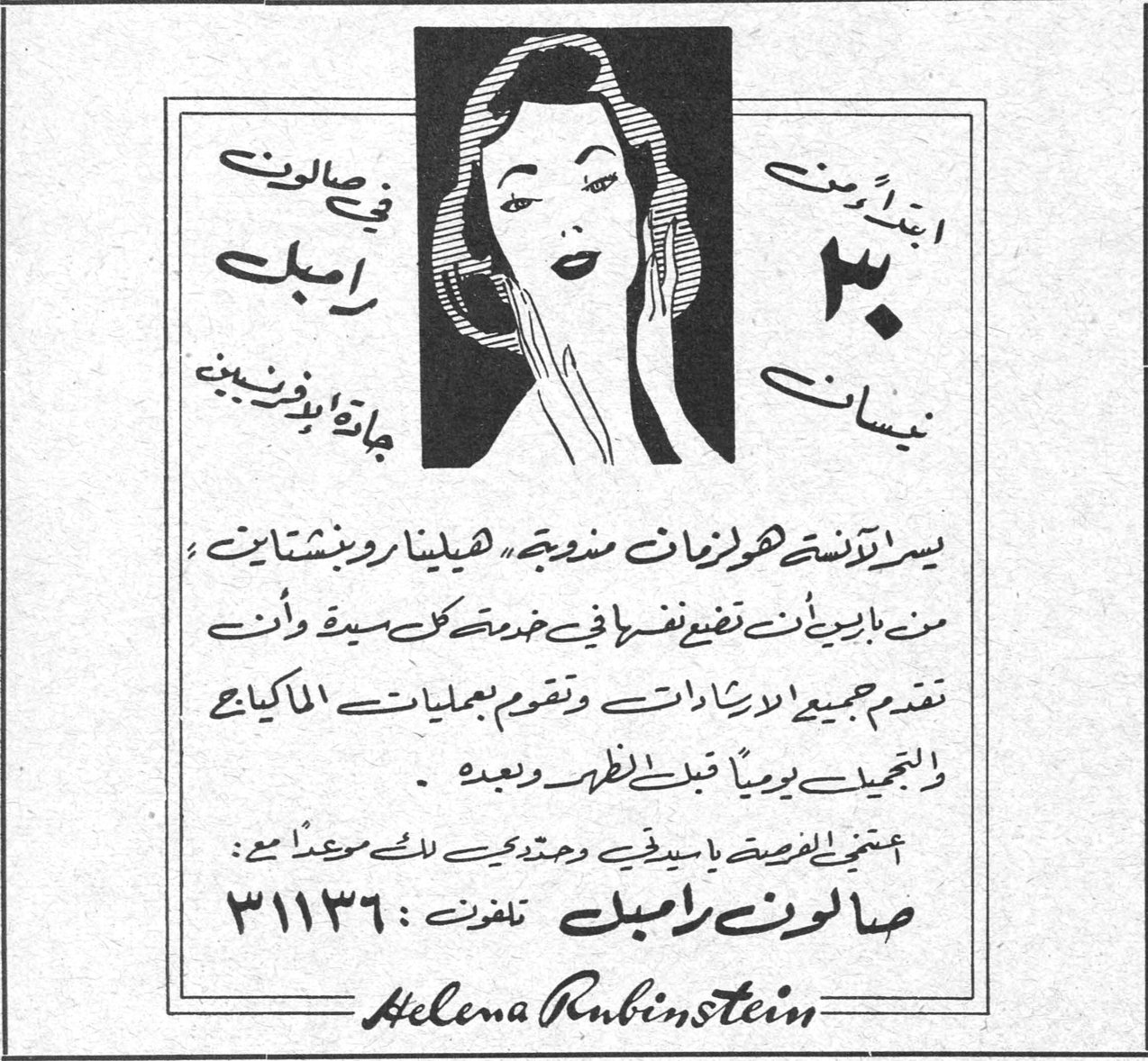
Salon Rambal — Helena Rubinstein
April 3
Opening at Salon Rambal
Free lottery prize
Miss Holzman, representative of "Helena Rubinstein" from Paris, is pleased to place herself at the service of every lady and to offer full guidance, performing make-up and beauty treatments daily, morning and afternoon.
Seize the opportunity, and fix yourself an appointment with:
Salon Rambal Telephone: 31136
Helena Rubinstein