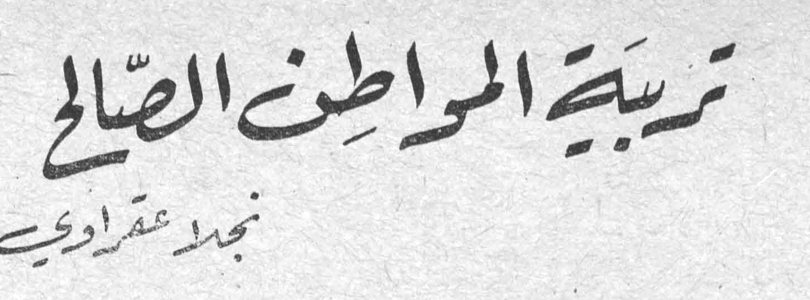
The Arab countries are still in the stage of formation, feeling their way toward knowing their true selves and establishing a justification for their existence in the world of modern civilization. They stand in urgent need of conscious guidance and sound direction in order to build the firm foundations upon which the being of the modern nation rests. Mrs. Najla Aqrawi's talk about the good citizen is the talk of a sincere and conscious lady, drawn from her experience and her observation during her travels and residence in the advanced Arab countries — and it is, accordingly, a precious message to her fellow Arabs everywhere...
There is no doubt that the cornerstone in the building of the nation is the education of the rising generation and its guidance, that it may be good citizens in its present and future society.
The institutions that undertake this mighty task are the home, the school, the religious institutions, the state, and the social institutions; and the quality of the citizens depends inevitably upon how each of these units, singly and in cooperation, performs its duty of developing the young and guiding them. What, then, are the foundations of this education we want, and what are its effective elements?
The moral and spiritual training in which the child grows up from his tenderest years, at home or at school, together with the high ideals of his religion, determines the most important part of his personality and prepares him to take his place, positive or negative, in his present and future surroundings. It has come to be recognized that this training is not fully accomplished unless theoretical instruction is accompanied by the concrete practical example. In other words, it is not enough to preach love, tolerance, and truthfulness to the child; we must ourselves be adorned with these lofty qualities we want in him. For the child imitates before he listens, and is influenced by the personality of his educator many times more than by theoretical sermons remote from his practical life.
This spiritual training is accompanied by intellectual training — that is, the development of scientific, logical thinking, to which the institutes of learning in the advanced countries attend. It is not enough to hand students a collection of ready-prepared information; we must accustom them to scientific thinking — to distinguishing the sound from the corrupt, the true from the legendary, the real from the imaginary, the possible from the impossible — and above all
this we must accustom them to distinguishing among the different values and their degrees, so that their choice may be wise, sound, and felicitous... How wretched is the country in which citizens multiply who live in a murky atmosphere of illusions, clinging to them, unable to distinguish between what is passed on by way of report and what is preached as a message, between propaganda and reality, between reckless emotion and the discriminating, restraining reason... Our advance up the ladder of civilization depends to a great extent upon how our schools perform their duty in this field. The school that neglects scientific training and logical thinking for the sake of superficial patriotic sentiment neglects the first aim for which it was founded.
It is indeed necessary that we bring up our children to love the homeland and to serve it; but more important still is to cultivate in them comprehensive spiritual character and sound scientific thinking — two effective weapons in the service of the homeland. From the ordeal of Palestine we have a painful lesson in this field: we grew angry, we raged, we cursed, and our patriotic feelings were stirred; but we did not face the ordeal with the conscious, discriminating mind — hence that tragedy, and the misfortunes and calamities it dragged behind it.
Someone may say: certain advanced peoples fall short in producing the good citizen, despite the excellence of their educational institutions, despite the multitude of their scholars and thinkers, and despite their ideal moral training. To that I reply that there is yet another factor in producing the good citizen, and that is giving education a practical direction, side by side with that essential idealism. It is not enough to teach mathematics, philosophy, logic, and religion; we must also give our children a practical direction, that they may turn their material surroundings to account to the utmost possible degree. Health care, sound nutrition, necessary cleanliness, and bodily exercise are among the essentials that cannot be dispensed with in raising a good generation; likewise practical adjustment, the teaching of handicrafts, and certain vocational skills are among the constituents of a successful society. And if we add to this the sense of responsibility and national duty, self-respect, and respect for the laws, we have before us a comprehensive picture of the aspects to which we must give our attention.
Yet none of these things can be accomplished unless the state does its duty of securing the minimum of economic sufficiency, social justice, necessary security, and laws that protect the laborer, the orphan, and the disabled. The government that respects itself, represents the nation in its entirety, and holds fast to the foundations of sound justice imposes respect for itself upon the individuals of the people, and contributes its share, to a great extent, in the making of the good citizen.