Goriot" by Balzac; then I turned the lamp down low and gave myself up to sleep. And every time Gibran got up to gargle, as the doctor had directed, he would say to me: "I am afraid you are cold, Youssef. My overcoat is in the wardrobe." And I would answer him: "I sleep in my youth, with 'the angels' around me, so I feel no cold!"
In the morning I lit the "spirit" stove to boil water and prepared tea and milk. Gibran was worn out with exhaustion, but he managed to drink a cup of tea with a few biscuits and some jam. He stayed in bed, but he did not sink into silence as he had the day before; he set to analyzing the mystery of life and death, and to teasing me: "If I had died last night, what would you have done, Youssef?" "I would have followed after you... And now, no more talk... Talking hurts your gullet!!"
"Your parents, Youssef, are still alive, and so are your brothers; as for me, my mother has died, and my sister, and my brother, and I do not know what has become of my father." His voice choked with emotion, and after a little he resumed: "I shall die before you, Youssef, there is no doubt of it. I ask you, from this moment, to set upon my grave a lion rearing up and roaring!" "And I ask you, Gibran, to be quiet now. Enough of death and graves and lions..."
Then we heard Rosine's knock on the door, and I went to meet her and told her of Gibran's condition, apologizing that we could not work, and trying to pay her the two and a half francs; but she refused and resisted petulantly — "I have told you again and again, you are not Rodin. Where is Monsieur Gibran?" And she came toward him and, like a tender mother, felt his forehead, then turned to me and asked anxiously: "Who looks after him and washes his clothes?" "The concierge!" She shrugged her shoulders and shook her head in disapproval and asked: "Where are the pillowcase and the shirts and the socks and the handkerchiefs?" And of her own accord she went to the wardrobe, opened it, examined the clothes and
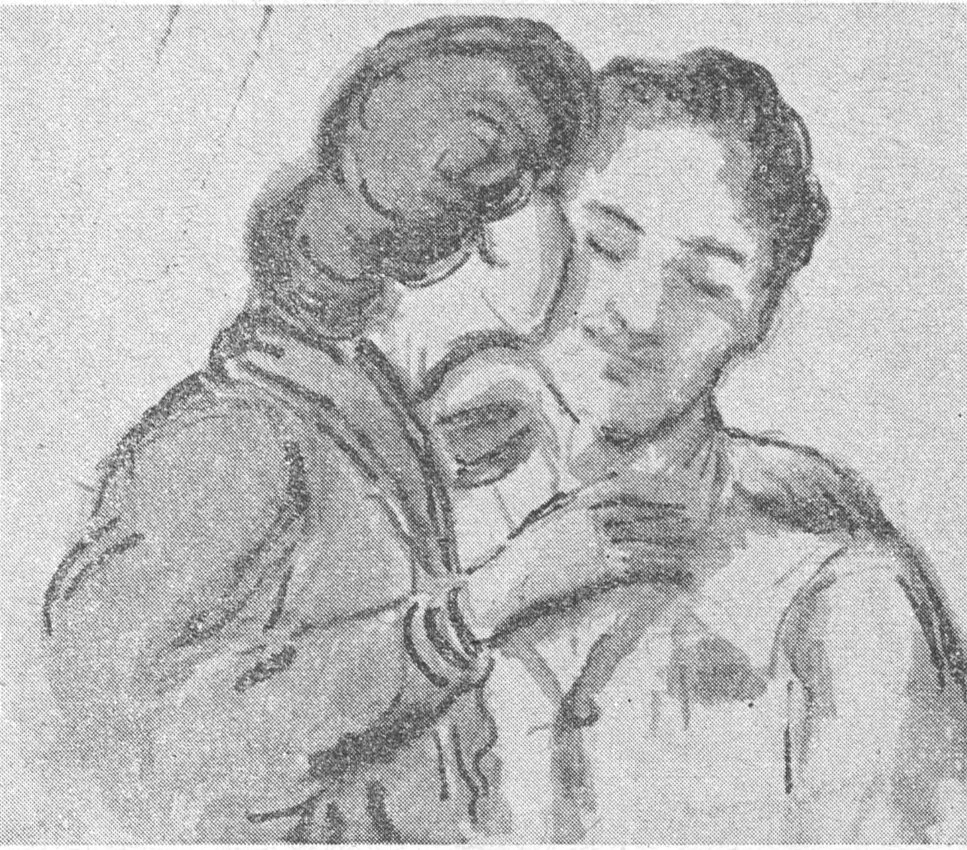
Gibran let her kiss him, without daring to return the kiss!
gathered up whatever seemed to her to need washing, paying no attention whatever to my attempts to stop her or to Gibran's protests from afar... And after she had changed the pillowcase, as though she alone gave the orders here, she wrapped the clothes up into a bundle, tucked it under her arm, and said as she opened the door: "I shall come back tomorrow."
Gibran turned to me, perplexity plain upon his face, as though illness had allowed doubt to steal into those dreaming eyes: "Do you think she will come back, Youssef? She has taken the shirts and the socks! Are you sure of her? Do you at least know her address?" "Set your mind at rest, Gibran. I am as sure of Rosine as I am of my sister the nun, and I know her address here and in Italy..." Then I told him of my receiving the five hundred francs, the price of the painting, and that I had an appointment with Calmy to hand over
the second painting! Reassurance settled over Gibran's features, and he sat up straight, saying: "I am hungry, Youssef. Bring something back with you for me to eat from Madame Baudet's restaurant — marrows, if possible!"
Toward evening Gibran's condition improved, and he insisted on taking a stroll, on condition that he wrap his neck in a scarf; so we walked slowly along together on a stretch of the bank of the Seine, looking at the prints and books on display and com
menting on whatever it pleased us to comment on.
And the next day Rosine came carrying the "bundle," and in it the shirts and the socks and the handkerchiefs and the pillowcase — all ironed and crisp, fragrant with laurel leaves!
And we sat down to finish the picture of the woman borne on the arms of the angels, Gibran, as was his habit, thinking aloud... He fell to analyzing the nature of woman and said: "I love her as a blend of Beatrice and Messalina; but the great calamity, Youssef, is when a woman is beautiful, for her very beauty becomes a cause of disquiet... And if she is not beautiful?... And if she is not
cultivated?... This simple girl