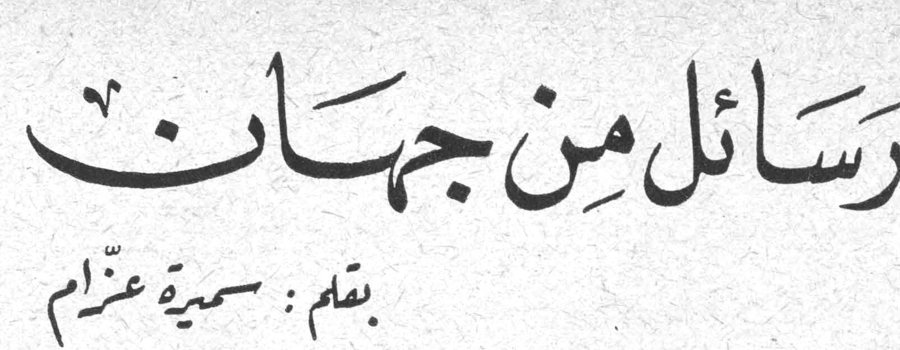
I was hurrying across Nejmeh Square when I heard her call to me, holding out a brown hand and saying, "Hello, Samira — where is your promise to visit me in Zahle? Summer is half over" — we were in early August — "and I have not seen you at my house..." I apologized and promised to visit her; then I shook her hand and she went off in haste...
A full month later... or less than a month, I was leafing through the daily paper when there was her name, published draped in black. Poor Jihan — she had died... Had I known that my meeting with her would be the last, I would have detained her longer... I would have come to know her better, would have taken from her more than I have... But I did not. I did not know that the fates would compel me to set down tearful lines for Jihan.
My acquaintance with Jihan does not go far back, nor do I claim it was a full one. The times it was given us to meet did not exceed the fingers of one hand, but each one of them deepened my conviction that I stood before a human being whose self and spirit held much to give...
I knew of her that she loved "Mayy" to the point of worship, and that her great hope was to devote herself to a study that would do this woman of letters justice and place her where she deserved to be...
Jihan wrote me five or six letters, most of them turning on Mayy...
The best thing I can do at this hour is to bring Jihan back to life in one of her letters, that we may hear her speak. In one of them, green of line, bearing the date of the sixth of June 1955, she says —
"My study (of Mayy) goes back five years, in which I gathered her fourteen books together with several bound volumes of the magazines al-Hilal, al-Muqtataf, al-Risala, and al-Mar'a al-Jadida, and what was said about her and of her during her visit to Lebanon in 1922, and what was said about her and of her during her calamity, the day she was placed under interdiction, and what was said about her and of her, too, after her early death. As for her letters to Gibran, which were in his museum in Bsharri, only one man of letters preceded me to them, one whose identity I do not know even now — Mr. Halim Kanaan; that writer had no sooner published his study of the bond between Gibran and Mayy in a booklet threadbare in dress and abundant in benefit than the two hands of (...) (*) snatched it
up and reworked it without any reference to the true source. As for the rest of the letters of Mayy and Gibran, they are preserved with me, together with a beautiful picture of Mayy in her childhood, as well as a few cards Mayy sent Gibran on certain holidays, in which her great soul, her philosophy of life, and her opinion of Gibran's art shine forth.
As for that wretched aberration, or that wearing repression, I found no trace of it in all that Mayy wrote. And as for what the Lebanese men of letters have said about Mayy, much of it bears no relation to her truth. One group alleged her abnormality and accused her of never having loved anyone — not even Gibran.
Another group said she was mannish, that she had mastered everything except opening her heart to love. Another said the direct cause of her madness was that one of her relatives stole Gibran's letters from her. And it was said, and said — would that these sayings had come from people who lend an ear only to gossip; then the matter would be a light one. But these sayings and their like came from men of letters who carry weight in the Arab world.
Yes, my dear Samira, there are those who accused her of dryness and frigidity of feeling and of a twisted sexual nature, and there are those who claimed she was so soft and superstitious that she went mad when Gibran's letters were stolen from her — all this, and not one of them took the trouble to study her through her literature. Our literary world, my dear, represents our social and political world most fully and most truly; the picture of our life is reflected in strange fashion in the mirror of our literature. We are lost and wandering; we know not how we go or how we come. We are in the midst of a sweeping current carrying us toward perdition, and yet for all that we ask nothing of our thinking, nor do we bind it to deliberation and balance.
This — together with the accusation of madness against Mayy, and that interdiction imposed by cousins of hers to seize Mayy's precious library, and Mayy's deep philosophy and her rising above the spinster's melancholy, and the testimony of a cultivated friend of mine who was a nurse at Dr. Rebeiz's hospital when they brought Mayy there — confirms my belief that there was nothing of madness in her at all. Rather, her insistence on refusing food and on facing no one whatever, even
(*) ... and she also mentioned ——
her intimates, went back to a crying sense — as with any idealistic character — that her dignity