
... After Rihani's visit to Paris ended, Gibran accompanied him to London, where they stayed a full month and wrote me from there a "comical" letter that testified to an excellent, merry state of mind... for they were both still at the beginning of the road, and had not yet bowed under the burden of philosophy, shortness of temper, and chronic "sulking"!!
The letter ran to no more than ten lines: Gibran began the first line, Amin wrote the second, then Gibran the third and Amin the fourth... and so on... all of it gentle banter that lifts care from the heart.
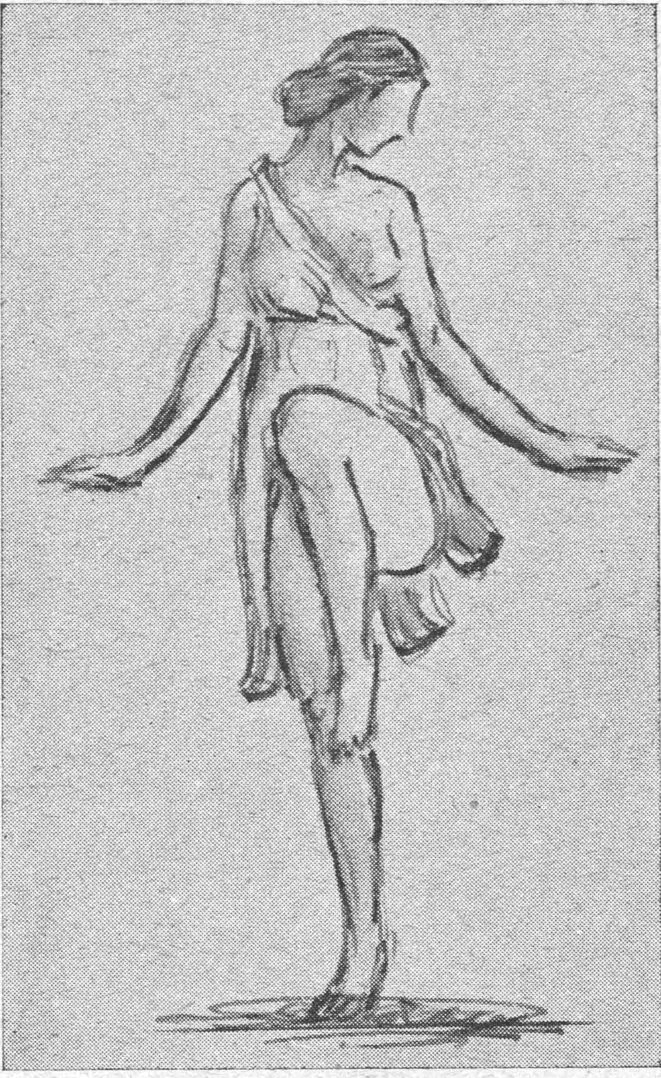
Rihani continued on his way to New York and Gibran returned to Paris, and we went back to our former life: painting, debating the affairs and sorrows of art, strolling along the banks of the Seine; and when invitations came our way, we would hurry to the Châtelet theater to watch the famous American dancer Isadora Duncan... And from time to time we would arrange, at my place, a musical dancing party, at which Olga would play and Marguerite and Zina would dance by the light of drowsy candles, while Gibran and I watched and sipped tea... and dreamed!!
In those days Gibran was giving himself more and more to writing, and sometimes he would read me what he wrote. As for me, I was under the influence of reading seven huge volumes on the history of the origins of the Christian religion by Renan, who had wrung out his brain over them and succeeded in presenting the subject with a surpassing skill that stirred my admiration for this genius of a historian. So I turned to Gibran and said:
"How good it would be, my brother, to specialize in one single kind of literature or art or science... This tone of the prophets (I meant his tone) does not please me; I take no pleasure in swimming through fog, and the reforming of the universe concerns me neither much nor little... I would give my eyes only to understand something clear about the obscure secrets of the universe that surround us..."
And Gibran would answer me with something like mockery, sipping his coffee and puffing out cigarette smoke: "Tell me, Yusuf, in which of the arts or sciences will you specialize? And do you suppose you are capable of understanding anything clear of the secrets of this obscure, wondrous universe?"
I asked his opinion of a statue of a dancer I was working on. He gazed a long while, taking in the statue with the eyes of an expert, probing artist, then answered me: "I congratulate you, Yusuf; your dancer is without doubt inspired by Isadora. You are certainly a better sculptor than you are a painter... To sculpture, then... specialize in sculpture!"
He talked while working the clay with his finger, smoothing certain lines of the body, and I teased him in my own particular way: "You'll dirty your finger... and that handsome ring on your finger!"
Then he asked to see the first drawing — the original from which the statue had been copied. I said: "Miss Marguerite liked it and expressed a wish to keep it, so I made her a present of it." Gibran flared up and said: "That is you all over... always scattering your drawings, never knowing how to keep them. You need an inspiration!" I answered him with my usual coolness: "Patience, my brother; it seems that Isadora saw the drawing with her pupil Marguerite, admired it, and asked about the artist who made it... perhaps she will come to visit me!"
Gibran shrugged his shoulder dismissively and said: "Delusions and dreams, Yusuf. She does not condescend to visit the richest of her countrymen... the millionaires... Did you not see with your own eyes how the crowd goes mad when she sweeps by, or turns about the stage with her graceful, harmonious movements? And how bouquets
of flowers are strewn around her?" And after thinking a little Gibran added: "And who knows — perhaps she truly savors art and values it at its worth... In any case she is rich, and she may
Isadora