
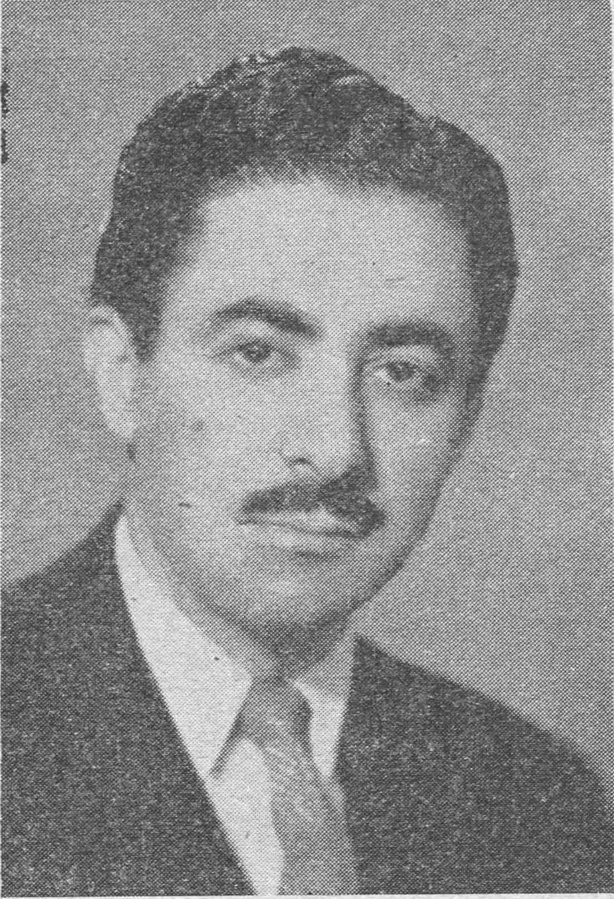
Dr. Azkoul received his university education between Paris, Berlin, and Bonn, ending with a doctorate in philosophy from the University of Munich. He is the author of the book “Reason in Islam.”
He began his working life in teaching. From 1947 his name came out into the international arena, upon his joining the Lebanese delegation to the United Nations, where his talents and qualifications found the setting in which to crystallize and show their substance...
He represented Lebanon in all the sessions of the General Assembly and was elected chairman or rapporteur of a large number of councils and bodies. Readers may remember that he was summoned twice to New York this year, to take part in the Security Council's deliberations on the Palestine question...
And in the halls of the United Nations, how many a bold cry has Dr. Azkoul raised in his speeches and debates! We recall among them his honorable stands in defense of human rights, the freedom of the press, and the Palestinian cause. He is, then, the best man on whose opinion to rely in what concerns the United Nations.
We shall try here to touch in particular on this side of his life, and to put the questions likely to enlighten Arab public opinion on the subject.
Q — There is no doubt, Dr. Azkoul, that you have learned
much and experienced much from your years in United Nations circles. Would you tell us first of the personal impressions you have carried away of the characteristics of international work at the United Nations?
A — Perhaps the impression that has left the deepest mark on me is that strong sense of the multiplicity, variety, and divergence of points of view on any subject laid before the international community. The simplest of proposals sometimes stirs up such interpretations, constructions, doubts, and objections as would never have occurred to anyone at all. For every delegate looks at it from a particular point of view, in the shaping of which the delegate's own mentality has joined with his country's interests and the intellectual, social, economic, and political conditions prevailing in it. Nor should we be misled by the similarity of positions in some cases: those very similar positions are reached, in the case of each delegate, by considerations
peculiar to him, varying or differing from the considerations that influenced others. This is what makes joint international work an arduous, complicated, exhausting operation, demanding much creative power, much patience and endurance, and much art in shrewdness and wisdom. For the unified result hoped for from joint international work must pass through this raging sea of variety, multiplicity, and difference of points of view, and overcome it in the end. This truth puts an end to the astonishment of the great mass of people, who so often ask: why do the delegates differ so? For the real wonder is not in their differing, but rather in their agreeing.
Q: It appears, then, that there are benefits to be reaped by one who has had the chance of experience and work in the ranks and corridors of the United Nations. What, in your view, are the most important of these benefits?
A — No doubt work under such conditions yields abundant benefits, but I should like to confine myself to mentioning three intellectual benefits reaped by whoever has been schooled in this work.
First — the conviction that there exists such a thing as the international spirit. For the tremendous effort expended in the bodies of the United Nations on the subjects dealt with is decisive proof of the existence of a tremendous desire for understanding, cooperation, and harmony. And this in turn is decisive proof of the existence of a general international spirit from which this desire springs; and from this conviction of the existence of the international spirit