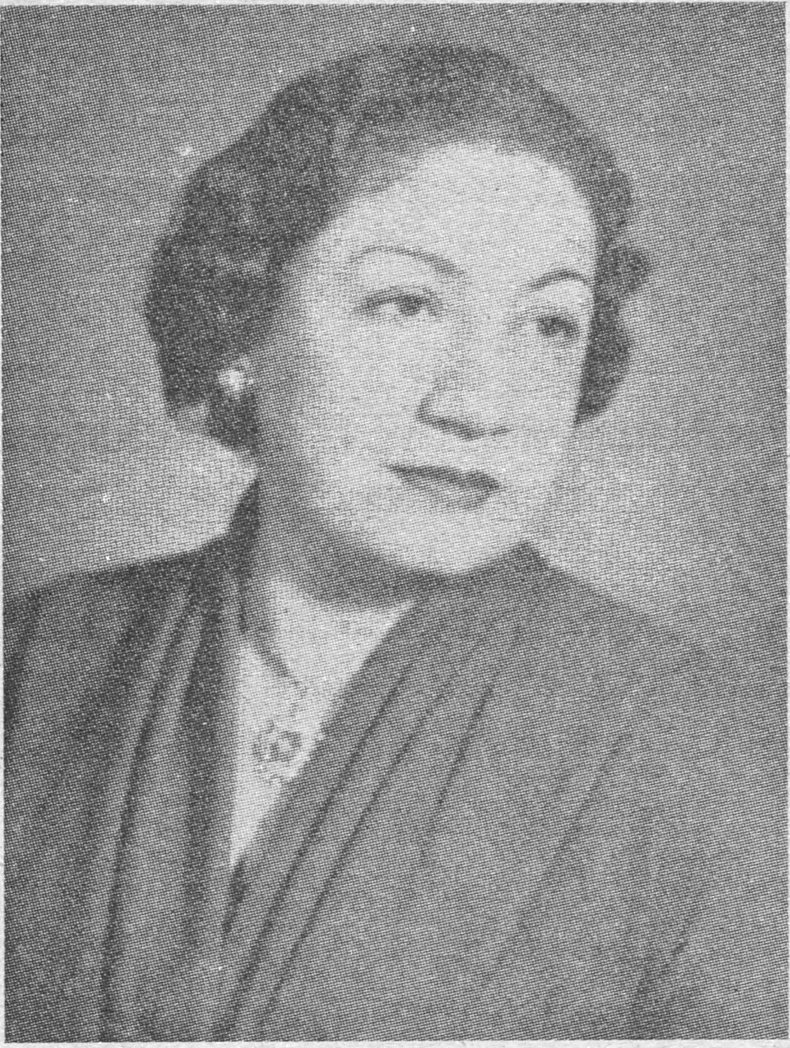
By a happy coincidence I met Mrs. Amina al-Said, the bold Egyptian writer and thinker, and my colleague, editor-in-chief of "Hawwa al-Jadida."
I met her at the home of Miss Ibtihaj Kaddoura, president of the General Arab Women's Union, in Aley, where I had gone to reassure myself about her health and her steady progress toward complete recovery, God willing, so that she may return to her activity in guiding the Arab women's unions for the general good of woman.
In a clear morning atmosphere, the woman of letters Amina al-Said — just back from Damascus, where she had been among Egypt's delegates to the Arab Writers' Conference — launched into telling us what the revolution has achieved for the Egyptian woman. She said:
The revolution has rendered the Egyptian woman four signal services. The first was its equalizing of man and woman on the morrow of the issuance of the agrarian reform law, in which land ownership was limited and the right of ownership reduced to only two hundred feddans. For the first time in Egypt's history, women's shares came out exactly like men's shares, and the two sexes were treated on the same footing in the distribution of land... and this is a great service, without a doubt!
Then came the abolition of the waqf system, lifting the great injustice from woman, who alone had been its victim in times past... A man used to endow his properties or his real estate either for purposes of piety and charity, or to deprive his daughters of their inheritance for the sake of their male brothers... With the abolition of the waqf system, the government cut off the root of injustice, trickery, and artificial charity, and people's properties became the right of the lawful heirs. In this measure is all justice and equity.
The third service the revolution rendered the Egyptian woman is its abolition of the religious
courts. Formerly each religion referred to its own particular court, and how often, in those circumstances, did scandalous contradictions in rulings occur...
And Amina al-Said went on to say:
The abolition of the religious courts is, in my opinion, the greatest thing the revolution has achieved. All our cases are now examined before the civil courts, by a jurist licensed by the Faculty of Law, and the Azharite sheikhs have in them no hand, long or short. Here cases are examined from a purely legal viewpoint, and in this viewpoint is a victory for the cause of woman...
The last service the revolution has offered woman, whose fruits we shall soon reap, and for the first time in our lives, is the granting to woman of her full electoral right. I am proud of the warm response that has appeared on woman's part. And do not be surprised, my dear, when I tell you: a large number of Egyptian women will nominate themselves for the coming electoral round — and I among them!
Amina al-Said explained the matter of her candidacy for election, saying with enthusiasm:
I shall not pay a single millieme for publicity on my own behalf. I shall stand for the district of Giza, which teems with educated people who know woman's worth and trust her, so long as she is worthy of trust... I shall contend with any number of men, and stand firm in their faces for my principle, and I shall not withdraw from the battle except for the sake of another woman — for I do not fight a sister of mine; rather,