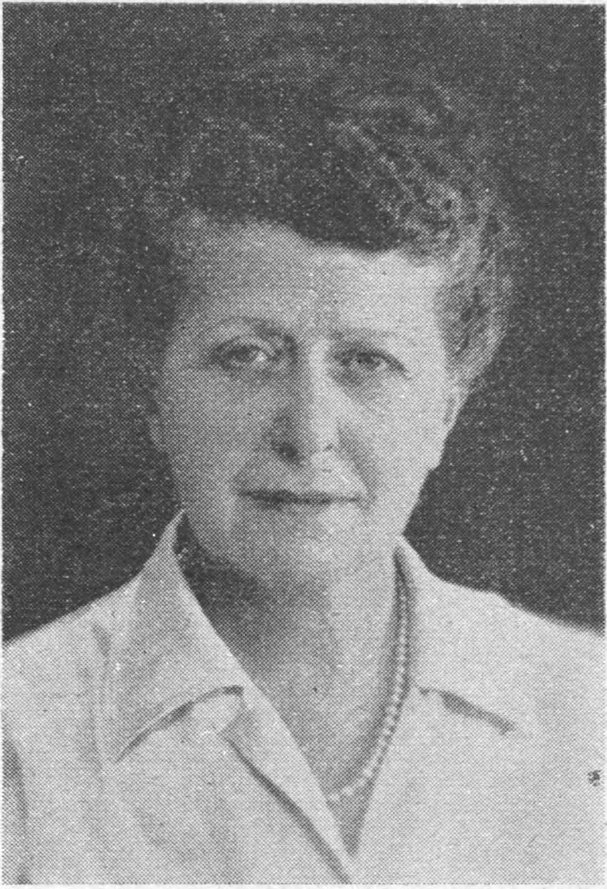
We welcome the pen of our friend Mrs. Aida Labaki, wife of Salah Labaki and only daughter of Salma Sayegh... We welcome her pen as it comes down into the field, and it is no wonder that Aida should excel, for she has gathered literary glory from both its ends... She wrote us this piece on the occasion of the third anniversary of her mother's death, God rest her soul:
Events interact, and the days and years pass, to give us an appointment with life, or an appointment with death, or appointments of memory. This past September twenty-seventh fell the third anniversary of the death of my mother — comrade in work with a great number of this magazine's readers, comrade in struggle in the literary, social, and national field. Salma Sayegh, my mother and my dearest companion, bearer of that gentle name, owner of that sweet face, and of that womanhood bursting with motherhood and feeling — her memory will not leave us so long as there are mothers on the face of the earth, and death will not take her from us so long as there remains among mankind a single soul that strives for the good and is faithful to a creed and a faith, and thus faithful to all humanity, with all its destitute, its homeless, and its deprived.
If I speak to you of her today, on this anniversary, I shall not have stepped outside the scope of speaking of woman in society; rather I feel, in doing so, that I am strengthening the structure with a solid course of masonry, if not with the cornerstone. And I am certain that in the hour my mother left me and closed her eyes for the last time and faced the great Judge to render her account, she earned the honor of sitting among the righteous who are near to Him.
It is a mistake to think that the Lebanese woman has not worked on the social plane. Our women were occupied with Lebanon's future and its independence in the days when the colonizer was strangling liberties, hunting down those who demanded sovereignty and freedom, and resisting every movement that rose to build this homeland and waken people's eyes to national consciousness. And chance willed that the feeling of two women of letters should answer one another — the first a Lebanese in the Nile Valley, the second in Lebanon — each bending over Lebanon, over its future, its condition, and its misery. May Ziadeh despairs in her exile and questions, then writes her historic article: "Where Is My Homeland?" And Salma Sayegh answers her, reassuring and encouraging. Said May, princess of modern Arabic letters: "When the names of the homelands were proclaimed, I wrote the name of my homeland and set my lips upon it to kiss it. Then I pondered the problems that admit no solution, and my brow was worn, and I fell to thinking; I felt a crushing that abased me — why should I, and no other, be the one who has no homeland? In the morning I am wakened by the bugle of departing armies and by chants urging them on to sacrifice and valor, and I loathe the victors, and
for a moment I wish I could be one with them, to forget in their wealth my poverty and in their might my abasement... But the peoples whisper a whisper that strikes my ear: these say, You are not of us, for you are of another sect; and those say, You are not of us, for you are of another race. Why then should I, and no other, be the one who has no homeland? I was born in one country, and my father is from one country, and my mother from another, yet I live in still another, and the phantoms of my soul pass from country to country — to which of these countries do I belong, and which of these countries shall I defend? The dead pass on, leaving to their descendants material and moral inheritances and a national honor to uphold; but as for me, nothing remains of the traces of my dead but the weights hung upon my hands and my neck."
"Every nation speaks of its own merit and nobility — so which of the nations shall I admire? And every nation — it and no other — guards the sanctuary of liberty and defends justice, equality, and brotherhood — so on which of the nations shall I rely? And every religion — it and no other — holds the monopoly, for its followers, of honor and virtue in