the sleeping princess and wakes her, telling her that Prince Tamino, who is pining with love for her, will set her free. At once Pamina falls in love with the prince, her unknown rescuer.
Scene Three: A sacred grove containing three temples — of Reason, of Nature, and of Wisdom.
While Prince Tamino is searching for Princess Pamina, voices reach his ears rising from the temples of Reason and Nature, warning him of the consequence of this act of his. But no sooner does he approach the middle temple, the temple of Wisdom, than a priest in a white robe appears before him and tells him that he is now within the land of the good Sarastro. The Queen of the Night had told him that it was Sarastro who abducted her daughter, and that he was evil. In vain does the priest try to change the prince's opinion of Sarastro.
Tamino hears the sound of Papageno's pipe and knows he is near, and hurries to meet him, while Papageno comes running in from the other side of the stage with Pamina in his company, the dwarf Monostatos and his slaves at their heels. Before they can be seized, Papageno remembers the magic bells; he rings them, and the musical strains that pour from them send his pursuers dancing away from him.
Then comes Sarastro himself, the high priest of Isis and Osiris, surrounded by his entire retinue,
and he proclaims openly that he has kept Pamina captive in his palace because her mother, the Queen of the Night, was plotting a conspiracy to overthrow the priests and demolish the temple. But he warns Monostatos against mistreating Princess Pamina. Then he gives orders to prepare for the trial and the ceremonies that are to be held, and to dress Prince Tamino and Papageno in the special garments.
Act Two
Scene One: A sacred grove.
Sarastro and the priests are assembled, he in their midst, all in white raiment. Under a tree three priests question Sarastro concerning Tamino: his character, his power of self-command, his forbearance, his courage. Sarastro assures the company that Tamino is worthy, in every respect, of becoming a member of the sacred order, and then he intones the religious hymn "O Isis and Osiris!"
Scene Two: The court of the temple.
Amid thunder and lightning Tamino and Papageno await their first trial. Two of the priests put questions to them about their desires. All that Papageno wants is: sleep, food, drink, and a pleasant wife. They warn the two of the wiles of women, and counsel them to keep silent whatever may happen.
The real test begins when the two priests go out. The three
ladies of the Queen of the Night come in and try to tempt them into renouncing Sarastro's principles. Tamino pays no heed to what goes on around him, while Papageno all but gives way, were it not for the prince's moral support. The world thunders and flashes with lightning, the ladies vanish in terror, and the priests enter and announce that Tamino has passed the first test.
Scene Three: The garden of Sarastro's palace.
Princess Pamina lies in the shade of a great fern, at the mercy of the dwarf Monostatos, who creeps toward her with exceeding eagerness. Suddenly the thunder crashes and the Queen of the Night appears at the back of the stage. Monostatos draws a little aside to watch, and the Queen of the Night sings her "Vengeance" aria and gives her daughter a sword with which to slay her enemy Sarastro. As she finishes the aria she vanishes amid the crash of thunder.
At once Monostatos leaps forward and wrests the sword from the poor princess, who is trembling in every limb with fear, and threatens her with death if she does not return his love. But she is saved by Sarastro, who orders the accursed dwarf punished. And Sarastro declares to the princess that vengeance, in
his kingdom, has no existence.
Scene Four: A spacious hall. Prince Tamino and the bird-catcher Papageno are being tested anew, to learn their capacity
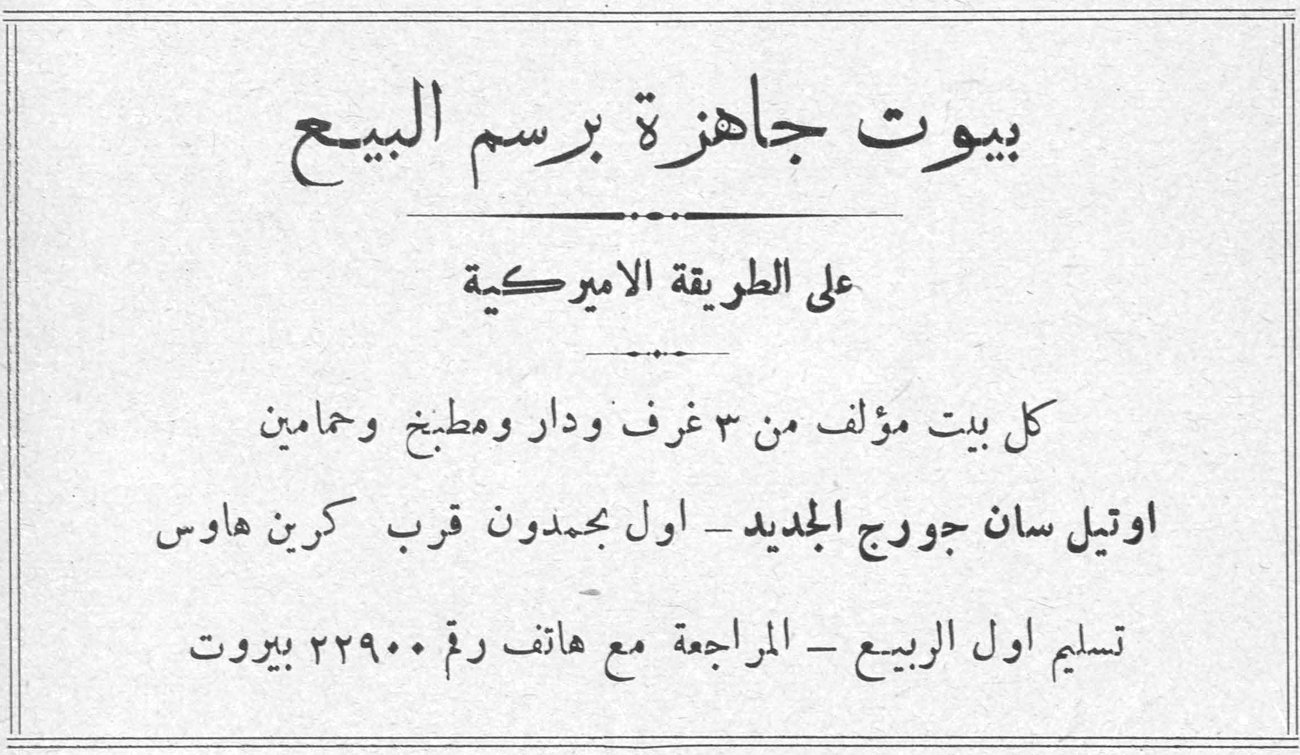
Ready-Made Houses for Sale
In the American style
Each house consists of 3 rooms, a hall, a kitchen, and two bathrooms
The New Hotel Saint-Georges — beginning of Mujammadun, near the Green House
Delivery at the beginning of spring — Inquiries by telephone No. 22900, Beirut