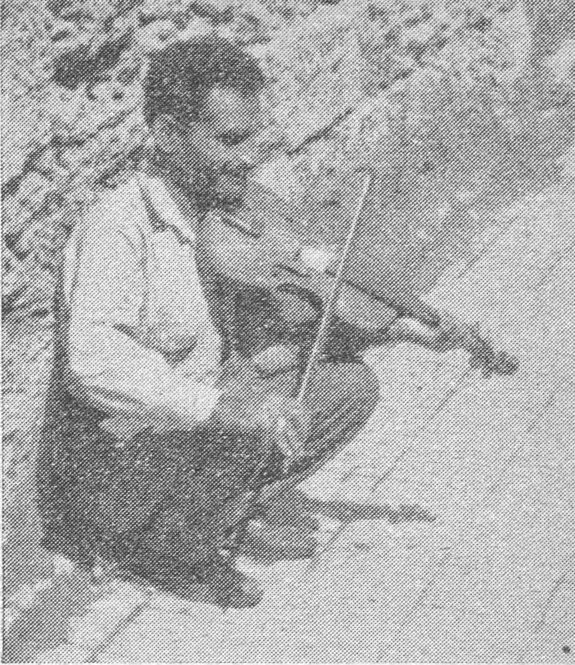
He plays and sings from the depths of his heart...
You know him, my reader, if you are one of the residents of Ras Beirut. You know him from your first glance at his figure. Yes! He is the blind musician, the violinist whom I have met — and whom you meet — dozens of times in the bends of the streets, sitting cross-legged on the ground, his back leaning against the wall, playing and singing from the depths of his heart; and you wish — if, like me, you are much occupied — that your time allowed you to stand beside him, listening and musing...
And it is the first time you feel, as you put something into his small open box, that this seller of melody is more generous than you, and that his giving is more liberal than your giving. Your conscience may prick you for having begrudged him the five francs... For he certainly... differs from all the practiced beggars you have met and meet... This one offers his wares with contentment and meekness, without holding out to you an abject palm... You can listen to his playing and his singing for a full hour and go on your way without paying him a
single piaster, fearing neither the sharpness of his tongue nor the pursuit of insolent glances... while those others wring the piaster out of you by force, and suggest to you nothing but the acting of false parts to stir your pity...
Years went by while I passed in haste, meeting him now and then, my soul tempting me to stop a few minutes and ask him his story. This man must surely have a singular story worth recording... Until yesterday, when Shaaban Muhammad Ibrahim stood before me, answering my questions now in Arabic, now in English... My guess proved right... This blind musician is no foster child of the street, as people imagine; he attended schools and kept company with people who had reached a high degree of culture...
Born in Latakia... his father a merchant. He fell in love with music while still a child, and had mastered good playing on the violin before he had passed his twelfth year. At school he learned English, and the recklessness of youth drove him — still a lad —
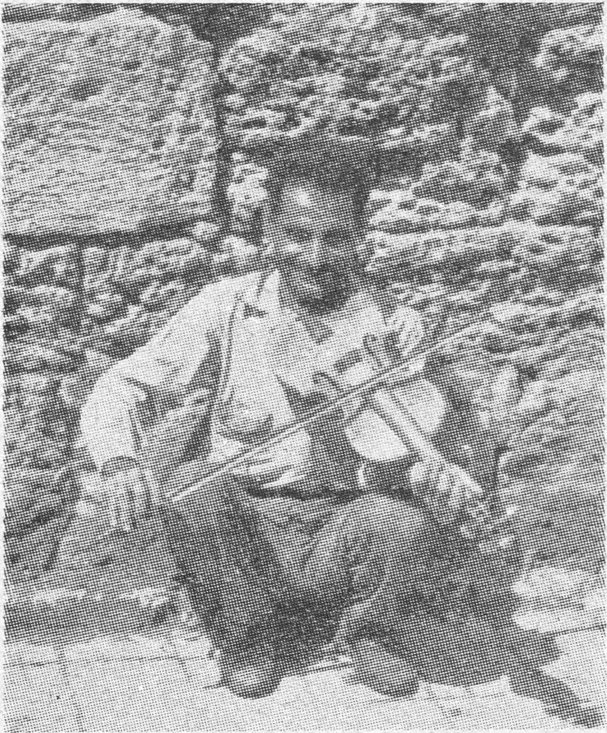
He gives you the impression that his heart is at peace
to volunteer, with a band of his comrades, in the British Army; in the army he reached the rank of officer, and he spent seven years in the service. In 1942 he was hurt in an automobile collision; the battery exploded in his face and left, in place of his eyes, two empty sockets...
Shaaban was then twenty-one years old, and the blind young man went out of the army... into the street... He affirms that he received no compensation for his services... nor for what had befallen him.
Here he gathered what remained to him of morale and went back to his musical gifts, polishing off what had rusted of them and tuning their strings... He offered his services to the Arab broadcasting stations, and worked for a short while at the Near East station in Haifa; perhaps his condition did not help him fit in with the ensemble... And a second time he went out to the street... with no helper but God! He accustomed himself — of necessity — to sitting cross-legged on the sidewalk — selling his melodies, at their own choosing, to those who appreciate his melodies, without opening his mouth in supplication or self-abasement...
He plays all the pieces and songs well... old and new. How quickly he learns the words of a new song, and how faithfully he carries it to your ear, so that no discord in the tune tears it... or scratches it...
Despite the darkness in whose depths Shaaban lives night and day, he is generally cheerful, suggesting