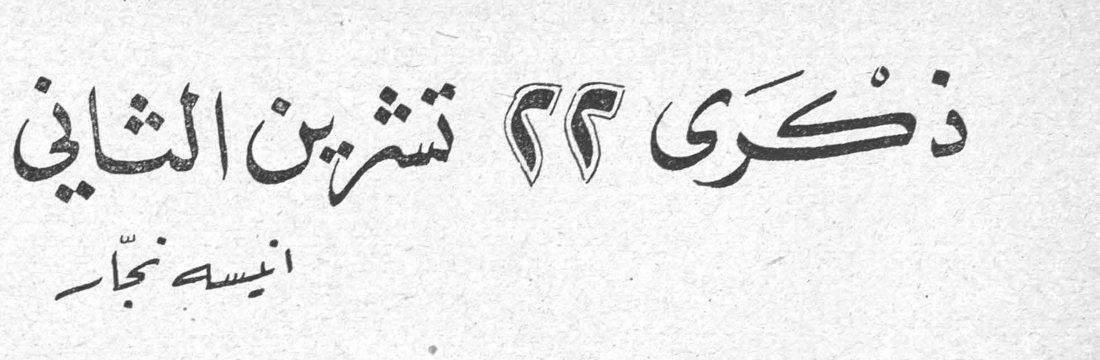
How many historic aggressions lie to November's account?! The Balfour Declaration, the stealing of the Lebanese government, and the assault on Egypt are among the events most firmly fixed in the imagination of every Arab.
I go back to the recent past to remember November — its merit, not its evil. Did it not allow the Lebanese woman to give proof of her existence, and of her being, in calamities, the man's peer? And of her understanding her national responsibility as well as she understands fashion? The events of November 1943 are a foundation stone on which we build today whatever building awaits us in the face of our present critical circumstances.
This afternoon Mrs. Najla Saab is visiting me. Is she not the best person to speak to my readers of her impressions and memories
of November 1943? She was at that time president of the Lebanese Women's Union; with all courage and soundness of judgment she gave voice to the murky hours of the November events, and she stood facing the rifle of the Senegalese soldier, telling him: “Shoot!”
Q — My dear Sitt Najla, would you tell me how the alarm was sounded on the eve of the November events, and what was the reaction of the Lebanese woman, who did not yet know independence face to face?
— There was no sounding of the alarm; rather, the Lebanese woman sensed, just as the man sensed, the treachery of the French and their contempt for our dignity in stealing our government. So the women gathered and deliberated, and the first meeting was at the residence of His Excellency our present President. From it the assembled women went out in a demonstration whose goal was the Great Mosque. But it turned aside from the mosque toward the legations. The British Legation was the first we visited. And it occurred to me to compose a telegram of protest to hand to the legations.
There, on General Spears's stairway, the companions settled on the view that I should speak in their name; so I went in with some of them and we presented the telegram, and I hinted to General Spears at the rumor accusing Britain of taking part in the aggression. He started up, agitated, saying: “It is a lie” — a lie, a lie, a lie. So we went out to reassure the crowd of women demonstrators, whom the news made all the more enthusiastic.
We sent the telegram in the name of the women of Lebanon, and this telegram of ours was the only protest that reached the ears of Britain and America.
The ladies marched in a peaceful demonstration that grew in size as it passed through the quarters. The educated Lebanese woman marched before the untaught, like a battalion of trained troops. No sooner had we reached the house of the President of the Republic than we set about organizing. There I was officially elected to lead the movement, and two secretaries were elected with me: Dr. Jamal Karam and Mrs. Eva Malik.
The strike covered the whole city, and the ladies had the upper hand in it, especially after the French announced that they would restore Sheikh Beshara to his post but would not restore the late Riad al-Solh and his government. It occurred to some of us to end the strike. But the police force which the ladies had organized two days before — and which, as I said, was untried in independence — prevented that, and carried the strike through until we had recovered our dignity in full measure and our sovereignty complete.
— What, then, is your opinion of the latent strength of the Lebanese woman, and do you believe she will have a part in Lebanon's future?
— I believe in the latent strength of the Lebanese woman, and I look to the future with the eye of hope — on condition that the Lebanese woman take this anniversary as her point of departure.
In the November events the leadership of principle and conviction prevailed over the love of show and boastfulness; conviction was the torch that lit our way, and the spirit of the ladies was a spirit of cooperation and solidarity for the sake of raising a lofty, solid structure.
And in the November events there is a great lesson lighting the roads of the future: mutual trust, the sweetness of personal sacrifice that the whole may live, the melting of self into what is greater than self, and the passing away of private interests in the sea of the public causes.
*