that the spread of the cooperative movement in the Arab countries is a necessity for attaining the benefits I have mentioned.
Q — Were the farmers satisfied with the apple season this year?
A — As regards the quality of the crop, yes; as regards prices, no. And in my view this situation will continue for a long time unless a strong body takes this precious harvest in hand and concerns itself with marketing it in the many markets that need it. Lebanon has expended a great effort in the field of production, and its harvest has come in abundant and sound. It remains for it to work energetically in the field of marketing, so as to rid itself of this situation to which it is exposed at the gathering of its crop every year.
Q — It is noticeable that the price of apples this year is lower than it was last year. Does this mean that their price in winter, too, will not reach what it was last winter?
A — Theoretically, yes. Practically, however, one cannot predict what prices will be during the winter season, because that is tied to the law of supply and demand. It is enough for the demand for Lebanese apples to strengthen — in execution of the trade agreements concluded between Lebanon and certain foreign countries — or for the Lebanese merchants to bestir themselves to find new markets for apples, for us to see apple prices leap to an unexpectedly high level; especially since Lebanese apples have not yet
reached their peak, a sudden rise in prices is therefore to be expected.
Q — Is it possible, Mr. Fouad, to give an idea of how much Lebanon has exported this year and how it was distributed?
A — If we take this year's crop, we find that most of it is still stored in the cold-storage depots in Lebanon, and only small quantities of it have been exported so far. This is natural where apples are concerned, because the export movement becomes active from now onward.
As for last year's crop, which reached approximately a million crates, close to 700,000 crates of it were exported, roughly half of them to Egypt; the remainder — that is, close to 350,000 crates — was exported to the rest of the Arab countries, which are, in order of the quantities exported to them: Iraq, Kuwait, Jordan, Saudi Arabia, and Syria.
Q — What is the proportion of the apples Lebanon consumes to those exported abroad?
A — In its present state of production, which slightly exceeds a million crates, Lebanon consumes roughly a third of what it produces. The consumption of apples in Lebanon is now confined to the well-to-do class and the wealthy middle class of its inhabitants; as for the middle and poor classes, they cannot now think of consuming apples, their means being too narrow in relation to apple prices in the natural season for their consumption — that is, in winter.
I believe that Lebanon could consume the greater part of its present production — the million crates, approximately — if apple prices were within the reach of all classes of its population.
Q — Do Lebanese apples have qualities that make them superior to the apples of other countries?
A — Without doubt Lebanese apples have qualities bestowed upon them by Lebanon's unique nature. The fertile soil, the clear climate, the bright, gentle sun, the air of moderate humidity, and the snows that clothe the mountains — all these have made the apple trees grow in the environment suited to them in every respect, so that their fruits have come forth fragrant in flavor, abundantly sweet, rich in vitamins, harmonious in composition, beautiful in shape, and splendid in color — which has opened respectable markets before them without any prior advertising.
Q — Is there fruitful cooperation between the Ministry of Agriculture and the agricultural organizations?
A — Cooperation stands at its fullest these days between the Ministry of Agriculture in Lebanon
and all
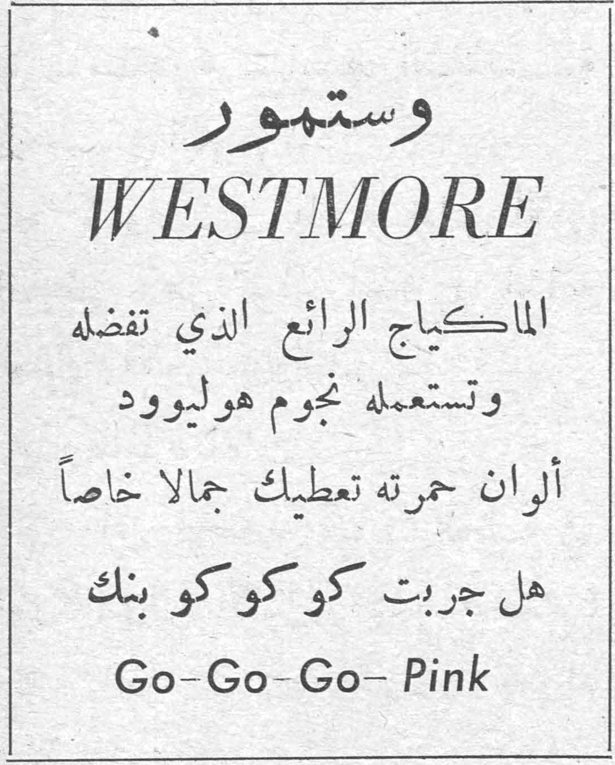
Westmore
WESTMORE
The marvelous makeup that the stars of Hollywood prefer and use
The shades of its rouge give you a beauty all your own
Have you tried Go-Go-Go Pink?
Go-Go-Go- Pink