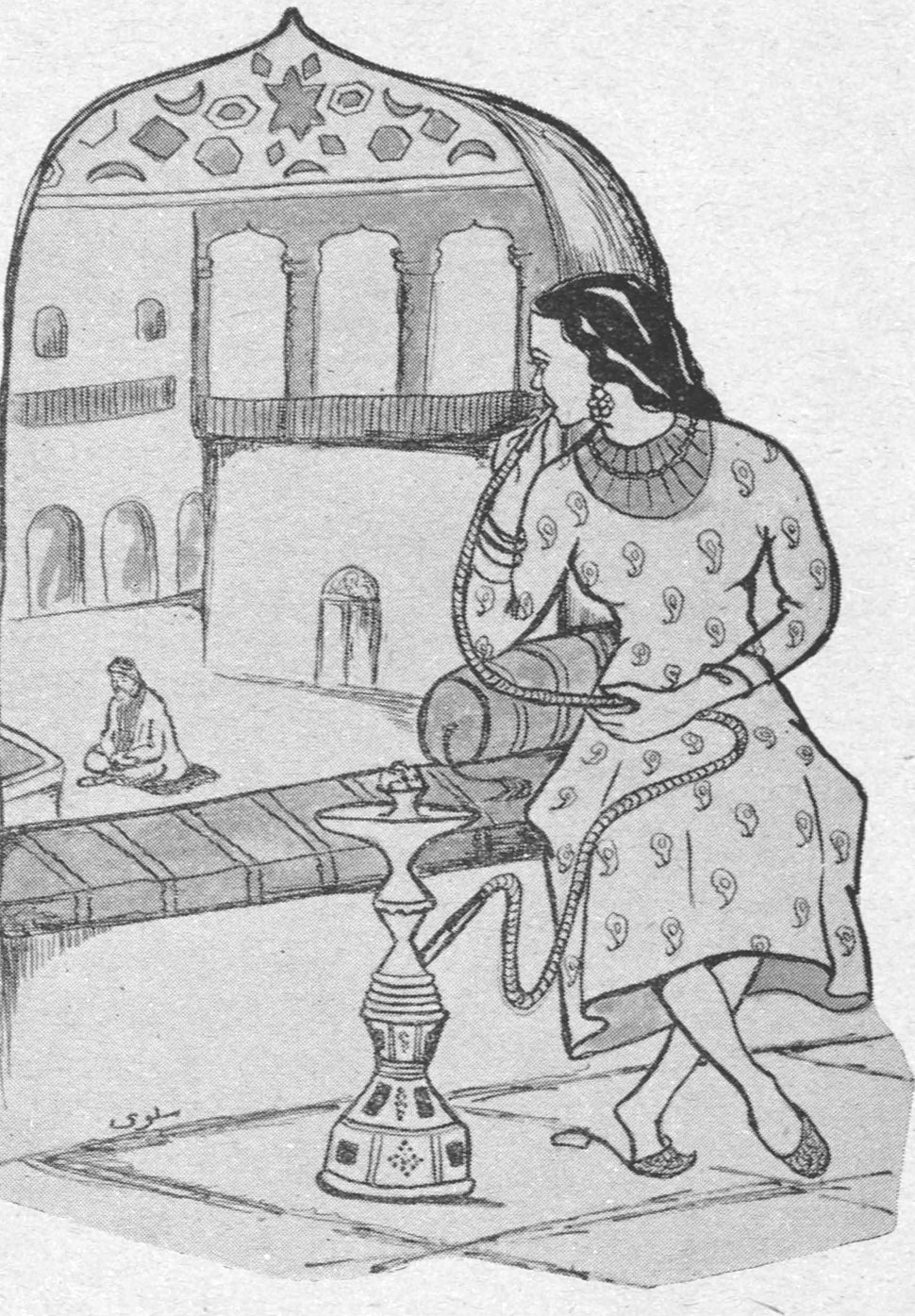
Ata said: There is no god but God, and Muhammad is the Messenger of God. He rose from where he sat, lifted the saddlebag and threw it over his shoulder, slipped on his red shoes, and motioned to the girl to walk ahead of him. The girl went strutting along while he stumbled after her across the courtyard, and followed her up the stairs to where Layla sat on the couch like one of the queens of Babylon. Ata stood at the threshold without moving his lips. She beckoned him to enter, so he greeted her, threw the saddlebag aside, and sat down near the door on a low stool.
Layla called to her servant girl: Bring a cup
of coffee. Then she turned to Ata and asked in a mellow voice: What is your name?
— Ata.
— And where do you come from?
He answered in a decided tone: From Harran al-Awamid.
— Tell me why you have been sitting all this long while in this sweltering weather, under the burning rays of the sun.
Shrugging his shoulders to show his unconcern, he said: Does anyone care about that?
Staring into his face, Layla asked him: And why not?
Fidgeting in his seat, Ata said: I beg you to leave me alone.
Layla gave him an
encouraging smile and said: Upon my life, this is strange. What is the matter with you?
Ata asked her: Must I pour out my troubles to all the people of Damascus? Must I tell you how far the treachery of your city's people goes?
Layla cried: Oh my! And what have the people of Damascus done to you? Then she added, smiling a bewitching smile: Don't forget that I am one of them.
Sadly, Ata said: I have suffered a great wrong at their hands.
— Tell me the whole story.
— Why?
— Perhaps I can help you.
Indifferently, Ata said: I am certain you will not succeed where the police have failed.
Layla smiled mockingly, and said, as the servant girl came in with the coffee: Tell me your story anyway. Ata sipped the coffee and handed the cup back to the girl, then thanked Layla and said:
— A short while ago I returned from the pilgrimage...
Layla interrupted him: Congratulations.
Ata went on: God bless you. But before I set
out for the Hijaz, I learned that in the quarter there was a man famous for his trustworthiness, to whom people go to deposit their precious valuables. I owned a hundred gold liras, so I carried them to him. When I returned yesterday and asked him to give me back my money, he refused to receive me, accused me of thievery and lying, and drove me from his house in the vilest fashion. And since there was no witness to my handing him the money, and I took no receipt from him for it, the police were unable to help me — and here I am now, lost in perplexity, not knowing what to do.
Layla drew a long
pull on the narghile, until the water in its ornamented glass bowl rumbled like the roar of a raging camel. At last her face brightened; she raised her hand, looked at Ata, and said: And where does this man live, and what is his name? Ata told her his name and his address. She said to him: In about two hours. Do you understand? In about two hours, go back to him and ask him for your money as though you were asking for it for the first time.
Doubtfully, Ata asked her: And what good will that do?