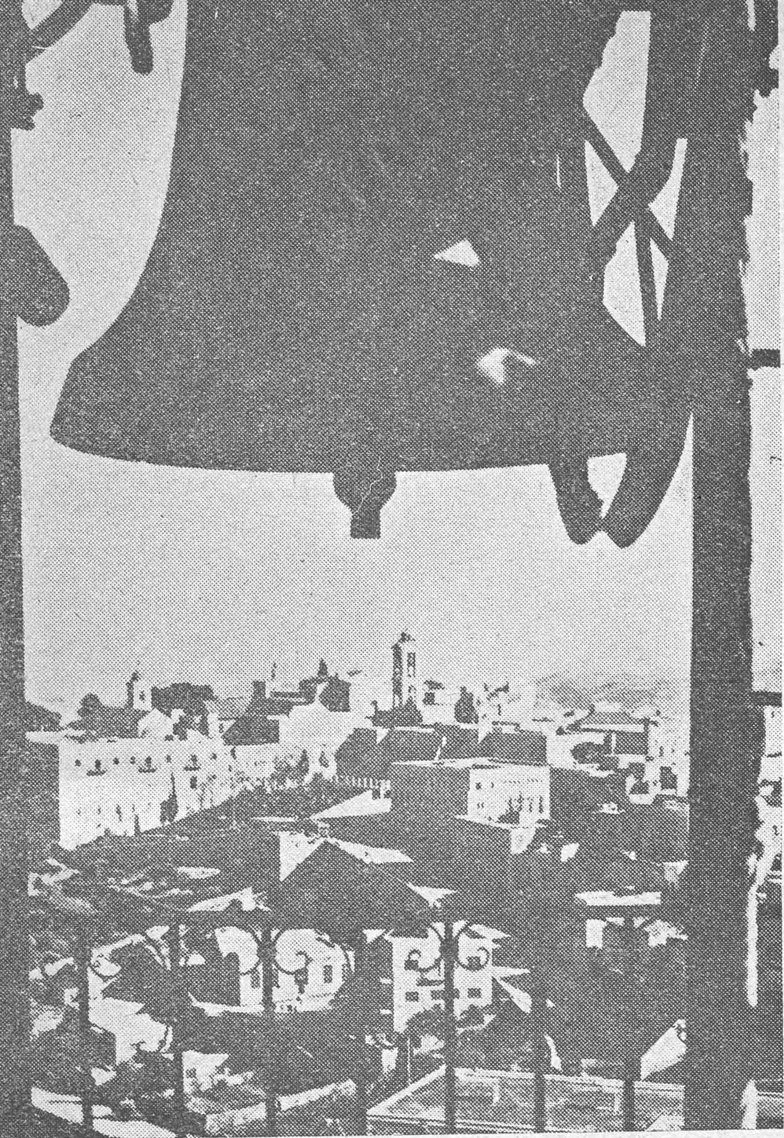
The town of Nazareth appears behind the bell
to seek the newborn. Such was
the will of God: for the glory and exaltation of His Son He chose these lowly witnesses.
To them we owe the grottoes of our traditional churches, for it was they who, in their artless way, described this wretched stable sunk into the rock, and they who saw the camel and the beasts breathe upon the child to warm him.
The Virgin's Gospel
The Gospels draw a curtain over the details... As for the popular accounts, the Church has not denied them, but has refrained from mentioning them. Yet the credit belongs to them — to those ancient texts which the people preserved — for without them the most beautiful face in the New Testament would have remained in shadow: the face of the Virgin Mary!
For the Gospels are extremely reticent, whether from modesty or from protectiveness, in what concerns the Mother of God. It is the popular accounts that acquaint us with the names of her parents, Anne and Joachim, and with the circumstances in which she came into the world: a miracle that caused the barren mother, in her latter days, to bear a little girl.
These same texts also teach us that Mary walked in her sixth month, and that in her second year she entered the Temple of Jerusalem alone, without any dread seizing her at the awesomeness of the place.
Nazareth was the stage of her childhood: a village crouched upon a hillside, looking out over a valley green with fertility, its furrows red of soil. One might well say that Nazareth has not changed to any degree worth mentioning since the Virgin's day. These narrow, rugged lanes, the dim shops, and the low houses like faded white cubes have been what they are for a long age.
Indeed, if you wander through Nazareth it is not in the least hard for you to picture the Virgin abiding in a humble dwelling sunk into the flank of the hill, dressed in white garments, preparing food and observing, in the making of it, the religious rites to the letter.
And when Mary reaches the age of marriage, the texts give us a sweet tale for the occasion — describing men from every corner of Palestine, young men and old, making their way up to Jerusalem — each one grasping a staff in his hand, all ignorant of the priests' purpose in summoning them to the Temple.
The Priests Await a Miracle
For the priests of the Temple had resolved to find a husband worthy of Mary, the pure maiden.
The candidates set down their staffs in the Temple, to receive them again on the morrow of that day. And how their hopes were dashed, for no miracle came to pass — save that one of them did not return to claim his staff. So the priests sent someone to trace him through the taverns, until they found him at the gates of Nazareth; he had wasted no great hope on being the favored one. And when the priests gave him his staff, and he made to take it, there fluttered up from between his fingers a dove of purest white...
The days of betrothal drew out long, as is the custom among the Hebrews, in the town of Nazareth, which in summer wakes from its daily slumber only at dusk, when the women and girls come down to draw water.
At the Well's Edge
One day some household tasks keep Mary from drawing water. She reaches the well late, when the smoke of the hearths has begun to rise into the twilight. The girl bends over the edge of the well, and behold, a dazzling light blinds her; she draws back
to see before her an angel with folded wings, who says:
Hail Mary, full of grace, the Lord is with thee. Blessed art thou among women, and blessed is the fruit of thy womb, Jesus Christ.
Wonder takes hold of the girl, and she cries out in the angel's face that this is empty talk, so long as she is still a virgin. Then the angel tells her that God has wrought a miracle for her sake, and that she will become a mother without sin defiling her...
Mary is close upon her delivery when the Roman authorities issue the order for the census of the Jews... So Joseph must needs go from Galilee to Bethlehem, his birthplace, in the land of Judah. The carpenter saddles his beast in readiness for the journey, and Mary expresses her wish to accompany him, fearing she might give birth in his absence. The man consents; Mary mounts the donkey, Joseph takes hold of its halter, and they set out.
Today, if you travel from the land of Galilee to the land of Judah, you are stunned by the vast difference