
Emir Fakhr al-Din al-Ma'ni the Second was great, in every sense the word greatness carries: great in his heart, his spirit, and his will; great in his boldness, his sagacity, and his cunning; great in his forbearance, his gentleness, and his justice — as he was great, too, in his firmness, his severity, and his crushing hand.
He was an eye that never slept in watching over his subjects, and a hand that took the side of the weak among them against the strong, and punished the aggressor whatever his station — even were he among those closest to him.
Among the proofs of this is our following story:
The Shidyaq Ra'd, son of the Shidyaq Khater al-Hasrouni, governed Jubbat Bsharri until the year 1613, when he died poisoned; and the Muqaddam Abu 'Ashina Shalhoub took his place. Between the death of the first and the accession of the second lies a link that makes up a tragedy — one of the most striking tragedies of Lebanese history.
And in this tragedy, look for the woman.
The woman of our tragedy was Sitt al-Banat, wife of the aforementioned Shidyaq Ra'd... History relates that this woman was of surpassing beauty, much given to frivolity and vanity. In vain did her husband try to restrain her from it, until she overstepped the bounds of dignity and violated the sanctity of honor, whereupon he saw fit to complain of her to her brother.
Sitt al-Banat was of the 'Anjalani family, and her brother was Jamal al-Din Yusuf al-'Anjalani; her family had ruled the Jubbah for a time, and was famed for a band
of its sons, among them the Muqaddam 'Ashina, son of Husam al-Din al-'Anjalani.
The complaint worked upon the brother, and he rebuked his sister with cruel harshness, warning her of the consequences of persisting in waywardness and of tarnishing her family's reputation.
The sister learned that her husband had informed against her; she could not endure her brother's rebuke and severity, so she harbored hatred against the two of them, and set about watching for the chance to plot their ruin.
The Muqaddam Shalhoub Abu 'Ashina, mentioned above, coveted the muqaddam-ship of the Jubbah, but he did not dare compete for it with the Shidyaq Ra'd, husband of Sitt al-Banat... He knew, on the other hand, that Jamal al-Din, Sitt al-Banat's brother, coveted it too... So he had to remove the two of them from his path, that the field might be clear for him and he might attain his desire.
Word came to him of what had passed between Sitt al-Banat and her husband, so he set about assiduously drawing near to her, until he occupied in her heart the place he desired, and gained such power over her as would bring her to do his bidding. And when he learned of the hatred she harbored for her brother and her husband, he found that the opportunity he sought had presented itself; so he began to inflame her breast against the two together, and to paint treachery against them in fair colors.
One evening, Jamal al-Din took supper with his brother-in-law, Sitt al-Banat waiting on them; after supper each retired to his bed — and their sleep that evening was everlasting, for the
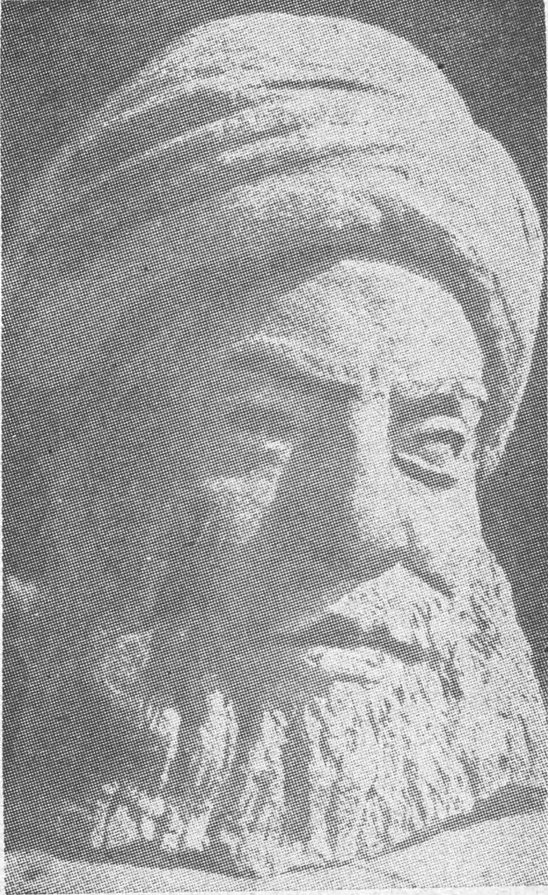
Fakhr al-Din al-Ma'ni
"Picture of a statue by the artist Youssef Howayek"
criminal wife and sister had slipped poison to them in a chicken she had prepared especially for that purpose.
Thus did that woman take her revenge on her husband and her brother.
And she opened the way of rule to her lover and her partner in crime.
Abu 'Ashina Shalhoub assumed the muqaddam-ship by order of Yusuf Pasha Sayfa, governor of the province of Tripoli... He sensed that Ra'd's brothers — they were three: Ni'meh, Daoud, and Jirjis — were working to recover the rule from him, so he denounced them to the Pasha — who was one of those whose rule rested on informers' tales — and he ordered them put to death by drowning and strangling.
The field was clear for Shalhoub.