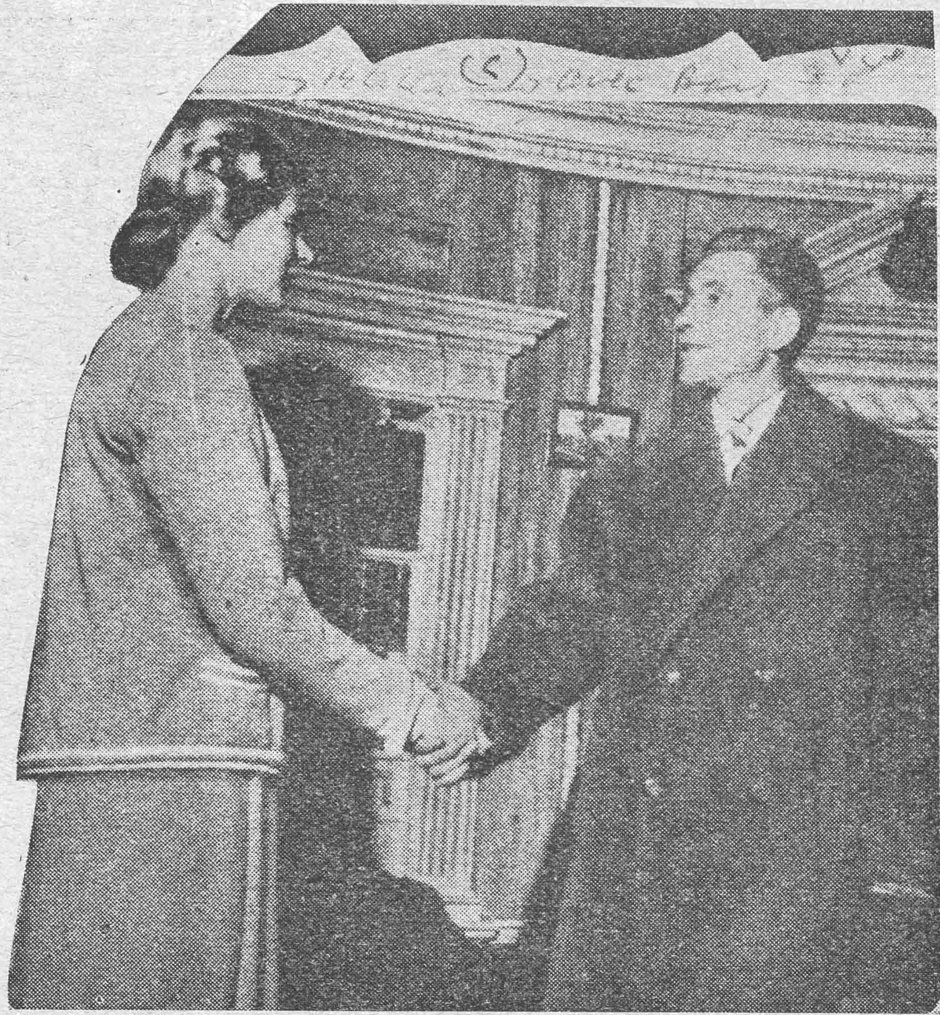


Tom's father (Bernard Lajarrige) asks the headmaster's wife, Laura, for explanations of his son's conduct
students comes upon them swimming by themselves in the sea, and imagines there is an unwholesome relation between them. The rumor flies among students and teachers; tongues repeat it and everyone believes it as if it were established fact. It reaches the dean's ear; he summons the teacher Harris and expels him from the college, and Tom becomes a target of contempt and derision. Tom tries to justify his position, but no one believes him; their argument is that his odd behavior proves beyond doubt the oddity of his nature. Tom asks in pain: And what is odd about my behavior? His friend Al answers him: Your love of classical music, your long hair, your unusual walk, your leaning toward solitude, and so on.
As for Tom's isolation from the rest of his comrades, it had other causes which Tom refuses to reveal: his infatuation with the young and beautiful Laura (Ingrid Bergman), the wife of one of his teachers. Laura senses his passion for her, and she knows with certainty that Tom's slender body and idealistic imagination conceal a manhood beyond reproach, and a great heart that scorns display and boasting. So she steps forward to defend him, and tries first to convince her husband of Tom's innocence and normality; but her husband forbids her to meddle in what does not concern her, and declares to her that the administration has decided to expel Tom, and there is no reversing it... Laura herself feels a passion for that solitary youth, and resolves to prove to the world, to Tom, and to herself that he is a man in every sense
of the word. She confesses her love to Tom, who falls into her arms in burning ardor, while from Laura's eyes shines the light of reassurance, love, and victory; and she lifts Tom out of the perilous pit of despair into which the cruelty of an unjust society had flung him.
From the foregoing it is clear that the writer wished to treat two important subjects in his play: the first ancient, rooted in human souls ever since society was first known — the tragedy of man's injustice to his fellow man, and his sacrifice of the individual who does not keep to the general level of the crowd in its notions and habits. The second concerns American education in particular: a criticism of that superficial education which sometimes prevails in certain modern American colleges.
"Tea and Sympathy" was performed on "Broadway" in New York in 1953, and in it the author's power of theatrical creation and literary invention shone forth. The play made its world tour before reaching Paris, where the Théâtre de Paris adopted it in French; and it met with dazzling success from its first night.
There is no doubt that the greater part of this success is owed to Ingrid Bergman's taking the leading role. This well-known actress has accustomed us to her greatness on the screen; but whoever sees her on the stage touches her singular genius, and understands that her artistic power goes beyond the scope of the cinema and its methods, and the veneer of glamour which the cinema habitually casts over its shining stars.
On the stage Ingrid appears beautiful, poised, and simple; a luminous smile adorns her face; her voice has an enchanting ring; she imposes herself by a
Ingrid Bergman and Yves Vincent — the stars of the play — receive congratulations from the author, Robert Anderson, at left, and from Roger-Ferdinand, who wrote the French dialogue