this window Gibran and I stood contemplating the display, without any intention of entering — especially as the books were dear! And while we were absorbed in gazing, behold,
the head of a dark girl peered out at us from behind the glass, welcoming us with a radiant smile and two black eyes that "spun flirtation" — (as Gibran put it) — and she opened the door for us, saying: — Come in, gentlemen; inside there are many books and magazines, and you may look at them closely and read, without being obliged to buy... and we also give reductions of ten percent...
We went in, of course! And with the dark one there was a girl younger than she, tending to fairness, with a captivating air and hair falling loose upon her shoulders in an artless feminine grace... The fair one came toward us inquisitively and asked in a childlike tone: — "Are you Spaniards or Italians?" — Gibran answered in the same tone, pointing with his hand into the distance: — "We are from over there... from Lebanon. Near Jerusalem... and near Heaven!"
The two girls cried out together on hearing Gibran's answer, and the face of the younger lit up as she said: "Ah, Jerusalem! We are Jewesses from Romania... our grandfather is in Jerusalem; he emigrated there years ago, so as to be buried, after his death, in the Holy Land, and to ascend with ease into the bosom of Abraham!" And in her laugh there rang an open mockery that endeared her to me. So I said to her, joining in her laughter: — After a long life... longer than Methuselah's!
Acquaintance was made... The elder, Suzanne, over twenty-five — of our own age — and the younger, Léa, about fifteen... When Suzanne learned that we were interested in the art of painting, she asked us: — What kind?
— We still lean toward the classical kind... She said at once:
What might this picture represent?
— There is no longer any demand for it.
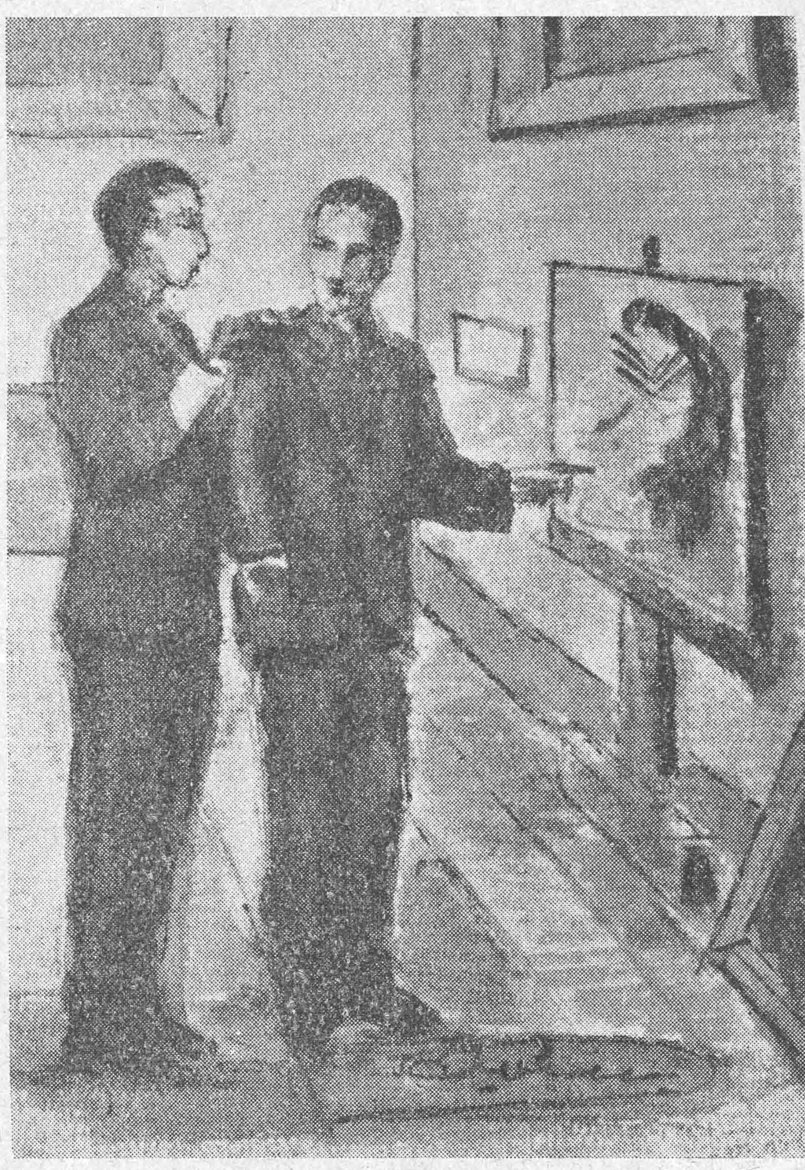
And she set about pointing to paintings here and there, some of them "Cubist" and others whose name I did not know — in which the body of woman appears twisted and deformed, as though seen in a concave or a convex mirror with intent to mock —
I pointed my finger at one that was much contorted, and asked Léa, in whom I had sensed a spirit of fun: — Is this your drawing, Mademoiselle? And are these the shapes of your body under your clothes?!
We all laughed except Gibran, whose face flushed with blood — the blood of anger — and he took up
the talk himself,
and in another vein, pointing with his stick at the drawings: — Have these mad artists forgotten their mothers and their sisters and their sweethearts? Or have they lost all feeling? And all measure? That they should so degrade the body of woman... the sacred, the divine?
He spoke in earnest, and Léa was dumbfounded, not knowing what to say... Suzanne interrupted him, trying to soften his wrath and explain to him the economic side of it: "This kind is in demand"... And Gibran went on with his sermon, as though unconvinced by this explanation, and as though Suzanne stood for all the people of art!:
— From the Stone Age to this day the artist has sung the body of woman — has sung beauty — beauty of whatever kind. Is this, then, the last song? Art is not for trade, Mademoiselle.
At this moment a tall young man of handsome appearance came in, whom Suzanne introduced as the owner of the bookshop, a kinsman of hers. The man held out his hand in greeting and introduced himself:
— Calmi.
— Gibran..
And little Léa completed it, imitating Gibran's gesture with her hand: "From over there... near Jerusalem." We wasted no time. We entered at once into talk of pictures and painting. And when it appeared to Calmi that we still leaned toward the classical kind, he repeated Suzanne's sentence: "There is no longer any demand for it!"
Gibran turned away from us to look over the books in silent contemplation, and Calmi drew me aside to ask whether it might be possible to see our artistic work... I told him that my place was five minutes away on foot, and that we had ample