While Mrs. Dorothy Thompson was in Dhahran I had occasion to meet her, and a short conversation passed between us, in which there was both inquiry and profit. I said to her: It has struck me that you are called Miss Thompson although you are married — does that not annoy your husband? She laughed and said: I was known by my name before I married, and when I married, my husband accepted me as I am. And she added, laughing: It once occurred to him to change his own name and become Mr. Thompson... that is my husband's favorite joke on the subject! Among my friends I am known as Mrs. Kopf, but outside America I am known only as Miss Thompson.
Then Miss Thompson said that her writings on the Middle East had caused her many difficulties, the chief — indeed the latest — of which was that three of the newspapers she writes for dispensed with her articles during this very journey.
She said: A day will come when I lose my work, and that does not trouble me in the least; I do what satisfies my conscience and the conscience of the world. As for journalism for women, and their work as compared with men's, she said that woman can succeed in it and surpass man if she is given the same conditions as he, and that nothing in the world can set bounds to woman's genius and activity; a just society judges a woman by her work, not by her sex. During the Second World War, for example, she was a press correspondent and representative of world news agencies in the middle of Germany, the field of battle. She shook her head and asked me: Do you think they chose me for that for nothing... or that, merely by being a woman, I had won their sympathy and admiration? No! I filled that post
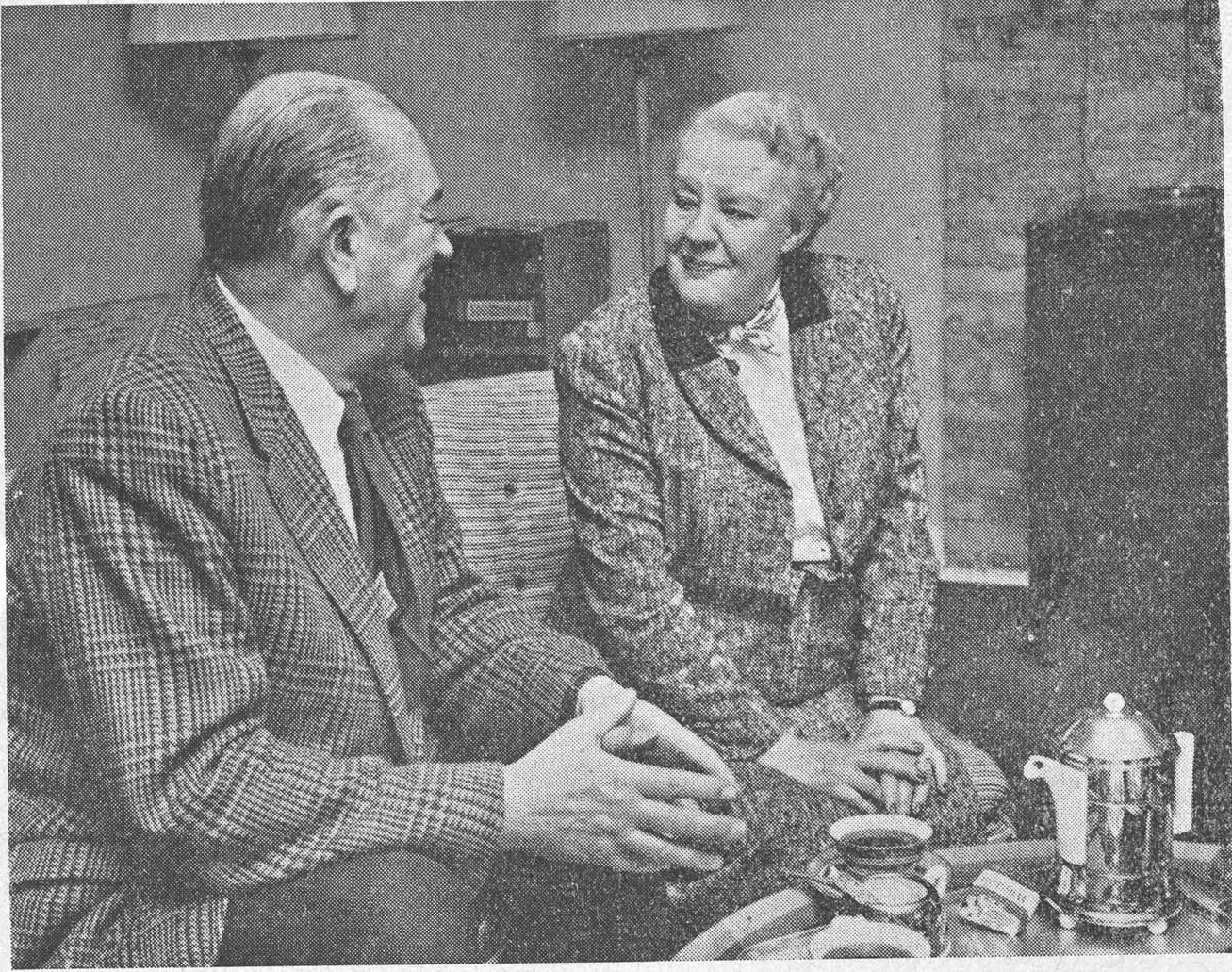
Dorothy Thompson with her husband in Dhahran
because of my journalistic ability — nothing else.
She was silent a little, then said: But society itself is hard on us women, and before everything comes the man. A husband, for example, will not accept his wife's being away from home at night or on his days of leave, even if she is doing a bold piece of journalistic work, the first of its kind. A woman can forgive her husband his absence from home most of the time, and sometimes for long days, if his work requires it of him; but a man will not accept his wife's working away from the house all the time — and this alone is the fundamental problem that besets the lives of married women journalists such as... and she mentioned to me the names of certain Western women journalists who separated from their husbands for nothing but the husband's opposition to his wife's work. Miss Thompson says she was twenty-five years old when she began her journalistic work, and that she is ready to give up her profession entirely if there is anything in it that vexes her husband or conflicts with her married happiness. But she thanks God that he understands her work, values her efforts, and always helps her in every side of her activity; for he is an artist who spends his time carving statues and painting pictures, and so he values human endeavor and works to foster it.
Miss Thompson has an only son, and one grandchild as well; and when she began to speak of her grandchild she forgot herself entirely — then recollected herself to say that her daughter-in-law is expecting another child, and that she will strive to finish her journey before the month of March, so that the birth may take place in her presence.
Miss Thompson told me that as a journalist she hates nothing more than censorship, and that the publication of one irregular piece of news without censorship is in her eyes far more important than everything written after the censor's review; for journalism under the censor has no value whatever. Newspapers exist to express frank opinions, to build up what is fit for building, and to tear down what deserves tearing down.