Among the obligations of tourism, especially the 'pretentious' kind, is the visiting of museums... those treasure-chests of the past, and its display windows...
Museums... the visitor enters them with curiosity and an embarrassed reserve, and it seems to him that everything in them cries out at time... at history... at the visitor... at memory: Halt! For in museums alone does the dutiful son of the past stand erect — young, esteemed, honored!...
And Peter Tchaikovsky is one of the young men of the past... one of those whom death did not snatch from the world of existence... for this death, though it felled the body, is the touchstone of life...
From afar, Tchaikovsky's music greets you, the visitor, perfuming the air of 'Klin,' that little village on the outskirts of Moscow where our artist took refuge and lived, far from the clamor... the empty clamor!...
The artist's house needs no describing; it is, of course, nothing like a furniture showroom — a nest of faithful beauty: in its rooms, spaciousness; in its windows, pictures of nature in motion.
And in the garden, dozens of strollers, their steps accompanied by melodies that cannot be called back... One of the people of 'Klin' told me that Peter's melodies have become of us and within us. And I remembered what Tchaikovsky used always to say: 'I must remain for my country a source of honor, and for my brothers a wellspring of hope.' All that good ardor he harnessed to the immortal, immortalizing melody.
The eye is bound to be arrested by the artist's familiar 'piano,' on which Tchaikovsky rehearsed and presented the embryonic tune and the new-born melody, to receive the first answer.
Tchaikovsky's desk stands near the 'piano,' and fastened upon it are some papers... their lines embroidered with notes set down by a stubborn, sharp pen. And what can you know of the secret of these symbols — perhaps a soaring flight in an opera, or a cadence in a symphony — and how abundant was Tchaikovsky's harvest in music... It is said that the closest of his compositions to his own self and his depths is the Sixth Symphony.
An artist's house — what always draws you in it is a taste ever renewed, or a character all its own; and you find this with Tchaikovsky in the cigarette dishes scattered everywhere, in which he would crush the stubs of his many cigarettes as he paced nervously, moving from room to room, gathering from his genius the scattered fragments of a new tune... You find
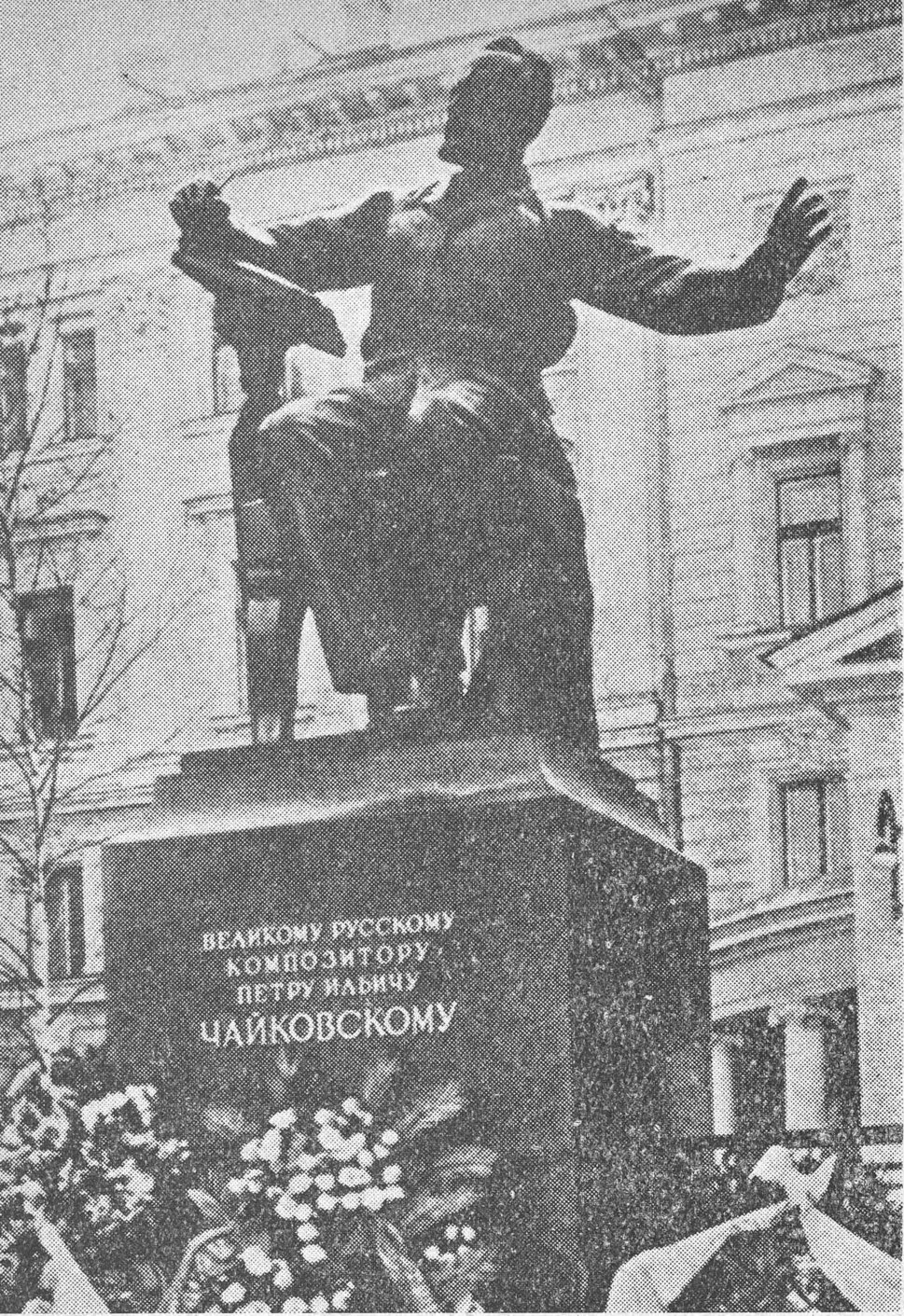
Statue of Tchaikovsky
the distinctive character too in the walls crowded with pictures large and small, faded and colored — pictures of nature, of family, of loved ones and friends, dearest among them the Rubinstein brothers, Anton and Nikolai, his trainer and his encourager.
The charming thing is that in this wondrous house there is also a moving picture, which acquaints you with most of what has escaped you... It is David, the son of the artist's sister, now in the seventh decade of his life. He spoke to me of his uncle — explaining, interpreting, commenting, in a cautious, deliberate French: his uncle Peter was a gentle, modest man who feared ostentation in all its forms and put his trust in order. He let his fixed daily program govern him and steer him.
As for his temperament... the temperament of geniuses... it was strange in its delicacy, violent in its nervousness, above all in the hours of creation and of writing down. And his elegance... my guide delighted me in speaking of it: it is the elegance of the artist... the elegance of one who has visited Paris — Paris, so skilled at slipping in her stamp. In Tchaikovsky's wardrobe is a collection of suits in colors both free and dignified, and in it too the daintily worked handkerchiefs and the silk shirts...