The film 'Gentlemen Prefer Blondes' raised a great stir in cinema circles. Here is its author, Anita Loos, telling us in her easy, flowing way how she began writing for the stars of the silent screen.
I feel alive only when I am working. I began work at the age of six, as a child actress — that, of course, was a long time ago! I thought then, and still think, that all work, whatever its kind, is a challenge to every barrier and difficulty that stands in a person's way, and I always feel triumph and pride at reaching excellence and success. I retired from work once, and it was the most miserable time of my life. I had gathered a large fortune from writing stories for the cinema, and I decided to rest and travel. I lived a life of ease and plenty between Paris, Palm Beach, and California; but this life soon turned monotonous and dull, because when one does not work, one sees all around one a crowd of idle do-nothings!... Fortunately the stock market crashed and I lost my fortune and was forced to go back to work — and I shall not stop as long as I live!!
I was happy and lucky in working with capable, gifted people. The first story I wrote for the cinema was played by the famous actress Mary Pickford together with Lionel Barrymore, under the direction of the celebrated director David Wark Griffith. I wrote all of Douglas Fairbanks's films in the first two years of my career, and I worked with 'Irving Thalberg' for eight years — he was, in truth, a great genius. The first thing I wrote for him was 'The Red-Headed Woman,' with 'Jean Harlow' in the leading female role; it was the first comedy she played in, and after it she became
a famous actress. Some time later I wrote the play 'Happy Birthday' for 'Helen Hayes,' and it was a great success; and recently I wrote the musical play 'Gentlemen Prefer Blondes,' which was the starting point of 'Carol Channing's' future on the screen. And with the play 'Gigi,' which I took from the French writer Colette, I introduced Audrey Hepburn. It is truly exciting
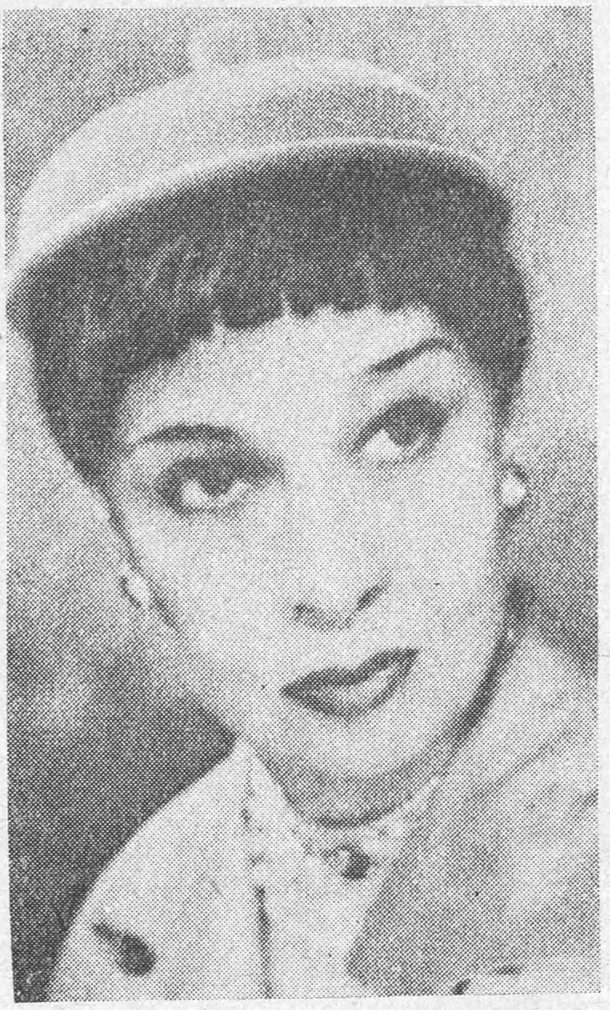
The contemporary novelist Anita Loos
to have a hand in bringing out rising players. Some time afterward I went to see Audrey in 'Ondine,' and she was superb; Alfred Lunt, who directs the play, said to me: 'This girl could play "Lady Macbeth" tomorrow if she wanted to' — and she was only twenty-three years old.
And now I had better go back to the beginning and tell you about myself. I was born into a family half of whom were theater people and the other half newspaper people. My father owned a newspaper and headed a small theatrical troupe in San Francisco, and when the famous New York companies came out here to perform, they brought with them — transport being difficult — only the important actors, and took the secondary players, grown-ups and children alike, from among us; and my share was always the part of the little actress. I began writing at the age of ten, for the 'New York Morning Telegraph,' which was the paper theater lovers turned to; I wrote two short, witty sentences and was paid ten cents a word, and after that I came to publish a column on the front page entitled 'Review of the Town,' and I went on that way for twenty years, writing about New York without ever seeing it. The first story of mine to be printed appeared in the magazine 'Woman's Home Companion,' when I was fourteen. But two years before that I had already written stories for the silent films, among them 'The New York Hat.' I was paid twenty-five dollars for it, Mary Pickford and Lionel Barrymore played in it, and it is shown to this day at the Museum of Modern Art in New York. I went on acting
until I was fourteen, and after that I gave all my time to writ