



Paris's connection with Chekhov's theater is of long standing, going back to 1919, when Georges and Ludmilla Pitoëff performed the play "Uncle Vanya" at the Vieux Colombier theater (Vieux Colombier). Since then Paris has returned from time to time to present some of his splendid
plays on its various stages — even the Comédie-Française itself. In the program of the current season are two plays by Chekhov: the first, "That Madman Platonov," at the Théâtre National Populaire (Théâtre National Populaire), and "Ivanov" at the theater of the Alliance Française.
The readers of The Woman's Voice must have a brief glimpse of Chekhov's life and the milieu in which he grew up before we can understand any one of his plays on its own. Chekhov was born in 1860 in the city of Taganrog (Tagonrog) on the coast of the Sea of Azov. He was a skilled physician and a bold dramatist, who portrayed in his plays the life of his troubled age and that violent, decisive period in Russia's social and political life. He mingled with the great men of letters, the likes of Dostoevsky, Tolstoy, and Gorky, and with the great stage director Stanislavski; and he created for himself a special method of dramatic composition and a personal Chekhovian art — indeed, he wrought a revolution in the style of Russian literature akin to the revolution of the Impressionists (Impressionistes) in the world of painting.
His writing is distinguished by simplicity and concision, for the speech uttered by the characters of his plays is very brief, merely hinting at what stirs within their souls; and the listener or spectator must deduce the content and feel it from the various expressions of the face, from the many intervals of silence, from those broken snatches of conversation, and from the total atmosphere created by the scene as a whole — through the actors' capacity for silent expression and through stage decoration in harmony with those states of soul whose deep, hidden depths Chekhov wishes to sound. Hence his affinity with poetic symbolism, even if he did at times mock it, and some of the extremist Symbolists of his age.
As for the music that rises
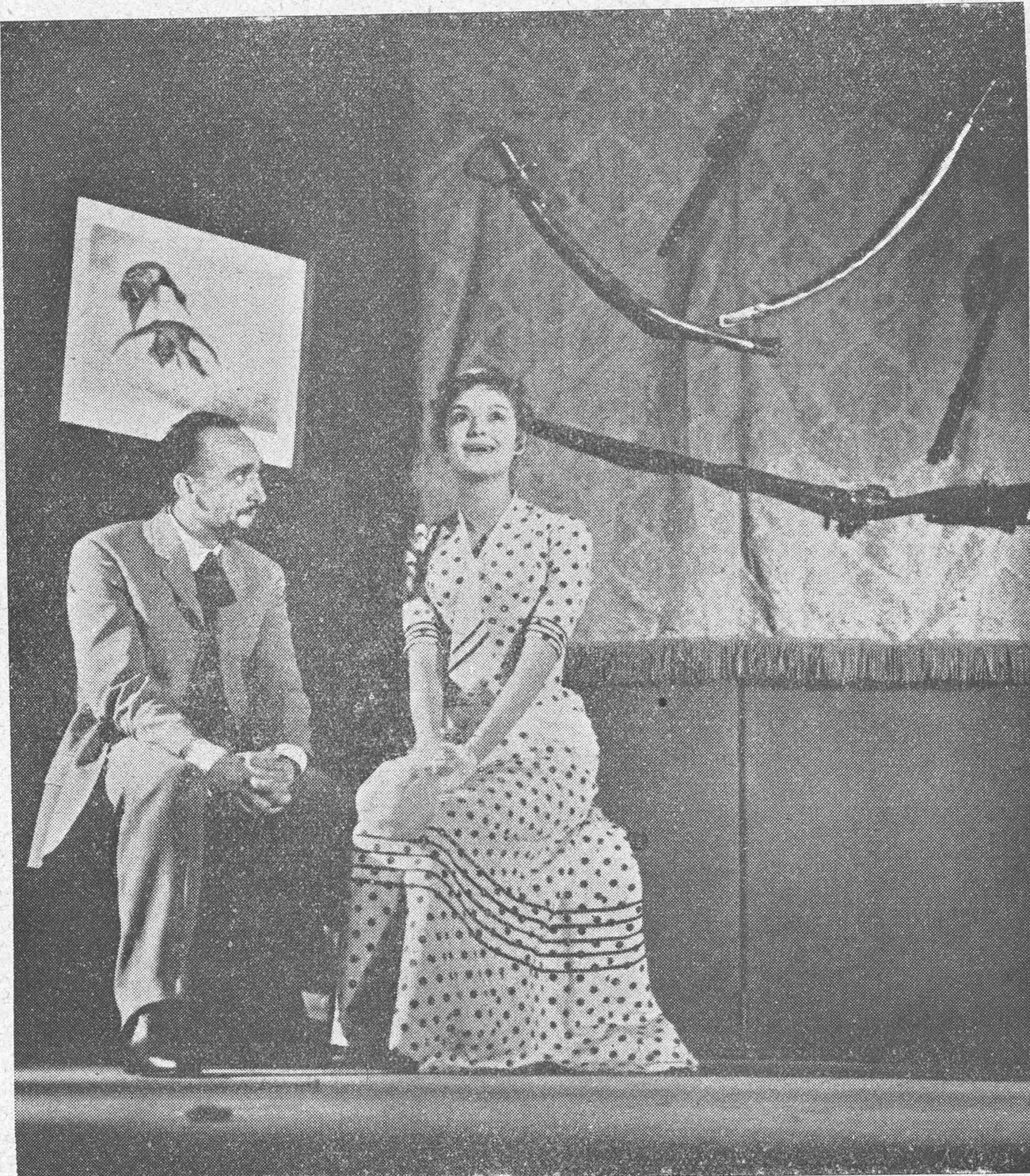
Young, hopeful Sashka soars on the wings of her ardent love. For a moment Ivanov (Jacques Mauclaire) imagines that he has grasped the meaning of the new life in her radiant, beautiful face.