from the folds of his words — how eloquently the Russian composer Rachmaninoff expressed it when he set Sonya's speech at the end of the play "Uncle Vanya" to music, saying: "I try to discover the music latent in Chekhov's writing, not to impose my own music upon it."
And when Chekhov cuts down speech and multiplies the moments of silence in his plays, he is portraying the Russian life of his age impressionistically, as does the brush of Gauguin (Gauguin) or Cézanne (Cézanne). His subjects are drawn from the very heart of the Russian life he knew so well — from the company of the leaders of thought to which he himself belonged, from the milieu of the actors whom he knew at close quarters, and from the community of physicians whose profession he knew and practiced. In nearly all his plays a single set of characters recurs: a dramatic author, a well-known actress, a young girl looking toward life with longing and hope, a country doctor working devotedly at his arduous profession, and a despairing person attempting suicide..
Yet these characters, however different their kinds and their milieux, all share one trait: they are Russians living in that anxious period at the end of the nineteenth century, as if standing at a crossroads, bidding farewell to a worn-out old life that must inevitably pass away, and groping their way to find a new goal, or a meaning for their lives, or a picture of the distant horizon. They are pained, rebellious, despairing, repressed; their emotions sometimes explode with the eruption of a destructive volcano. In a word, they are psychologically sick people who, had they lived in our
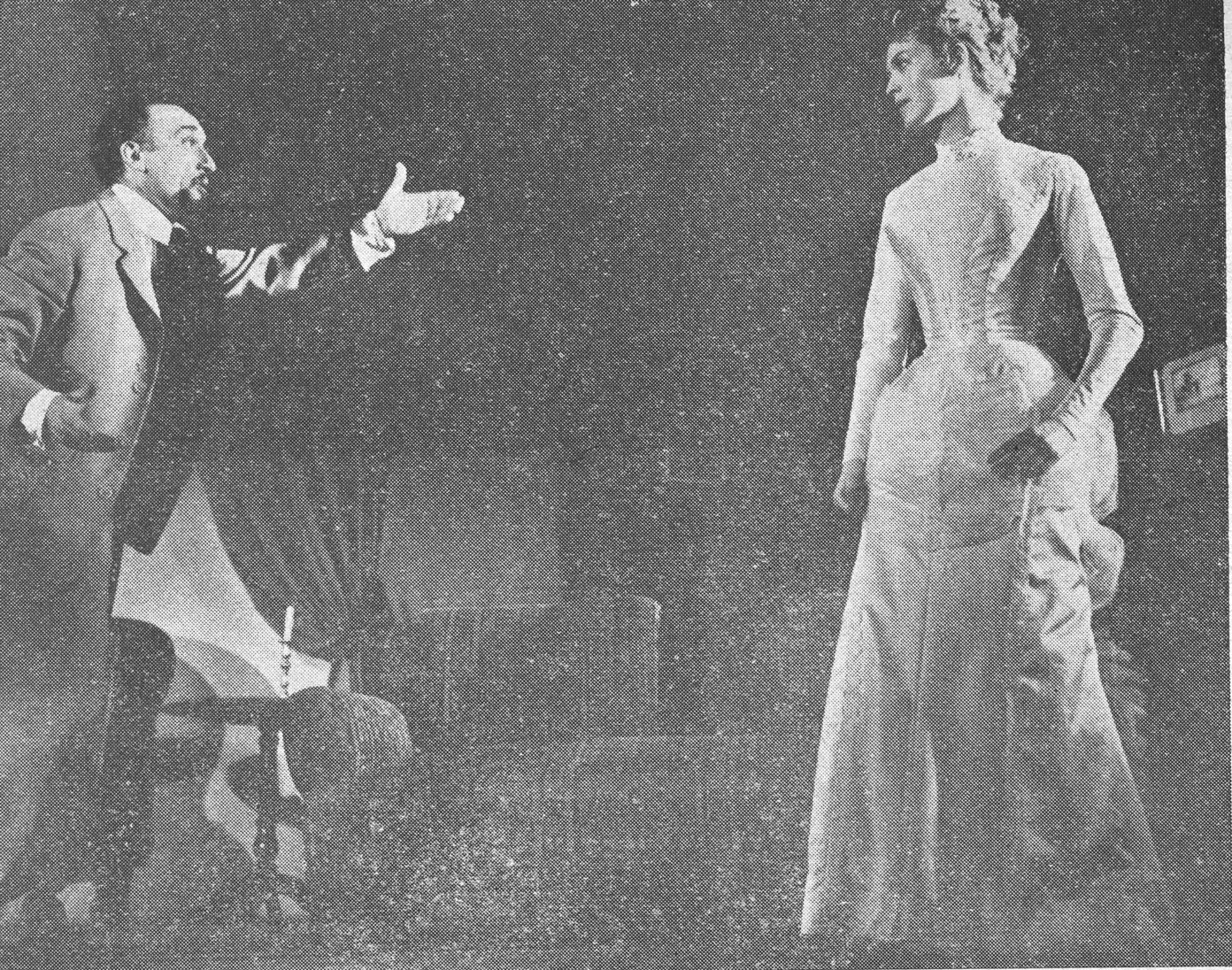
Ivanov tries to persuade Sashenka not to marry him — this a few minutes before his suicide, at the house of his friend Lebedev.
age, would have sought out a psychiatrist to treat their emotional disturbances and their ailments of the soul. Despair sometimes takes hold of them and drives them to complaint, to moaning, and to confession. Each of them knows that his life is on the wrong track, and each knows that he must rid himself of his present condition. But how to find the way?
The answer sometimes comes like a gleam of hope on the face of a young girl yearning for the new life, like the face of "Sashenka" in the play Ivanov, or on the tongue of a young student dreaming of a new upheaval, like the student "Trofimov" in "The Cherry Orchard" (La cerisaie) — states of soul shifting between crushing despair and radiant hope, which Chekhov draws with the graceful skill of the artists, and colors with biting irony and a droll wit that provokes the laughter that eases souls, together with the burning tears of pain.
From the foregoing it is clear that the actor in a Chekhov play faces an arduous task, for he must sound the depths of the psychology of his author and his characters, and must personally steep himself in the profound Russian atmosphere that the author wished to express. And so when the actor "Jacques Mauclair" undertakes to render the play Ivanov into French, to direct it, and to play the leading role in it, and wins, by the unanimous verdict of the critics, success in his task, he has inscribed a glorious page in the history of the Russian
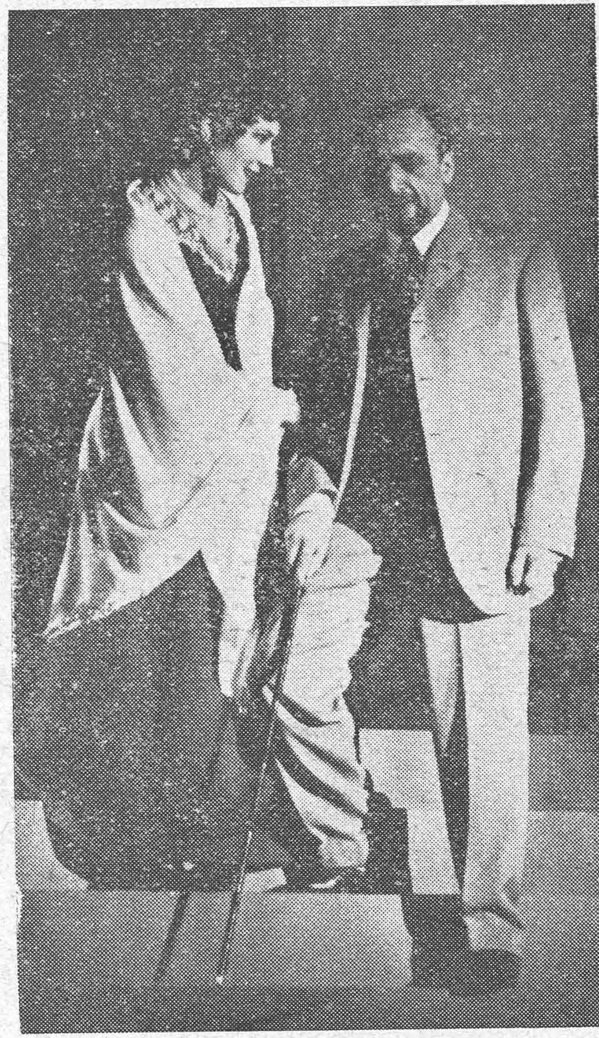
"Anna Petrovna" (Lolleh Bellon), with her sweet smile and the gentleness of her talk, tries to keep her restless husband home for the evening.