


– 3 –
A story by the American writer Faulkner, put into dramatic form and produced in French by the French writer Albert Camus.
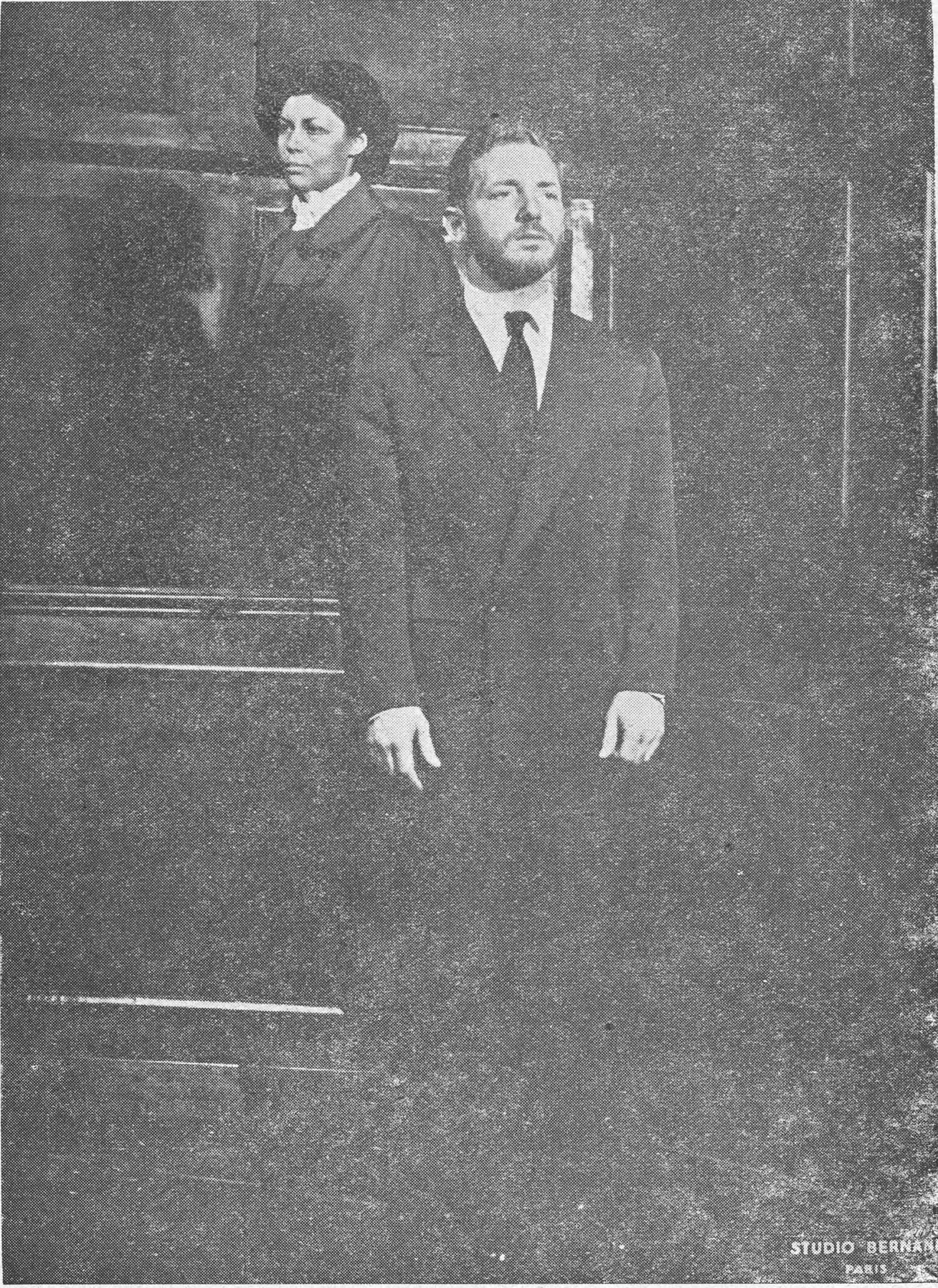
We are in the courtroom of one of the Southern cities of the United States of America. The judge's voice rises: "Let the accused stand!" The accused is a Negress of thirty who stands motionless, her face wearing a calm whose depths cannot be sounded... She stands on a high platform where she is seen raised aloft, alone, above the audience hidden from view, whose presence we imagine from the hesitant, stifled whispers... From her platform the accused looks out over the heads of those present — nay, far beyond them, as though she were floating in a private atmosphere cut off from those who have come to hear the trial of the white child's murderess... In the sallowness of her dark skin she seems safe from the clamorous current of hatred around her, as though innocent of the blood of the child whose breath she smothered with her own hand. For she is fortified with impregnable armor — nay, with a halo that stands as a barrier between her and the hands stretched toward her demanding justice, vengeance, and peace of mind.
The judge pronounces his sentence in a few clear words: "Death by hanging for the woman Nancy Manigoe, murderess of the child in her cradle, daughter of Mr. Gowan Stevens and Mrs. his wife..." Nancy's face does not change; her features reflect a quiet serenity and deep, faraway looks, and from her lips escape whispers that reach our souls with the solemnity of prayer and the light of its source: "Yes, my Lord. I thank you, my Lord." And the music of these words strikes a chord whose echo we hear from among the audience hidden from
The accused, Nancy Manigoe (Tatiana Moukhine), listens to the death sentence; before her stands her lawyer, Mr. Stevens (Marc Cassot), uncle of the murdered child.