other secondary strains that recur on the lips of the characters of the play and bind them together in the tangled, shattered web of life.
Faulkner declared his literary creed in a speech he delivered in Stockholm on receiving the Nobel Prize, on the twentieth of December 1950. He said: "Man is immortal because he has an immortal soul capable of compassion and sacrifice and the endurance of pain. The truths of the human heart are love and honor and pity and sacrifice. And the task of the writer or poet is to write of these old truths with the sweat of his brow and the agonies of his spirit, so as to lift up the heart of man."
As for the language he uses to express this modern classical tragedy, it is outwardly a simple language, expressing the modernity of its characters, yet at the same time grand and measured, lifting
them to the summit of classical tragedy. Albert Camus faced this problem when he rendered the play into French — and no wonder that he succeeded, being one of the distinguished writers of contemporary France and an admirer of Faulkner's world literature. He preserved the spirit of the English original in a pure French mold, and the play carried off the palm in the current theater season in Paris.
Catherine Sellers took the role of Temple, crystallizing this suffering soul in the immortal world of tragedy; as she poured forth like a raging volcano she reminded us of the confessions of Phèdre, Racine's heroine, and the grandeur of her struggle.
As for Nancy, the actress Tatiana Moukhine took charge of her, and excelled in expressing this puzzling, complicated woman — the believing criminal, limited and great. She
reminded us of Dostoevsky's characters and the clashing of the rich elements of their souls.
And we have a right to ask: is this American literature? Or is this American life? We have grown used to seeing in America a face other than this. It is the land of the practical, "pragmatic" bent, the land of optimism, the smile, and sexual laxity. Whence, then, this tragedy, and whence this violence? The answer is that Faulkner is the heir of the ancient literature of tragedy; he is a world classical writer before he is an American. And perhaps the American soul has a classical face we have not yet discovered — and here is the hand of genius drawing back the curtain from it...
Note:
The proper names in English are as follows:
Faulkner Nancy Manigoe Temple Drake
Maarouf Chaar & Co. Tours
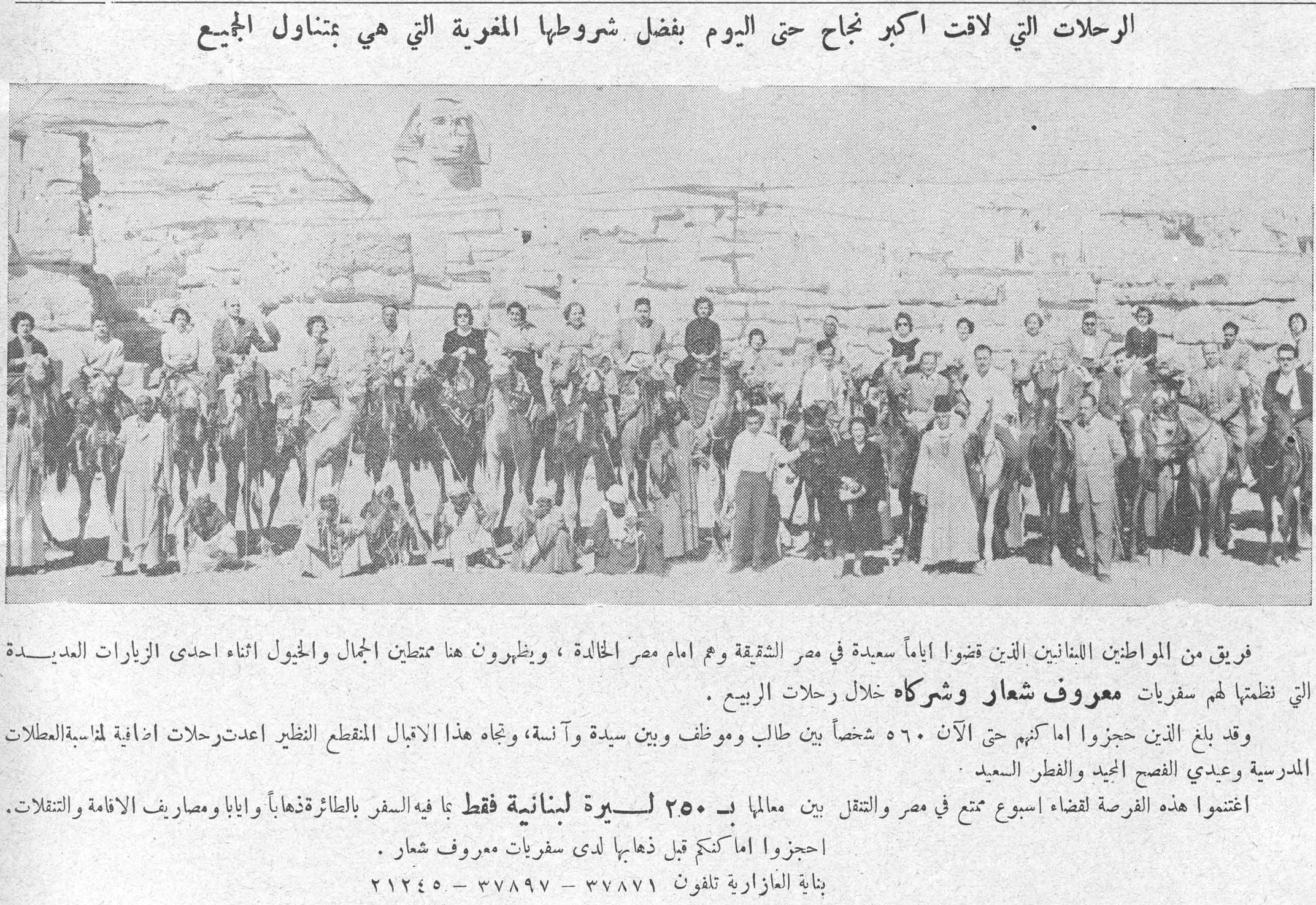
The tours that have met with the greatest success to date, thanks to their tempting terms, which are within everyone's reach.
A group of Lebanese citizens who spent happy days in sister Egypt, standing before immortal Egypt; they appear here mounted on camels and horses during one of the many visits organized for them by Maarouf Chaar & Co. Tours in the course of the spring excursions.
Those who have reserved their places so far number 560 persons — students and employees, ladies and young ladies — and in the face of this unparalleled demand, additional tours have been arranged for the occasion of the school holidays and the feasts of glorious Easter and the happy Fitr.
Seize this opportunity to spend a delightful week in Egypt, moving among its landmarks, for only 250 Lebanese lira, including the journey by airplane there and back and the costs of lodging and transport.
Reserve your places before they are gone, with Maarouf Chaar Tours.
Azarieh Building — Telephone 37871 – 37897 – 21245