it had taken shape as an art with its own principles, passed through stages that raised it to a high degree of perfection, in style and in instrument. Music first appeared in a form with its own principles, instruments, and ensembles among the ancient Egyptians, who used it in religious ceremonies. From the Egyptians it was taken up by the Greeks and the Hebrews. The Hebrews used it for chanting the Psalms of David, while the Greeks used it for every side of their life; and music among the Romans did not differ greatly from the music of the Greeks.
When Christianity spread through the world, its first followers were Jews and Romans, and so, in chanting their religious hymns, they drew upon what they had learned of the Greek melodies.
The Debt Music Owes to the Poets of Greece, France, and Germany:
The turning point in music came by way of the folk music and folk song, which expressed truthfully the hopes of the peoples, their sorrows, and their joys. The torch of this new movement was carried by the singing poets, and history tells us that Homer the Greek was the first poet of this kind: he would chant the verses describing the wars of Troy, extolling the courage of the Greek soldiers.
This movement took organized shape on a wide scale in the Middle Ages at the hands of the "troubadours" in France and the "Minnesingers" in Germany, who composed the verses they sang to the accompaniment of a musical instrument and wandered from place to place. This activity lay outside the fold of the Church, which had adopted the free choral chant, and which, by the effort of the Italian musicians, was able to carry it to its summit. As for the choral melody outside the Church, it took organized form in the Italian opera, which appeared at the beginning of the seventeenth century.
The Age of Bach Marked the Beginning of the Renaissance and
of Stability:
The development of instruments left its mark on composition. Among the first fruits of this renaissance were Handel and Bach. We may say that the age of Bach was an age of transition in which many things settled that had been unknown. With Bach's death dawned the Classical age, which took Austria as its capital and seat. Among the masters of this period were Mozart, Haydn, and Beethoven, who represents the connecting link with the Romantic age. The masters of that age, besides Beethoven, were Schubert, Mendelssohn, Schumann,
Chopin, Liszt, and Berlioz.
The revolutions and wars that took place in the nineteenth century had their effect not only on systems of government and the peoples' way of life, but on their thinking and their art as well. Music was affected by these revolutionary movements, as were the other arts, and their imprint is reflected in the music of Dvořák and Rimsky-Korsakov. Folk music, too, found great favor, and made its way into the compositions of many, such as Tchaikovsky and others.
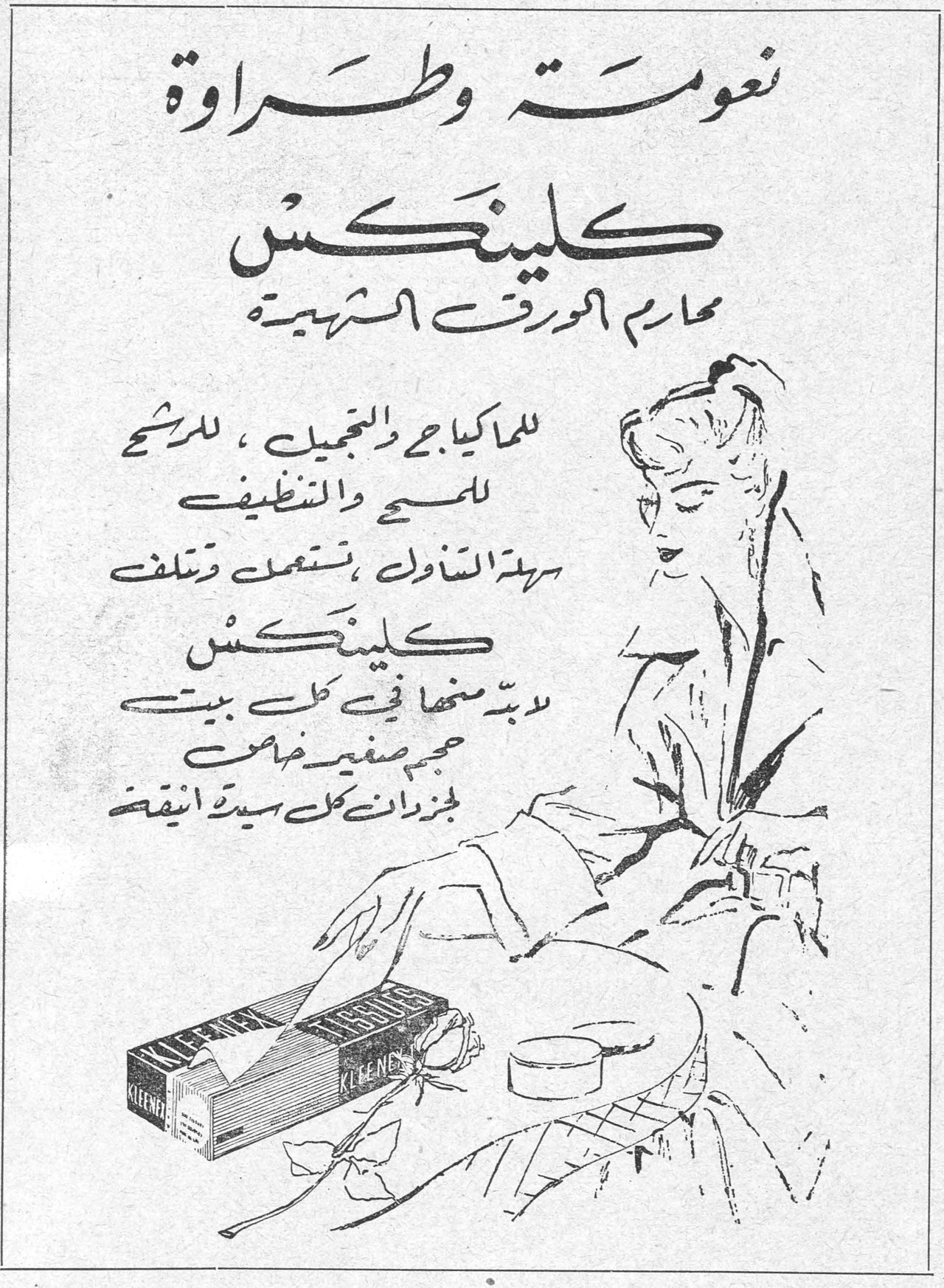
Kleenex
Softness and delicacy
Kleenex
the famous paper tissues
For make-up and beautifying, for colds, for wiping and cleaning
Easy to take up — use and throw away
Kleenex
Indispensable in every home
A special small size for the handbag of every elegant lady