We marvel at how far music developed among the nations, and how it flourished! I shall speak here of three of the ancient nations that used music in their worship, their literature, and their amusements:
Ancient Egypt — great in her pyramids, her Sphinx, and the history of her men — worshipped, thousands of years ago, Osiris, god of light, health, and the crops, and Isis, goddess of the arts. The Egyptians worshipped their gods to the beat of melodies, the pounding of drums, and the clash of cymbals; they sang praises to them with devotional music while the scent of perfume and burning incense filled the air of the temple, deepening the worshipper's awe and reverence. Music formed no small part of the ancient Egyptian's life, for he used it in official ceremonies, popular festivals, family evenings, weddings, and military parades.
Yet although the role music played in the Egyptian's life was very important, few of them took up its study,
and so the range of its progress remained narrow and limited. The practice of music was hereditary, like the other trades: the musician's son was a musician, and the singer's son a singer, even if his voice was so hoarse it would not serve for crying wares in the public market. Singing was confined to the company of the priests, because of their constant need of it in worship; as for playing the various instruments, that was left to the poor or to the slaves.
In the temples it was necessary to employ musical companies, for playing or for singing, of a size to match the vastness of the temples; and we do not exaggerate when we say that a single company would exceed six hundred players and singers, whereas today we boast of an orchestra of a hundred members! It is related of one of the rulers of Egypt that he held a celebration at which a chorus of a thousand sang, accompanied by three hundred players!
As for dancing, it was performed in the temples and in private gatherings, but it was used most of all in worship. The men performed the parts that demanded effort and vigor, while the women performed the light parts, those demanding softness, coquetry, and grace.
xxxx
The music of the ancient Jews did not go beyond what they took from the Egyptians on their departure from the land of Egypt for the Promised Land. Almost all we know of their music is what is said of it in the "Old Testament." They would chant the "Psalms" to the strains of the rebab and the harp which David — the chief of the singers, as the Torah describes him — appointed for this purpose. In the last psalm we find, in his words: "Praise Him (the Lord) with the sound of the trumpet; praise Him with rebab and lute; praise Him with timbrel and dance; praise Him with strings and pipe." Beyond this we know almost nothing.
xxxx
Music among the Greeks — A great deal has come down to us of the intellectual and scientific greatness of the Greeks, but only the merest trifle about their music. What little we have has come down scattered through the various branches of their scientific and intellectual heritage, and from a few rare musical pieces. It is well known that the refinement and progress which music attained among the Greeks did not match the level reached by the other arts, whether in painting, sculpture, and architecture or in the other literary arts.
But before we go further we must recall that music occupied an important place
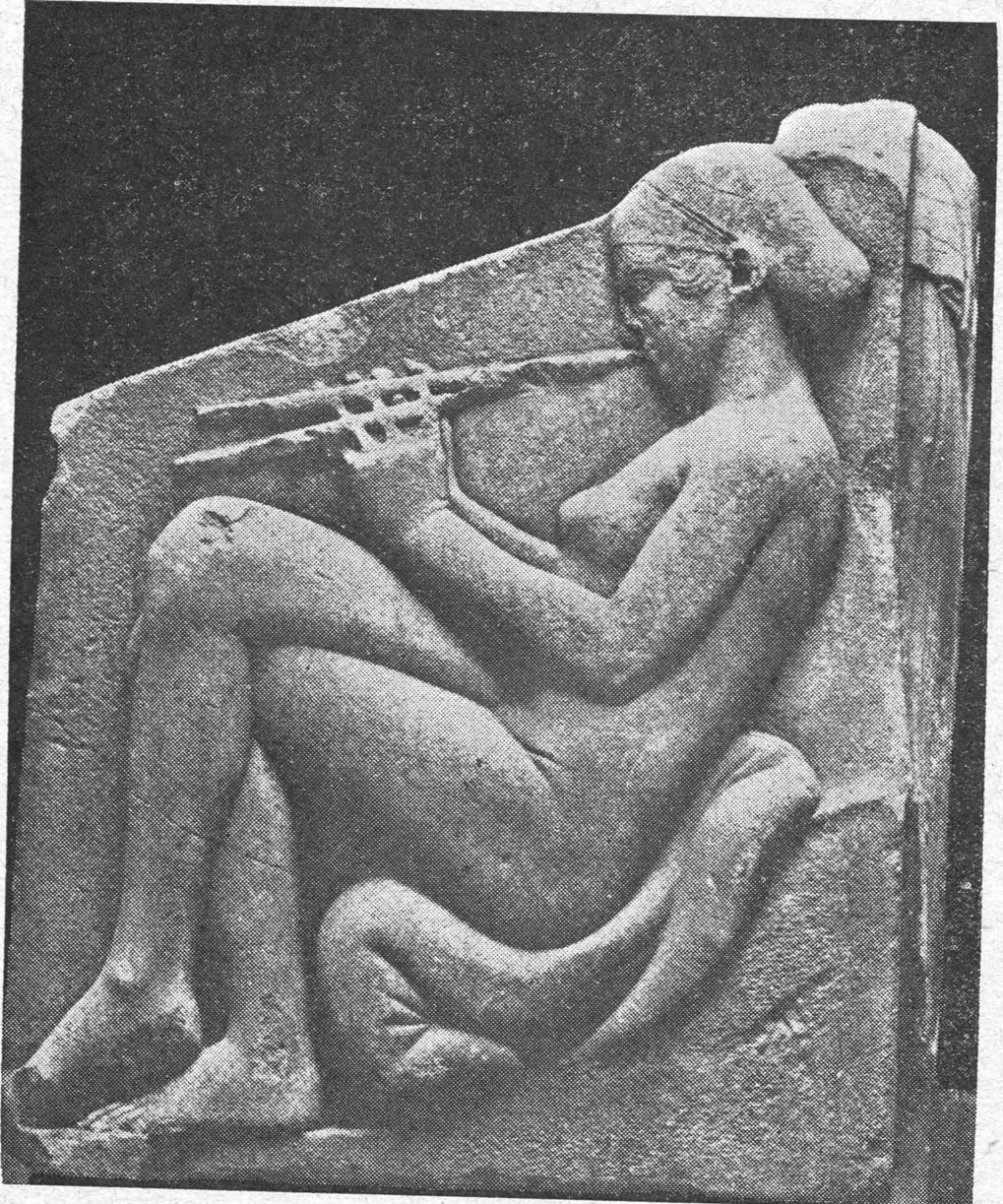
A Greek girl playing the double flute