among the ancient Greeks, who brought it into their drama, their dancing, and the recitation of their poetry; and that the word "music," when first used among the Greeks, denoted not only its present forms, such as singing and dancing, but embraced all the arts and sciences, mathematics among them. In the eyes of the Greeks, the ancients of Hellas, the harmony and beauty of the universe were themselves the result of music in its broad sense.
The Greeks were deeply concerned with
the effect of music on morals. Some music — in their view — stirs the feelings; some braces and strengthens the will; and some breeds softness in a man. For this reason the rulers of the city of "Sparta," the city of the "iron discipline" and Athens's rival for leadership, allowed their young men to listen only to the traditional military music that instills strength and courage in men's souls and makes them hardy defenders of the homeland.
Myths played an important part in the Greek's life, above all those concerning the gods, for they served him as the stories of the Bible serve the Christians; and some of the myths tell us something of music and the origin of some of its instruments. One of them is told of the god "Pan," god of the woods and fields, of the flocks of sheep and the pastures: it is told of him that he invented the shepherd's reed-pipe, and of this invention there is a charming story. It happened that the god "Pan" fell in love with one of the bewitching daughters of the forest, and she stole his heart away, so that he could no longer bear to be parted from her and followed her wherever she went. But she fled from him, terrified by his hideous appearance — for his legs were shaped like the legs of a goat, and his ears were long and pointed, though his body was the body of a man.
Once he saw her strolling on the bank of the river and followed her; she was seized with terror at the sight of him and cried out for help to the deities of the water, and the deities of the water changed her into a tall reed. When the god "Pan" reached the place where his beloved had been, he did not find her; in her place he saw only a hollow reed. He heaved a sharp sigh that shook the reed, and from it came a mournful air — the air of lovers denied. So he cut the reed and carried it with him wherever he went, playing upon it the most plaintive melodies for his beloved.
Among the Greeks there excelled in music "Pindar," called the king
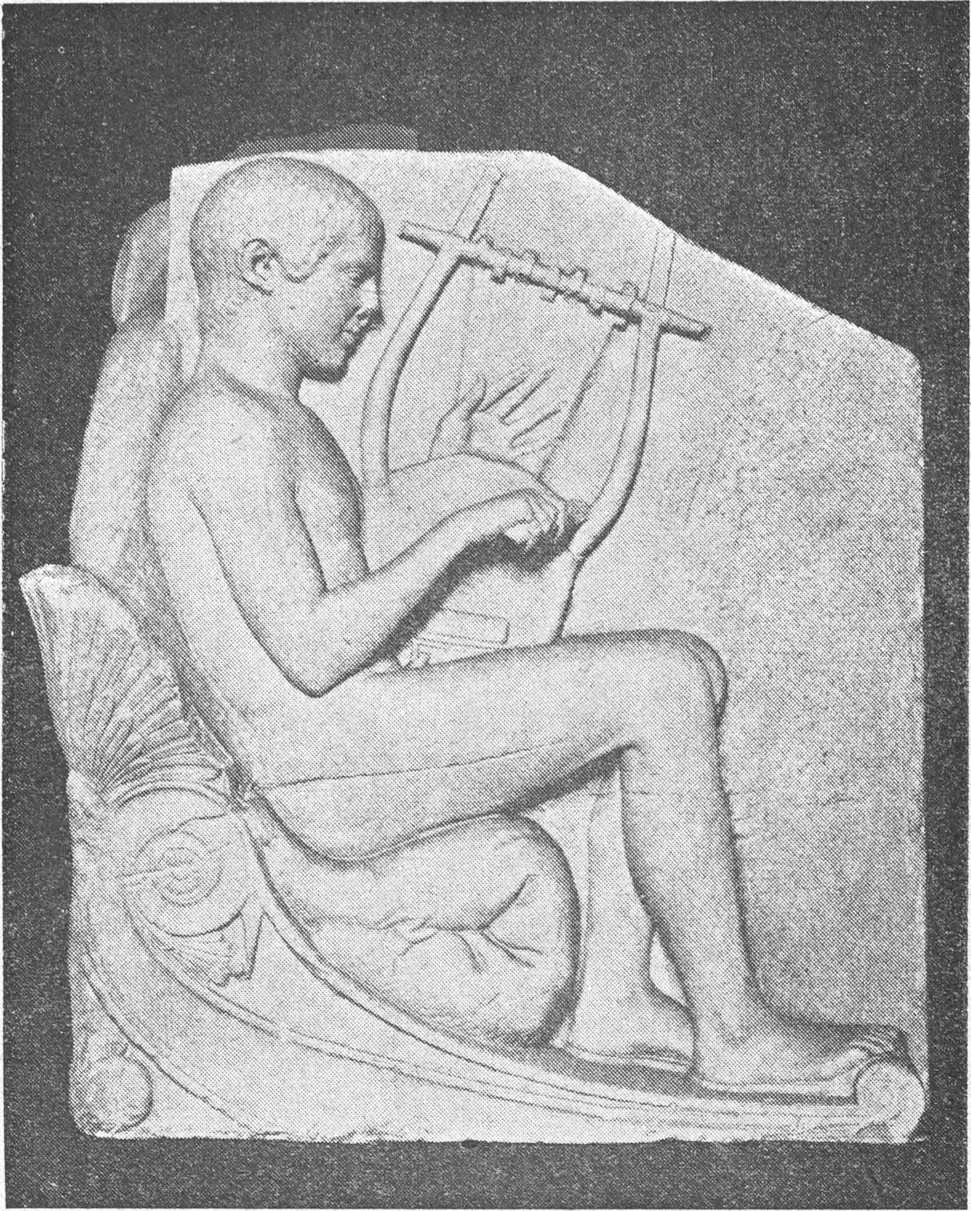
of melodies, in the fifth century before Christ; and among the most famous plays are those written by "Aeschylus" (Eschyle), which rival in their splendor the sonata and the symphony of our present age. Among the chief instruments they used were the "lyre," the "cithara," and the "aulos." It is established that the Greek inclined more strongly to instrumental than to vocal music, and that solo playing won his admiration and esteem, and stirred his feelings, more than any other kind of music.
The flowering of the Greek theatrical art brought with it a like flowering in music, for all the plays, tragedy and drama alike, were performed to the accompaniment of solo music, or of singing by a chorus set apart for this purpose, which was an effective factor in the production and success of the plays.
A Greek boy playing the cithara
— No one who lives on the face of the earth can do without dealing with people, cooperating with them, and profiting from their help; and there is no path for anyone to success and prosperity unless he knows how to win people's affection and how to avoid stirring enmity in their breasts — for that is the struggle in the battle of life.