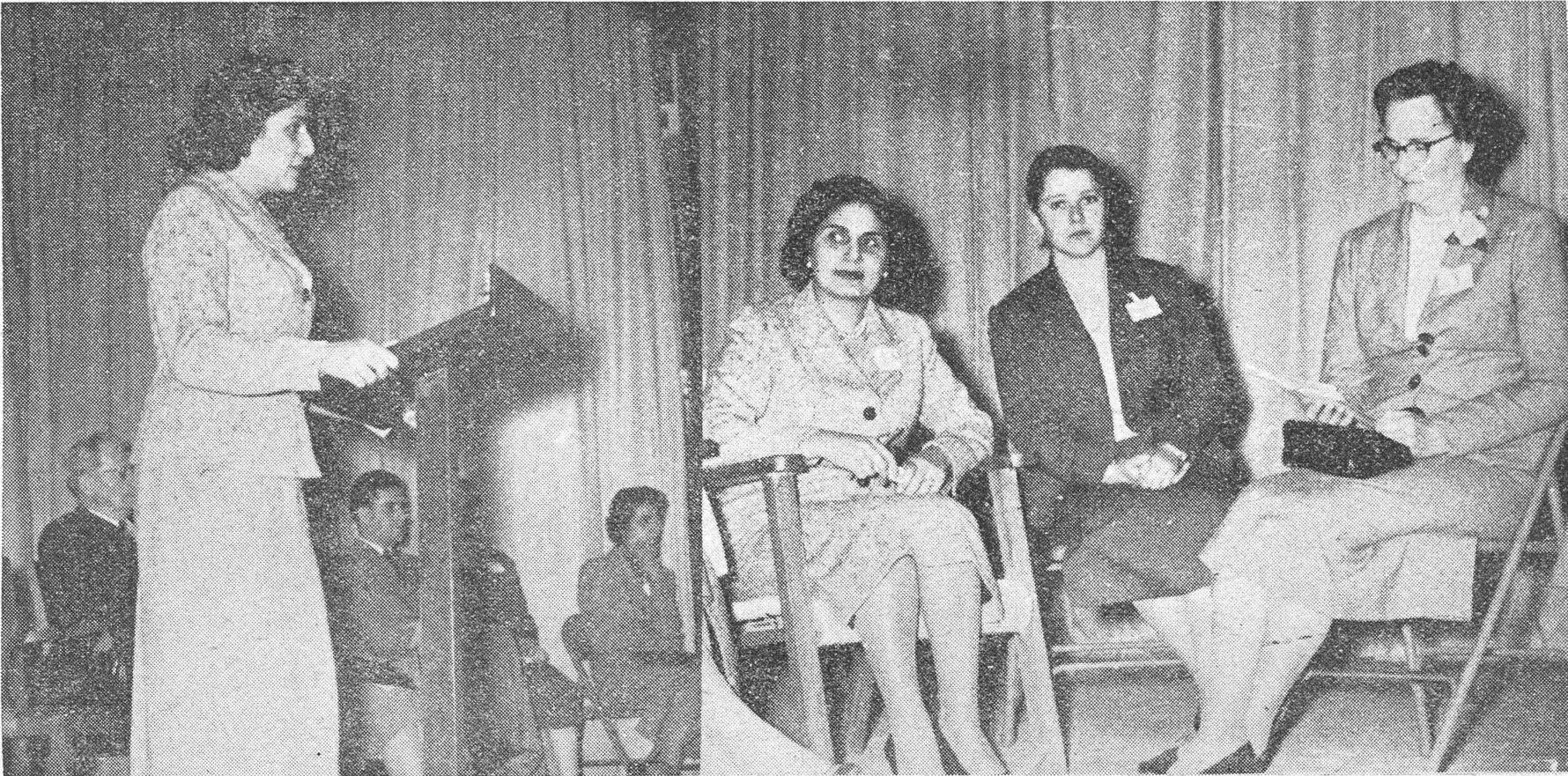
Members of the executive committee — Miss Irene Teagarden, then Mrs. Nahla Shuman, then Miss Ruth Hempkins (president of the Association), then Mrs. Anissa Najjar
Then have you forgotten, brother, the hours you spent and the great sums you laid out on the furnishing of the house — and when you had finished, you kept pursing your lips, not knowing why? Once you said, with a lump in your heart: Today I visited the house of a Swiss director and noticed that everything in his house was utterly simple, yet exquisite, comfortable, beautiful; the soul finds rest in it, and the visitor feels tranquility and calm. On our house I have spent a great deal, but... You did not finish; perplexity and dissatisfaction stayed on your face.
Had you seen the two scenes acted on the College's platform — the first on "the orderly house and the disorderly" in its furnishings, and their effect upon a person's spirit; the second on the problems of the village house and how to solve them by teaching one of the branches of home economics, given by the College's students together with the Rural Training Center at Jibrail — had you seen those two scenes, brother, you would have known the reason for your perplexity and your dissatisfaction in furnishing our house. For this calls for art, and art calls for study, training, and taste.
And your grumbling, your sighing, your many shouts in the faces of our father and mother, threatening that you would leave the house — and why? Because you know that all the members of our family bring in money, but with no keeping of accounts, neither of income nor of outlay; each spends as he pleases, and we are forever drowning in debt. Had you heard — or rather, had we all heard — Mrs. Hawkins that night on family economy and its importance, perhaps we would have understood the cause of our backwardness, and perhaps we would have thought of delivering ourselves from the debts heaped upon us. And why?
Because our house has no budget, and there is no understanding among the members of our family; we live "free," each as he pleases — when the truth is that we live in the bondage of chaos, and there is no bondage worse!
Before long, brother, you will be head of a household, and you will have a child; and how I wished you had seen the play whose dialogue turned on family ties and the raising of the child. I ask you: do you not know more about riding bicycles than you know about raising a child? And do you not know more about "rock and roll" than you know about the human bonds that join a man to his life's companion, so that the two may be partners in the true sense?
And on Saturday I wished from the depths of my heart that you had joined me in listening to those short addresses, all of them turning on home economics, from specialists who have served, and still serve, this field. In an engaging style Miss Suad Wakim spoke on home economics and its relation to education. She was followed by Miss Zahiyah Dughan on the art of teaching home economics in the Middle East; then Miss Irene Teagarden on the teaching of home economics in Lebanon and how far its teaching has advanced in the secondary schools and the colleges; and finally Dr. Perouhi Najarian on scientific research in home economics.
At this conference we also heard men like yourself speak. Dr. Olter spoke on man's role in the field of home economics — and this man, brother, took part in planning the conference as well. And Dr. Habib Kurani spoke with earnest devotion on the role of home