to this earth; our feet touch its hard crust and we throw ourselves into its embrace, for it is our tender mother, and our leap was no more than a yearning excursion toward the world of infinity — to return to the world with, in our gait, a trace of the adventure's reeling, and in our gaze a gleam of that perfect light...
This dialogue ends with the triumph of Alcmène, the simple
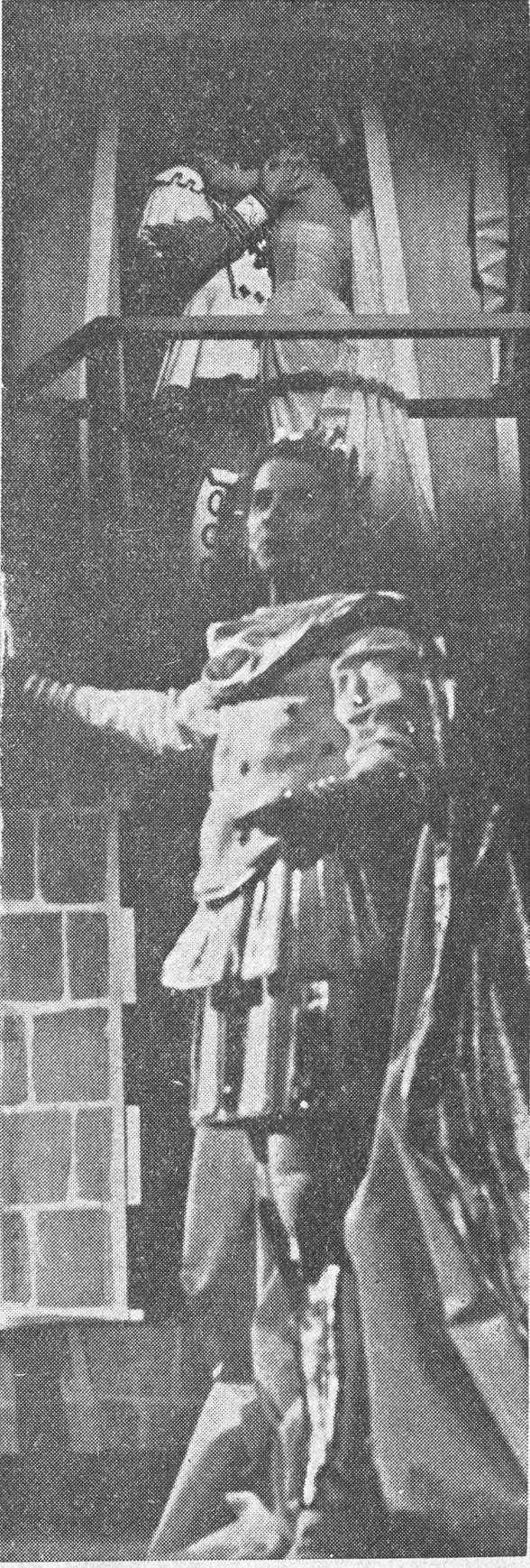
The final scene: Jupiter returns Alcmène to her husband's arms, in his eyes the gleam of contentment... Who is the victor — the gods or the woman!
woman, over Jupiter, king of the gods: she insists on her conjugal fidelity, prefers death to betrayal, and offers the master of the universes a balanced human friendship in place of the unbridled love of the gods. It pleases Jupiter to try human friendship, and he accepts this new covenant between himself and this weak, stubborn human creature... He gives her a farewell kiss, and heavenly voices repeat: Farewell, Alcmène... Farewell, Jupiter... The gods return to their abode and the processions of priests to their cells, and Alcmène throws herself into her husband's arms, to enjoy the earthly happiness for which she was created...
A struggle between gods and men — between earth and heaven — between the supernatural and the ordinary — a theme Giraudoux treated again and again, and from which he created a theater that has astonished the civilized world for thirty years, and that still discloses human truths and artistic values which point unmistakably to its permanent place in the immortal literature of the classics... And as he depicts this struggle with his original literary style and his brilliant theatrical skill, he leaves us in a delicious perplexity, not knowing to which side the scale has tipped... For if Alcmène triumphed over the gods by her human will and her attachment to this perishable conjugal happiness, the gods had triumphed over her before that, and had quickened in her womb Hercules, the demigod whose destiny was decreed from all eternity...
Ondine (in the play Ondine), the sprite of the waters, triumphs over the woman Bertha and wins the love of the knight Hans, but in the end she returns, disappointed, to her watery world after Hans betrays her... And Isabelle (in the play Intermezzo) dallies with the beautiful
specter of her dreams, who all but carries her off to the world of the dead, until a violent struggle breaks out between him and her practical young fiancé, and the latter brings her back to life once more... And likewise, in the play Judith, the yearning to break free of the rule of the gods... A continual struggle between imagination and reality — between fate and man — in which the forces are evenly matched and the standards differ; for man has his earth and all that is upon it, and the gods have their world and their standards...
And if we try to arrive, behind these magical games and these intellectual turns, at a clear creed of Giraudoux's, we come back disappointed, for this beloved poet, with his enchanting smile and his winning personality, remains an obscure secret that puzzles the great writers and thinkers... Perhaps his genius is distinguished precisely by defying description and comprehension... He is that French man of letters, heir of logical classicism; he is that modern renewer, the symbolist bearing the banner of his age; and he is the humanist of violent existential excursions and of refined poetic feeling — he is all of that, and yet he is a folded secret who never spoke of himself and never once proclaimed his creed... The literary historian faces an arduous task if he attempts to uncover the folds of his thought or to solve the riddles of his literature and its symbols...
For that reason, the staging of his plays is a difficult matter, demanding deep understanding, refined sensibility, and brilliant artistic skill. Shortly before the last war, and after it, the genius actor Jouvet took part in staging them, and he was at once interpreter and inspirer; he collaborated with Giraudoux
on the production of "Amphitryon" in 1929, which met with the admira