and in it were reflected the hopes of the masses, their sorrows, and their joys. These singing poets are the pioneers of the modern musical renaissance that burst forth in strength and might in the centuries that followed. They freed music from every bond that stood as an obstacle in the way of its progress and development, and worked to raise its level and improve its instruments, until it was able to keep pace with the other arts, if it did not indeed surpass them.
The minnesingers and troubadours occupied a respected position: the palaces of the nobles were open to them at whatever hour they knocked, and the camps of soldiers — enemies and friends alike — always welcomed them, for they were the only entertainment, and the traveling newspaper that carried news from one place to another, and the storytellers who related tales of adventure and heroism in song, to the accompaniment of a musical instrument. Many of these popular melodies have been preserved, and the great musicians drew from them abundant themes for their compositions. This period extended between the middle of the twelfth century and the end of the thirteenth.
Composition and Musical Writing:
The most important event in the world of Western music was the introduction of polyphonic composition in place of monophonic composition. The new method depended on performing two or more melodies at one time while harmony was maintained, or on adding numerous melodies differing from the first tune, so that from playing them together a harmony was formed. This development in the method of composition was accompanied by a pressing need to fix speed, rhythm, and time in writing, for the musical staff until that time indicated only the rise and fall of pitch. Each note was given a name, the lines of the staff were fixed and each line assigned a note, and the musical accidentals, flats and sharps, were introduced (fourteenth century).
The New Musical Forms:
The development of the method of composition and the introduction of the new musical staff had a great effect, for music in general, religious and popular alike, was freed from the restrictions imposed upon it, and was made subject instead to flexible laws and rules of wide scope. New forms besides the Mass came into being, such as the motet and the madrigal.
The motet is religious choral singing usually made up of a basic melody known to the listeners; this melody might be part of a Gregorian mode, or a dance tune, or a folk song. The words are usually from a sacred text. This new musical form arose and flourished in France in the fifteenth and sixteenth centuries.
The madrigal, or popular motet, followed the pattern of the motet in melody, but its texts were free and not bound to a sacred text; the difference between the madrigal and the motet lies in the lightness present in the former and lacking in the latter.
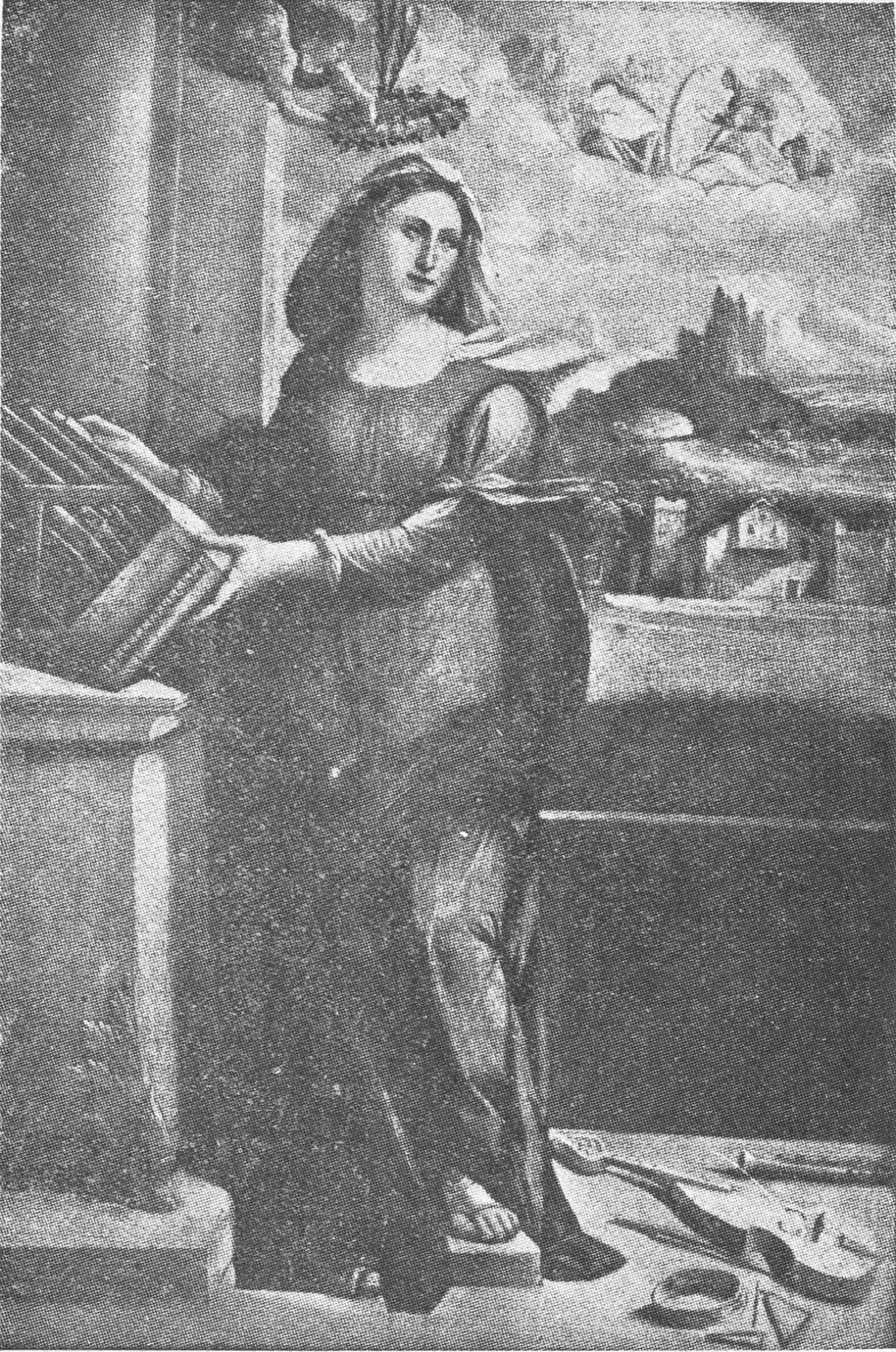
"Saint Cecilia — Patroness of Music," a painting by Garofalo in the museum of Rome
The Tailor Elias Thabet
The latest models
from the most famous Parisian houses of tailoring — at
The Tailor Elias Thabet
Rue Georges Picot — the slope by the Hotel Normandy
Beirut — Telephone No. 32793