— 5 —
"Port Royal"
By the French writer Henry de Montherlant At the Comédie Française
A play in one act
Place: the reception room of the convent of Port-Royal, in the Saint-Jacques quarter of Paris. Time: August 21, 1664.
The stage setting is very simple, suiting the atmosphere of austerity that governs the order of the nuns of Port-Royal. The walls are gray. The chairs are of plain straw. In the middle of the room stands a bare wooden table. On the left side of the room, in a niche in the wall, a wooden cross and two candles...
The subject of the play is bound up with a well-known historical event in France: the struggle that broke out between the community of Port-Royal, called the "Jansenists," on one side, and the religious and civil authorities — Rome and the King — on the other. A struggle that lasted seventy years, in the course of which Port-Royal suffered every kind of persecution, imprisonment, and interdiction. Among its fruits were immortal pages of spiritual-philosophical literature set down by Pascal in the "Provinciales" in defense of Port-Royal and in reply to the Jesuits, who helped the authorities to crush this order. The struggle ended with
the disappearance of the Jansenists and of Port-Royal from existence: their convent in the valley of the Chevreuse, twenty kilometers from Paris, was demolished by order of Louis XIV in 1709, and the nuns were dispersed, together with the community of ascetics who used to withdraw into the hermitages of the woods of Port-Royal for meditation, prayer, and worship.
Montherlant chose the day of August 21, 1664, in which to gather the storms of this long conflict — the day on which the Archbishop of Paris came to the nuns' convent to demand that they submit to the decree of the Apostolic See declaring heretical five points from the book of Jansenius, Bishop of Ypres... The nuns refuse to sign this order, believing that four of the points in question are not to be found in Jansenius's book, but are merely the interpretations of the theological council of the Sorbonne, nothing more... Jansenius's theory bears on the problem of salvation and the freedom of man, and Jansenius inclines toward pressing to an extreme the Christian view that grace alone saves man...
And when the author gathers up the scattered elements of this storm and confines them within a single day, a single place, and a single act, he does so by design, in order to leave the theater a classical piece in the pure Greek sense — believing that what takes place in the soul by way of inner spiritual overflow is finer and more violent than what a multitude of varied scenes can produce, thereby defying the modern theatrical currents that prefer facility and entertainment to
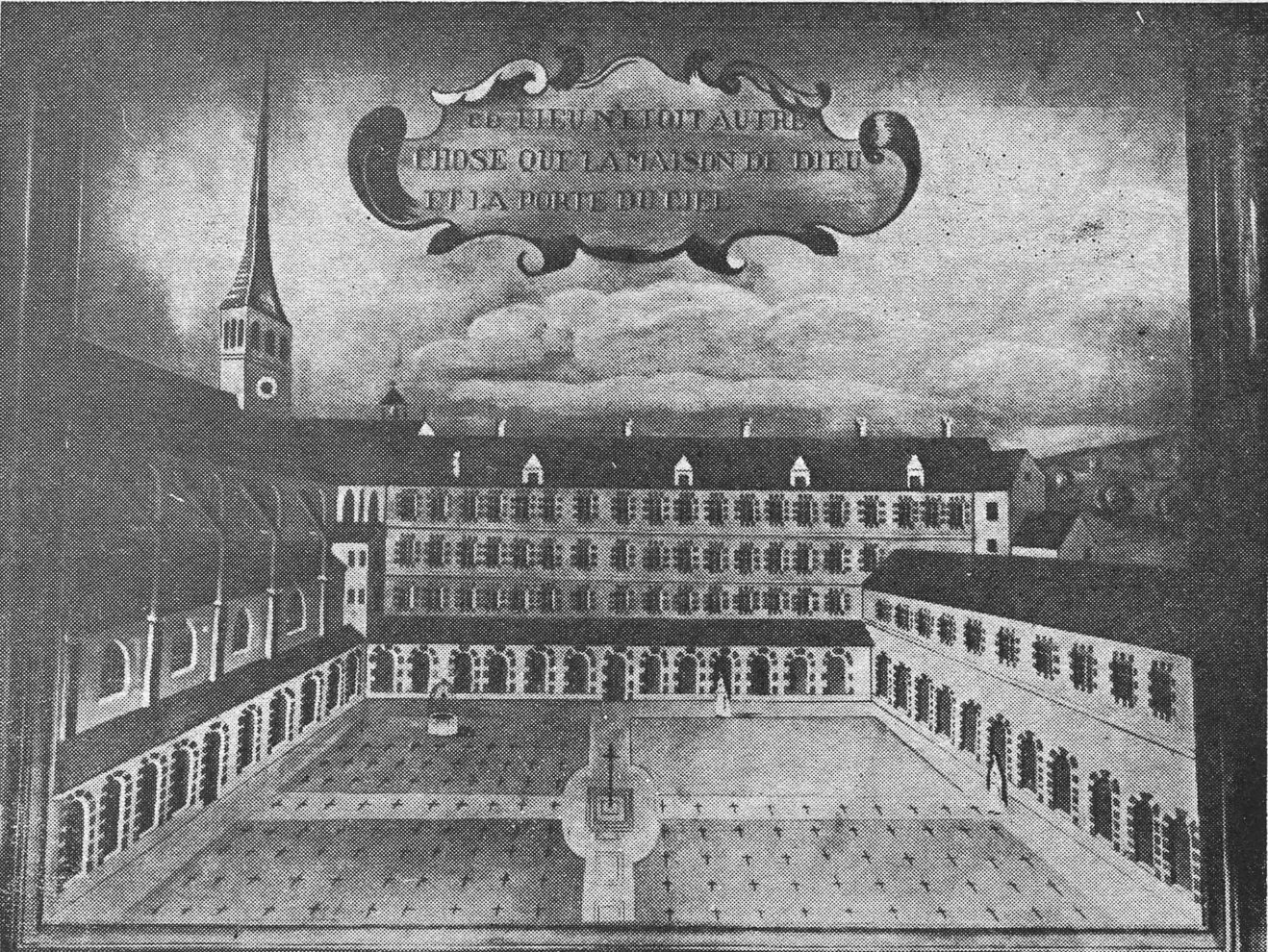
The front curtain for the play "Port Royal"