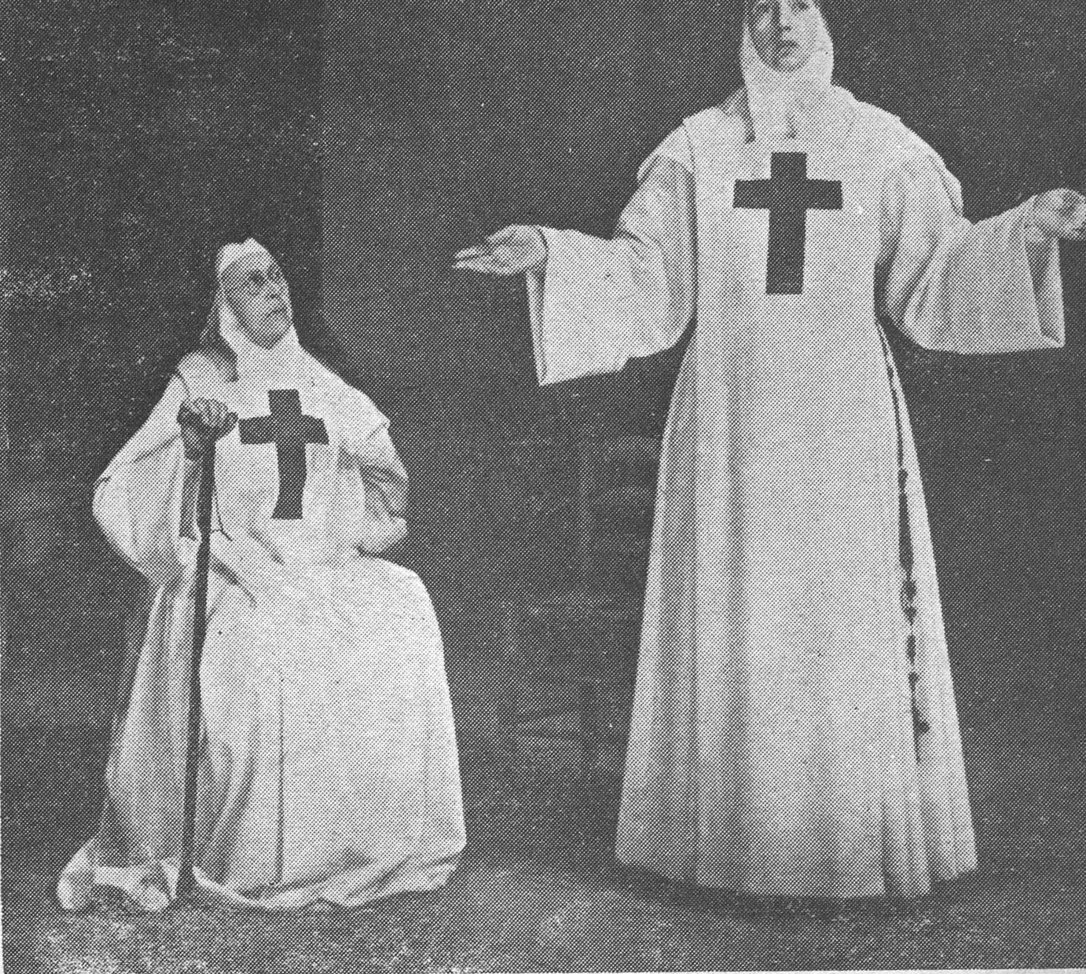
Sister Angélique de Saint-Jean (Annie Ducaux) confides to Mother Agnès (Andrée Chauveron) the anxiety and the doubts that beset her
sober classical simplicity...
The debate that takes place between the Archbishop of Paris and the nuns of Port-Royal is nothing but the distillation of that struggle which lasted seventy years between the Jansenists on the one side and the Jesuits and the state on the other; nay, it is the distillation of the conflict between dry absolute idealism and the bent toward practical flexibility; or rather, let us say it is the essence of the ancient quarrel between the individual who dares to say "no" and the authority that tells him "be silent and obey"...
The author makes his position clear in a preface to his play, where he says that he tried to adopt the point of view of authority at one moment and the point of view of the Jansenists at another; for each side has its opinion, and each has a part to play within the broad Christianity that sometimes holds within its bosom two violent adversaries who love one another. He holds that Christianity has its tears and its sufferings — the tears of the nuns of Port-Royal, persecuted for no fault that could justify it, and the tears of the Archbishop, who imposes obedience and does not find it, and who sees in that disobedience a departure from the unity of the truth he represents... Christianity, then, lives by the sufferings it endures and by the sufferings it imposes...
When the nuns refuse to submit to the religious authority, the Archbishop imposes a punishment upon them: twelve nuns are to be removed from the convent of Port-Royal and deprived of the sacrament of Holy Communion. He addresses the Mother Superior:
— I am sorry, Mother, to cause you pain.
The Mother answers him in the tone of a believing Jansenist:
— Truly I tell you, I no longer feel pain; and if I do feel it, I do not distinguish the persons who are its instrument...
The Archbishop tries by every means of persuasion to turn them from their disobedience, saying:
— We have not asked of you anything impossible; all we want is obedience — like the others... Obedience like the others, nothing more...
— We are not like the others... That is our crime... That is the accusation brought against us...
— Obedience... that is all we ask... Your motto is: liberty, purity, truth? And I say to you: there is no liberty, no purity, no truth outside the authority I represent... Truth is one, and if it multiplies it has a name, and that name is being applied to you now...
— We cannot go against our conscience...
This dispute ends with the removal of the twelve nuns from Port-Royal, after each of them has knelt before the Archbishop to ask his blessing, and after he has asked each of them to remember him in her prayers in the hour of her sufferings in her prison...
The subject of the play does not stop at this point, but goes beyond it to what is weightier and more far-reaching. For the author calls upon us to look behind the well-known historical events, to discover the deep emotions that stir in suffering, frightened souls... With the lens of his piercing mind and his wide learning he takes aim, to reveal to us the secrets of two souls whom he chooses from within the walls of the persecuted convent, each of them made manifest in her progress toward blessed grace or toward dark doubt...
The first is Sister Angélique de Saint-Jean. Historians are all agreed that she was among the most astonishing personalities Port-Royal ever knew, and among the richest of them in soul. Yet she was the only one who faced a violent spiritual crisis that nearly destroyed her faith. She was intelligent and cultivated, known for her stubbornness and the firmness of her opinions; contradictions met in her, for she overflowed with feeling and love while wearing an appearance of deliberate hardness. And for all the sharpness of her intelligence and the breadth of her learning, she was weak of nerve, prey to violent distur